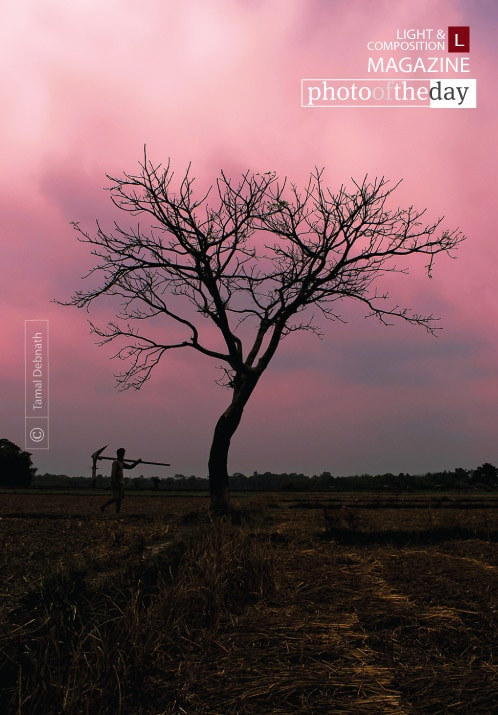
Under the Twilight Sky by Tamal Debnath
Captured during a spontaneous journey through the countryside, this image depicts a solitary plowman silhouetted against the fading light of a twilight sky. The photographer was struck by the quiet dignity of the scene, recognizing the perfect harmony between the rural landscape and the laborer’s return home. By choosing a wide-angle perspective, the composition emphasizes the vast, atmospheric beauty of the evening horizon. This photograph is award-worthy for its evocative storytelling and its ability to transform a simple, everyday moment into a poignant reflection on life, labor, and the serene transition from day to night.
Tamal Debnath
Based in Cooch Behar, West Bengal, Tamal Debnath is an English language teacher and dedicated amateur photographer. Since beginning his creative journey in 2008, he has cultivated a deep passion for the craft, viewing his camera as a constant companion and a tool for perpetual learning. By observing the works of others and finding inspiration in his daily surroundings, he continues to refine his artistic vision, capturing the quiet beauty of the Indian landscape with sincerity and technical curiosity.
Resonance Score Breakdown
Transparency Note: The resonance score (12.5/20) is calculated based on social engagement metrics collected before the award announcement.
Expert Photography Reviews · 4
The Quiet After the Work
I walked past the community garden on my way home this evening. It was nearly dark, and the last person there was packing up their tools, moving with that slow, heavy rhythm that only comes after a long day of physical labor. I stopped for a second just to watch.
Read the reflection →The Long Shadow of Home
The day does not end with a shout, but with a slow folding of light, as if the sun were tucking itself into the pockets of the earth. There is a particular rhythm to the return—the heavy, rhythmic pull of feet against soil that has been worked and worn.
Read the reflection →Reviews & Comments
Share your thoughts about this award-winning photograph. Your reviews contribute to the community engagement score.
The horizon swallows the plowman. It’s a heavy, quiet descent. I’ve stood in fields like this, feeling the day drain away. The sky doesn’t demand attention; it simply exists. There’s a profound weight in that vast, darkening expanse above the laborer. Nothing here is accidental. The empty corner isn’t empty. It’s a breath held in the cooling air. I find myself wanting to stay in this silence. It’s enough. It’s everything.
At 18mm, the lens pushes the horizon to the edge of the sensor, where the diffraction limit softens the transition between earth and sky. It’s a delicate balance; the f/7.1 aperture keeps the plowman’s silhouette sharp against the chromatic aberration bleeding into the twilight. I’m genuinely moved by how the glass captures that fleeting, low-contrast light. It’s not just a silhouette; it’s the physics of a day ending, resolved with a precision that feels almost fragile.
The horizon line bisects the frame with surgical precision, anchoring the silhouette against a gradient of fading light. It’s a rigid geometry that demands attention. The plowman serves as a necessary fulcrum, breaking the horizontal monotony. While the wide-angle perspective risks losing focus, the spatial tension holds. I’ve grown weary of such rural sentimentality, yet the structural discipline here is undeniable. It doesn’t rely on narrative fluff. The architecture of the frame simply works.
Spontaneity is the enemy of the profound. One suspects the photographer stumbled upon this plowman while passing through, rather than committing to the field for a week. It’s a pleasant silhouette, certainly, but the light feels borrowed rather than earned. I’ve spent enough shivering dawns in West Bengal to know that true resonance requires more than a quick shutter click. It’s a pretty enough postcard, but I’m left wondering if he ever bothered to return.