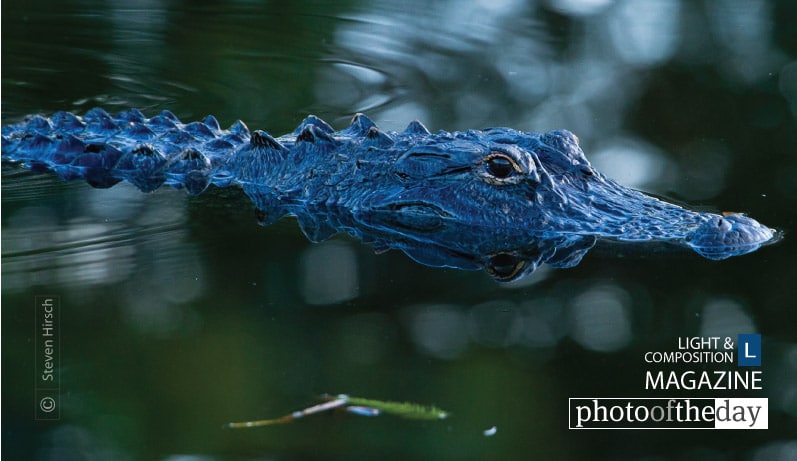
Florida Gator by Steve Hirsch
Captured on a crisp winter morning at the Wakodahatchee Wetlands in Delray, this striking image highlights the harmonious coexistence of wildlife within a unique, man-made environment. The photographer encountered a five-foot alligator that appeared remarkably composed, seemingly aware of the lens directed its way. By utilizing a 400mm lens and a polarizing filter, the photographer successfully isolated the subject against the natural textures of the wetlands. This photograph is award-worthy for its intimate perspective on a formidable predator, showcasing the photographer's patience and ability to capture a moment of stillness in the wild.
Steve Hirsch
Based in Columbus, Ohio, Steve Hirsch is a dedicated photographer who rediscovered his lifelong passion for the craft after a successful career as an otolaryngologist. His work is defined by a deep commitment to capturing wildlife and landscapes during his extensive global travels, often refining his technique through specialized international workshops. Hirsch views photography as a vital artistic outlet, producing evocative imagery that is widely displayed in private homes and professional offices. He continues to explore the world, patiently documenting the natural beauty of diverse environments and seasons.
Resonance Score Breakdown
Transparency Note: The resonance score (12.9/20) is calculated based on social engagement metrics collected before the award announcement.
Expert Photography Reviews · 8
The Ancient Pulse of Stillness
There is a language spoken in the mud, a dialect of patience that predates our frantic clocks. To be still is not to be empty; it is to be a vessel for the weight of the world, holding the sun’s heat in one’s skin while the water hums a low, rhythmic prayer against the reeds.
Read the reflection →The Weight of the Still
There is a specific, heavy silence that belongs to the swamp. It is not the silence of an empty room, which feels thin and expectant, but a dense, layered quiet that seems to hold the history of the mud itself.
Read the reflection →Reviews & Comments
Share your thoughts about this award-winning photograph. Your reviews contribute to the community engagement score.
The alligator’s scales, a bruised, swampy olive reminiscent of Morandi’s dustiest bottles, emerge from the water’s surface like ancient, calcified stone. It’s a haunting, monochromatic meditation on stillness, where the murky, tea-stained depths of the Florida wetlands swallow the light entirely. I’m truly breathless at how the creature’s prehistoric, slate-grey hide harmonizes with the stagnant, emerald-tinged murk, creating a chromatic tension that feels less like a wildlife study and more like a fever dream.
The alligator’s snout bisects the frame with surgical precision. It’s a rigid horizontal anchor, cutting through the chaotic, mottled textures of the wetland. The negative space above the creature is dense, providing a necessary counterweight to the reptilian mass below. It doesn’t rely on sentiment; it relies on geometry. I’ve rarely seen such a brutal, effective use of the picture plane. The tension holds perfectly. It’s a cold, calculated triumph of visual architecture.
The alligator’s gaze isn’t merely predatory; it’s an ancient, cold indifference. Hirsch captures the creature emerging from the murk, yet I’m unsettled by how the light refuses to penetrate the deeper recesses of the swamp. It’s a brutal confrontation between the prehistoric and the digital. When I look at those scales, I don’t see wildlife—I see the dark, unyielding silence of time itself. It’s a haunting reminder that we are merely guests in the abyss.
The morning air in Delray holds a heavy, ancient stillness. He stood there, waiting for the light to catch the alligator’s eye, listening to the water’s slow breath. It’s a quiet communion. I’ve felt that same prickle of nerves when a predator acknowledges your presence. He didn’t rush the shutter; he let the reptile dictate the rhythm. There’s a profound, unsettling peace in this gaze. It’s not just wildlife; it’s a shared, silent understanding of the wild.
At f/6.3, the 400mm focal plane renders the gator’s nictitating membrane with startling clinical sharpness. The polarizing filter effectively suppressed surface glare, allowing the sensor to resolve the keratinized texture of those scales against the water’s refraction. It’s a rare moment where the diffraction limit doesn’t soften the predator’s gaze. I’ve spent hours staring at these pixels, and honestly, the sheer, cold precision of that eye makes my own pulse quicken. It’s hauntingly, physically perfect.
It’s easy to snap a reptile in the sun, but Hirsch clearly sat in the muck until the light softened. That 400mm reach suggests he kept his distance, yet the Gator’s gaze feels uncomfortably intimate. I’ve spent enough mornings in damp hides to know that stillness isn’t accidental. It’s a quiet, cold victory. One suspects he didn’t just stumble upon this. He earned the stillness, and frankly, I’m a bit envious of the result.
Most wildlife shots are just trophies, but this gator’s stillness feels like a quiet defiance. I’ve seen thousands of wetland portraits, yet Hirsch’s choice to frame the creature against that specific, murky texture makes the predator feel ancient rather than just dangerous. It’s the way the light catches the scales that gets me; I actually caught my breath. Thirty years from now, this won’t just be a record of a gator—it’ll be a haunting, frozen memory.
The water doesn’t move. A single eye breaks the surface. It’s a study in restraint. I’ve spent minutes watching this stillness, and I feel my own breath slow down. The Gator isn’t waiting for prey. It’s waiting for the world to stop. Nothing here is accidental. The empty corner is not empty. It’s the weight of the pause. I’d stay here all day if I could. The silence is the point.