The Path by Faisal Khan
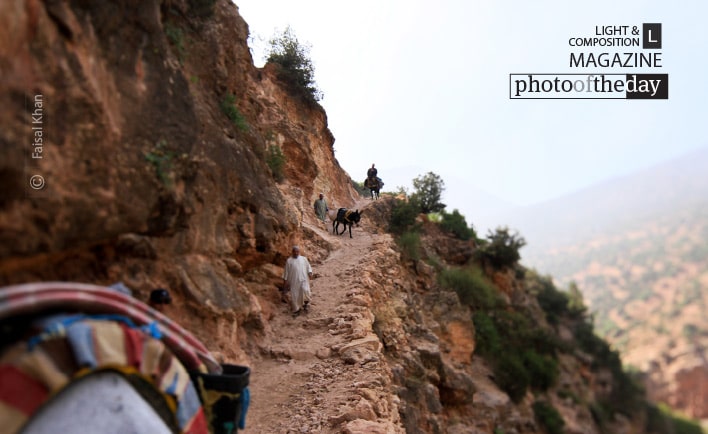
Captured amidst the rugged terrain of the High Atlas mountains, this photograph documents a poignant encounter with villagers returning from a Saturday market. The photographer, struck by the contrast between the arduous, hours-long journey required for basic errands and the frantic pace of city life, frames the moment as a meeting of two distinct paths. The image serves as a meditative reflection on human connection, highlighting the shared journey of individuals moving in different directions across a landscape that demands resilience and patience. Its award-worthy quality lies in the evocative storytelling and the profound sense of stillness found within the challenging Moroccan environment.
Faisal Khan
Raised in Saudi Arabia, Faisal Khan is a Casablanca-based photographer whose work is deeply influenced by his diverse international background and experiences across Thai, Middle Eastern, and Moroccan cultures. Having discovered photography as a dedicated passion only recently, he approaches the craft as a profound medium for contemplation, self-discovery, and heightened awareness. Through his frequent travels and explorations, Khan seeks to document the human experience, finding inspiration in the new friendships and cultural exchanges that define his creative journey.
Resonance Score Breakdown
Transparency Note: The resonance score (13.7/20) is calculated based on social engagement metrics collected before the award announcement.
Expert Photography Reviews · 7
The Grit of the Long Road
The smell of dry earth after a long walk is a specific kind of perfume—it is the scent of dust settling into the creases of your palms and the fine, gritty coating that gathers on the back of your throat.
Read the reflection →The Weight of the Walk
I walked to the corner store this morning, just to pick up a carton of milk. It’s a five-minute trip, yet I found myself annoyed by the uneven pavement and the slight incline of the street.
Read the reflection →Reviews & Comments
Share your thoughts about this award-winning photograph. Your reviews contribute to the community engagement score.
The ochre dust of the High Atlas doesn’t merely coat the earth; it sings in a dry, sun-bleached harmony with the villagers’ garments, creating a palette reminiscent of Morandi’s muted, contemplative still lifes. It’s a chromatic ache, that dusty terracotta meeting the pale, bruised violet of the distant peaks. I’m breathless, truly, at how the light clings to these figures, turning their arduous trek into a slow, rhythmic dance of pigments against the unforgiving, arid stone.
Most travel photography is just visual tourism, but this frame earns its place. I’ve seen thousands of market shots, yet the way Khan positions these figures against the crushing scale of the High Atlas creates a rare, quiet tension. It’s not just a walk; it’s a lifetime of endurance captured in a single stride. I felt a genuine ache in my chest looking at it. That’s why it’ll still matter in thirty years.
The mountain dominates. It’s vast, indifferent, and dry. Two figures walk. They’re small against the slope. I’ve spent minutes staring at the dust between them. It’s not empty. It’s the weight of the journey. The silence here is heavy. It’s a relief. We’re so used to noise, to clutter, to filling every gap. Khan lets the landscape breathe. Nothing here is accidental. The empty corner is not empty. It’s where the stillness lives.
The light here doesn’t demand attention; it settles into the dust of the Asni Valley. Faisal waited until the sun softened, allowing the mountain’s weight to press against those weary travelers. I’ve felt that same ache in my own legs, watching the shadows stretch across the High Atlas. It’s a quiet, humbling grace. He didn’t just capture a path; he listened to the silence between their footsteps. It’s a rare, patient stillness that I find deeply moving.
The Atlas mountains don’t invite us; they endure. In Khan’s frame, the light doesn’t reveal the path so much as it carves a jagged silence into the rock. I’m unsettled by how the shadows swallow the villagers’ feet, tethering them to the earth. It’s a brutal, necessary gravity. We’ve forgotten that walking is a form of thinking, but here, in the deep, ink-stained crevices of Asni, the darkness finally demands we pay attention.
At 17mm, the Canon 7D’s sensor resolves the High Atlas terrain with startling micro-contrast. The f/5 aperture keeps the villagers within the focal plane, yet the bokeh as a function of that wide-angle depth is what truly moves me; it’s a gentle, optical softening of the arid horizon. I’m genuinely struck by how the light scatters across the dust. It’s not just a journey; it’s a precise, physical interaction between photons and the rugged Moroccan earth.
The Atlas doesn’t yield such stillness to the casual tourist. One suspects Faisal waited until the dust settled and the light grew thin, rather than snapping a quick frame from a passing vehicle. I’ve spent enough mornings shivering in similar valleys to recognize the quiet discipline here. It’s a decent effort, though I’d have preferred a tighter focus on the weariness in their gait. Still, he clearly put in the hours. Respect is due.
Thanks to everyone for liking the photo. I’m really glad that I was able to capture this moment; and I appreciate L&C support which enabled me to share it with you..
Thanks Sebastien for the continuous support.
Dear Trekking Tips team,,
Thanks for appreciating the photo and sharing it. You got some amazing collection for places i’d love to visit.
Faisal