The Well of Death by Prasanth Chandran
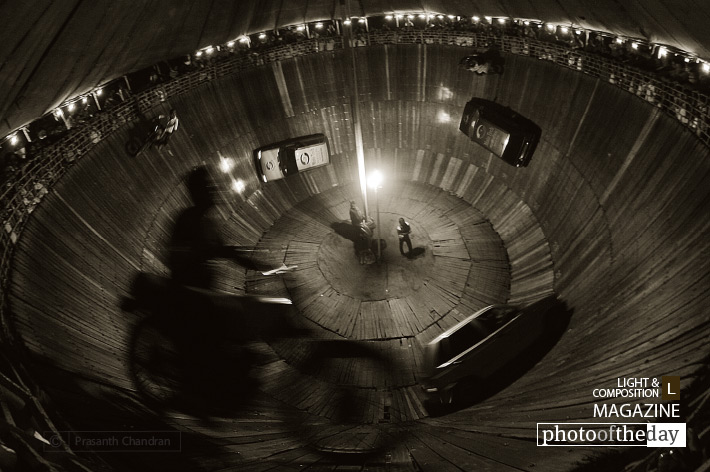
Captured during the vibrant Aluva Shivarathri Mahotsavam in Kerala, this photograph depicts the high-octane intensity of the 'Well of Death' carnival attraction. The photographer utilized a fisheye lens to emphasize the dizzying speed and circular motion of the performers, creating a visceral sense of danger and proximity. The technical decision to use a wide angle captures the chaotic energy of the scene, while the tight framing places the viewer directly into the heart of the action. This image is award-worthy for its ability to freeze a blur of motion into a sharp, compelling narrative of traditional spectacle and human daring.
Prasanth Chandran
Based in Cochin, India, Prasanth Chandran is a dedicated photographer whose work focuses on documenting the rich cultural tapestry of Kerala. Since beginning his photographic journey in 2009, he has traveled extensively to capture the essence of local festivities, people, and landscapes. His approach is driven by a desire to tell evocative stories that resonate with the viewer, aiming to inspire through the authentic, human-centered narratives he discovers behind his lens.
Resonance Score Breakdown
Transparency Note: The resonance score (11.5/20) is calculated based on social engagement metrics collected before the award announcement.
Expert Photography Reviews · 3
The Hum of the Spin
The smell of burnt rubber and gasoline always brings me back to the fairgrounds of my childhood, where the air tasted of spun sugar and ozone.
Read the reflection →The Geometry of Gravity
There is a peculiar physics to the way we seek out the edge. We are creatures of habit, tethered to the flat, predictable earth, yet we harbor a strange, persistent hunger for the vertical.
Read the reflection →Reviews & Comments
Share your thoughts about this award-winning photograph. Your reviews contribute to the community engagement score.
The blur circles the center. It’s a dizzying, frantic geometry. I’ve spent minutes watching the riders, yet my eyes keep drifting to the wooden slats above. The stillness of the rim. It’s where the chaos ends. I feel a sudden, sharp ache for that quiet wood. Nothing here is accidental. The empty corner is not empty. It’s the breath between heartbeats. Chandran doesn’t just capture speed. He captures the silence waiting for the fall.
The fisheye distortion forces a claustrophobic geometry upon the frame. Circular motion dictates the spatial tension, pinning the motorcycle against the vertical wood grain. It’s a brutal, dizzying architecture. The blur doesn’t soften the image; it anchors the kinetic energy to the center. I’ve rarely seen such a violent use of the picture plane. It’s relentless. The frame holds because the centrifugal force demands it. It’s a rare moment where the chaos actually obeys the lens.
It’s a dizzying bit of work. One suspects Chandran didn’t just stumble upon this; he likely endured the deafening roar and the smell of petrol for hours to find the precise angle where the blur makes sense. I’ve spent enough time in cramped, loud spaces to know that kind of patience isn’t cheap. It’s a visceral, nauseatingly good shot. He clearly stood his ground until the chaos finally decided to behave. Well earned.