Caustic Childhood by Abhishek Dutta
Captured in the tribal village of Surjapur, this poignant image highlights the resilience and boundless energy of youth amidst challenging surroundings. The photographer utilized an 18mm focal length to immerse the viewer in the environment, documenting the children's playful spirit with a sharp, documentary eye. The image serves as a powerful reminder of the universal nature of childhood, where joy transcends economic hardship. Its award-worthy quality lies in the raw, authentic connection between the subject and the lens, capturing a fleeting moment of pure, uninhibited life that resonates deeply with audiences across the globe.
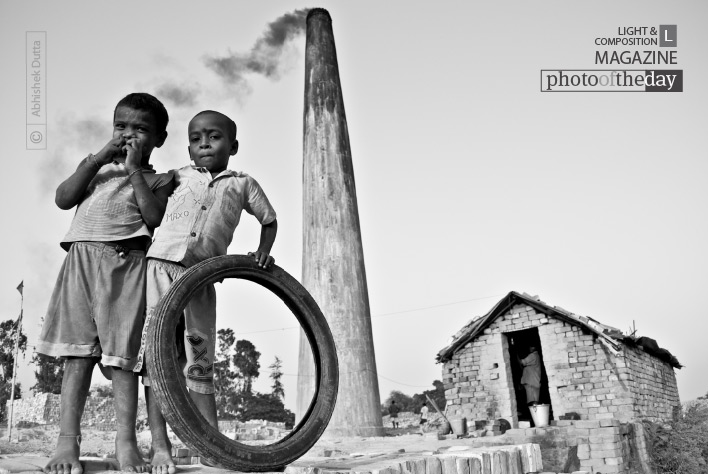
Exposure 1/250sec @ f/5.0 | ISO 100 | Focal Length 18mm
Abhishek Dutta
Based in Kolkata, West Bengal, Abhishek Dutta balances a professional career in a private firm with a deep-seated passion for photography. What began as a childhood hobby has evolved into a serious artistic pursuit over the last several years. Driven by a love for travel and cultural exploration, he dedicates his limited spare time to documenting the human experience, capturing evocative stories from the diverse landscapes of India.
Resonance Score Breakdown
Transparency Note: The resonance score (12.2/20) is calculated based on social engagement metrics collected before the award announcement.
Expert Photography Reviews · 7
The Architecture of Play
In the quiet corners of a garden, or perhaps in the dust of an alleyway, there is a physics to childhood that defies the gravity of the adult world. We spend our lives building structures—schedules, walls, expectations—designed to keep the chaos of existence at bay.
Read the reflection →The Weight of a Smile
I was walking past the local park this morning when I saw a group of kids playing with nothing but a discarded cardboard box and some sticks. They were laughing so loudly, completely absorbed in a world they had built out of thin air. It made me stop in my tracks.
Read the reflection →Reviews & Comments
Share your thoughts about this award-winning photograph. Your reviews contribute to the community engagement score.
Most documentary work from 2012 feels dated now, but this survives because of the wide 18mm distortion. By pulling the lens so close to these children, Dutta forces us into their chaotic, dusty orbit. It’s not just a record of poverty; it’s a visceral collision. I’ve seen thousands of shots of rural play, but the way the foreground limbs stretch toward the frame edge makes me ache for their fleeting, unburdened kinetic energy. It’s raw, honest, and enduring.
At 18mm, the Nikon’s barrel distortion pulls the periphery into a subtle, wide-angle curvature that mimics the human peripheral field. The f/5.0 aperture keeps the depth of field just shallow enough to isolate the children from the harsh Surjapur light. I’m genuinely moved by how the sensor resolves the dust motes dancing in the caustic glare. It’s a raw, optical collision where the lens’s limitations don’t matter—the sheer kinetic energy of their joy simply transcends the glass.
It’s a decent enough snapshot, though one wonders if the photographer simply walked by and clicked. There’s a lack of grit here; it feels snatched rather than earned. I’ve spent enough afternoons in the mud to know when a lens has been kept at a safe distance. It’s a pleasant scene, but it doesn’t ache. I’d have preferred to see the photographer return until the light—and the children—stopped performing for the camera. It’s just too easy.
Light here doesn’t merely illuminate; it interrogates. Dutta’s frame forces these children into a harsh, unforgiving glare that strips away the sentimentality we usually project onto poverty. I’ve stared at the deep, encroaching shadows behind them, and it’s there—in that suffocating, ink-black void—that the real story hides. It’s a haunting reminder that joy is often just a fragile defense against the encroaching dark. It makes me ache, honestly. The shadows aren’t empty; they’re waiting.
The light in Surjapur doesn’t just illuminate; it clings to the dust, softening the harsh edges of a difficult life. Abhishek stood here in the heat of the day, waiting for the children to forget he was watching. I’ve felt that same stillness, that quiet surrender to the moment. It’s not about the camera, but the way the sun catches their laughter. It makes my chest ache, seeing such pure, unburdened joy amidst the dry, unforgiving earth.
The ochre dust of Surjapur rises like a Turner fog, swallowing the children in a haze of parched, sun-bleached earth that feels almost tactile against the skin. It’s a palette of dried clay and searing heat, yet I’m struck by the sudden, piercing clarity of their laughter. One finds here a Morandi-esque restraint, where the muted, dusty browns don’t merely frame the subjects but breathe with them, creating a chromatic ache that lingers long after one turns away.
Dust settles on the frame. The children occupy the center, yet the periphery holds the weight. I feel a sudden, sharp ache in my chest looking at the vast, dry earth surrounding them. It’s a heavy silence. They’ve filled the space with movement, but the ground remains still. Nothing here is accidental. The empty corner is not empty. It’s a pause. It’s the breath before the dust rises again. I’m left watching the quiet.
POETRY OF LOOK
Thank you Light & Composition…