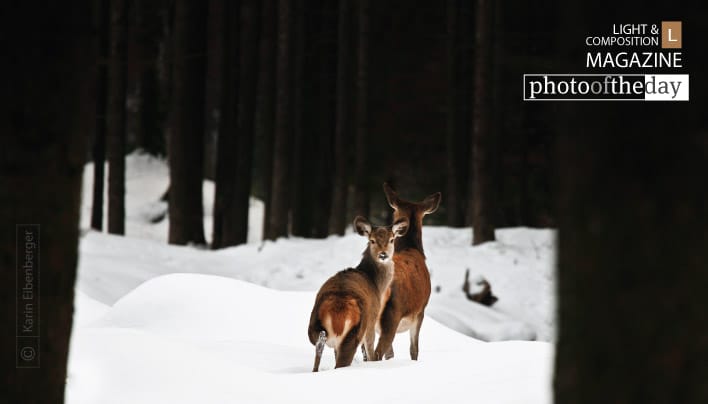
Red Deer by Karin Eibenberger
Captured during a hike through the damp, hibernal forests of Styria, this image documents a rare, intimate encounter with a family of Red Deer. The photographer managed to approach the animals closely before they were alerted, allowing for a serene composition as the deer retreated with cautious curiosity. The technical choice of a 400mm focal length enabled the photographer to maintain a respectful distance while isolating the subjects against the moody, atmospheric woodland backdrop. This photograph is award-worthy for its ability to convey the quiet majesty of wildlife in its natural habitat, freezing a fleeting moment of connection between human observer and wild subject.
Karin Eibenberger
Born and raised in Waidhofen, Austria, Karin Eibenberger is a multifaceted professional who balances a career in biomedical engineering with a deep-seated passion for the outdoors. Currently based in Baltimore, Maryland, she brings an adventurous spirit to her photography, often trekking through remote wilderness with heavy gear to capture the beauty of the natural world. Her work serves as a powerful medium for communication, aiming to evoke direct emotional responses and inspire viewers to look beyond their immediate surroundings to appreciate the splendor of the global landscape.
Resonance Score Breakdown
Transparency Note: The resonance score (3.3/20) is calculated based on social engagement metrics collected before the award announcement.
Expert Photography Reviews · 5
The Breath of Pine and Frost
The air in the high woods has a sharp, metallic edge that catches in the back of the throat, tasting faintly of wet bark and ancient, decaying leaves.
Read the reflection →The Weight of Breath
There is a moment before the animal turns. It is a suspension of time, a thin wire stretched between two lives. In the forest, silence is not the absence of noise; it is a presence that demands a price.
Read the reflection →Reviews & Comments
Share your thoughts about this award-winning photograph. Your reviews contribute to the community engagement score.
At f/6.7, the 400mm focal plane renders the deer with surgical precision, yet it’s the bokeh that truly captivates. The damp Styrian air acts as a natural diffuser, softening the background into a creamy, low-contrast wash that prevents chromatic aberration from bleeding into the fur. I’m genuinely moved by how the lens resolves the texture of the coat against such atmospheric density. It’s a rare moment where optical physics and wild grace collide perfectly.
The forest doesn’t crowd them. It recedes. The grey mist creates a boundary, a soft wall of fog that lets the deer exist in their own time. I’ve stood in woods like these, waiting for the air to settle. It’s quiet. The space between the trees isn’t just distance; it’s a held breath. Nothing here is accidental. The empty corner is not empty. It’s the silence they leave behind. I feel a sudden, sharp peace.
Styria’s damp air doesn’t just cling; it obscures. Eibenberger’s deer emerge from the gloom like ghosts haunting their own habitat. I’m struck by how the shadows swallow the forest floor, forcing the animals to define the space through sheer, trembling presence. It’s a cold, existential standoff. When the light fails to reach the undergrowth, the deer become the only truth left. It’s haunting, really. They aren’t just wildlife; they’re the silence we’ve long forgotten how to inhabit.
The damp, hibernal air of Styria clings to these deer. Karin didn’t just capture them; she waited until the forest allowed her presence. I’ve spent enough mornings in such silence to know that ache in the shoulders when you’re holding your breath. It’s a sacred stillness. Looking at the soft, muted light against their coats, I feel a sudden, sharp longing for that cold, quiet woods. She listened to the light, and it answered.
The frame’s geometry is compromised by the chaotic verticality of the Styrian timber. While the deer provide a necessary focal point, the background’s lack of tonal separation creates a visual clutter that refuses to resolve. It’s a messy, claustrophobic arrangement. I’d prefer a tighter crop to force a dialogue between the subjects and the negative space. The composition doesn’t hold. It’s frustrating, really, because the potential for a rigorous, balanced architecture was clearly there.