Out of Africa by Orhan Aksel
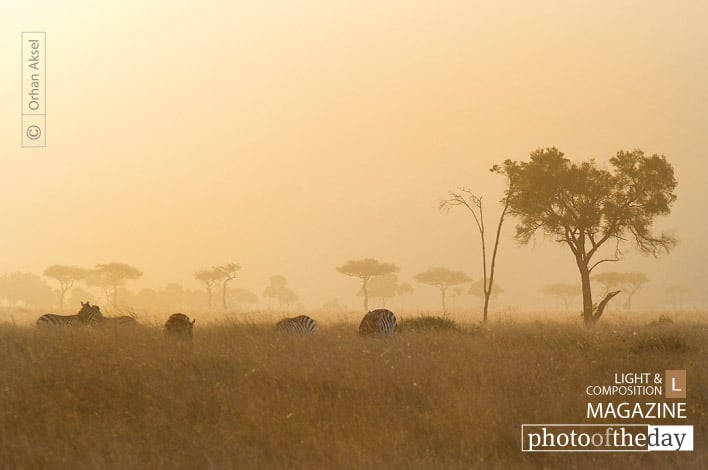
Captured in the vast expanse of the Masai Mara, this photograph immortalizes the fleeting transition of light as the sun dips below the horizon. Orhan Aksel masterfully documents the region’s iconic golden hues, which transform the patchy, spotty savannah into a dramatic landscape of deep warmth and shadow. The image is award-worthy for its evocative capture of the African wilderness, showcasing a profound sensitivity to natural light and the raw, untamed beauty of the environment. By balancing the technical demands of manual focus with the ephemeral nature of the golden hour, the photographer creates a timeless portrait of one of the world’s most storied ecosystems.
Orhan Aksel
Born in 1961, Orhan Aksel is an Istanbul-based industrial and systems engineer who has nurtured a lifelong passion for photography since the age of twelve. Having developed his technical foundation in traditional darkrooms, he now balances his professional career with a philanthropic approach to the craft, aiming to support the education of children in need through his imagery. His work reflects a dedicated amateur’s pursuit of excellence, blending technical precision with a deep-seated desire to use his creative vision for meaningful global impact.
Resonance Score Breakdown
Transparency Note: The resonance score (12.2/20) is calculated based on social engagement metrics collected before the award announcement.
Expert Photography Reviews · 8
The Quiet After the Heat
I spent this morning trying to organize my bookshelf, but I ended up just sitting on the floor, reading the spines of books I haven't touched in years. The house was so still.
Read the reflection →The Weight of the Horizon
In the early days of cartography, mapmakers often filled the empty spaces of the world with drawings of sea monsters or vast, unmapped forests. They could not bear the silence of the unknown, so they populated it with their own anxieties and dreams.
Read the reflection →Reviews & Comments
Share your thoughts about this award-winning photograph. Your reviews contribute to the community engagement score.
What a beautiful image. The strong golden colors and haze in the image really drew me into the photograph. The monotone golden color and low contrast conveys the sunset perfectly and makes me feel the afternoon atmosphere. Beautiful image. Well done!
The sun doesn’t just set in the Mara; it surrenders. Orhan waited until the light grew heavy, thick with the day’s heat, before he let the shutter fall. I’ve felt that same stillness, where the savannah’s gold turns to a bruised, aching violet. It’s a quiet prayer of a frame. Looking at those long, stretching shadows, I find myself holding my breath, hoping the earth stays exactly this way for just one more heartbeat.
The ochre here doesn’t merely sit upon the grass; it hums with the bruised, burnt-sienna intensity of a Turner sunset, bleeding into the shadows like ink in water. It’s a chromatic ache, that specific, dusty gold of the Mara that makes one’s heart stutter with a sudden, sharp longing. I’ve rarely seen such a visceral marriage of light and earth, where the palette feels less like a capture and more like a fever dream.
It’s easy to snap a sunset; it’s quite another to catch the Mara when the light actually bites. Using a manual Vivitar zoom in that heat suggests Aksel didn’t just stumble upon this. He sat in the dust until his patience outweighed his discomfort. I’ve spent enough afternoons waiting for a horizon to turn that specific, bruised gold to know he earned this. It’s a quiet, honest bit of work. He clearly stayed put.
The Vivitar’s glass struggles with the high-contrast transition at the horizon, yet the resulting longitudinal chromatic aberration adds a haunting, spectral fringe to the acacia silhouettes. It’s a fascinating failure of the optics that elevates the scene’s emotional weight. I’m genuinely moved by how the diffraction limit softens the distant savannah, rendering the light as a tactile, golden fluid. It’s not perfect, but it’s exactly how the retina wishes it could perceive the dusk.
Of the hundreds of savannah shots I’ve reviewed, most are just postcards. What separates this is the way the shadows stretch across the grass, turning the terrain into a jagged, rhythmic pulse rather than a flat backdrop. It’s the restraint in the exposure that gets me; I actually felt the temperature drop while looking at it. It’s not just a sunset. It’s a quiet, permanent record of a world that’s slowly disappearing. That’s why it endures.
The horizon line bisects the frame with surgical precision, anchoring the savannah’s chaotic texture. It’s a rigid geometry that forces the eye to navigate the encroaching shadows. The spatial tension between the foreground scrub and the fading light creates a necessary equilibrium. I’m genuinely unsettled by how the negative space swallows the periphery. It doesn’t rely on sentimentality. The structure holds, and that’s rare. It’s a disciplined study of mass, refusing to dissolve into mere atmosphere.
The savannah here doesn’t merely glow; it bruises. Aksel forces the golden hour into a confrontation with the encroaching void, where the long, jagged silhouettes of the acacia trees act as anchors against the dissolution of form. I’ve stared at these encroaching blacks until my eyes ached, feeling the heavy, silent weight of a world that refuses to be fully known. It’s a haunting, necessary darkness. It doesn’t invite us in; it demands we acknowledge the abyss.
The horizon doesn’t end. It dissolves. Aksel leaves the savannah to breathe in the dark, heavy lower third of the frame. I’ve stood in such heat, where the silence feels physical. It’s a rare restraint. He trusts the void. He lets the golden light retreat until only the shadows remain. Nothing here is accidental. The empty corner is not empty. It’s a pause. I find myself holding my breath, waiting for the sun to return.