Bed of Beauty by Laria Saunders
Captured within the lush, vibrant gardens of Los Angeles, Bed of Beauty showcases the elegant presence of peacocks as they roam freely through the landscape. The photographer utilized a 105mm macro lens to isolate the subject, balancing the natural light with a precise aperture of f/7.1 to achieve a shallow depth of field that emphasizes the intricate textures of the bird’s plumage. This image is award-worthy for its masterful composition and the photographer's ability to transform a fleeting moment of wildlife into a serene, painterly study of color and form.
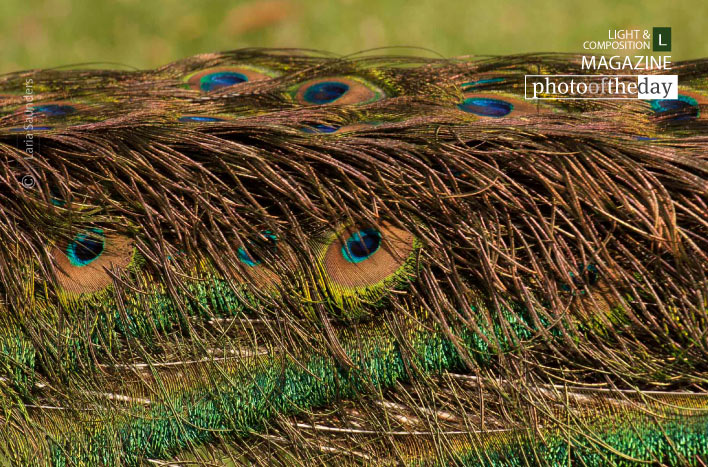
Exposure 1/200sec @ f/7.1 | ISO 320 | Focal Length 105mm
Laria Saunders
Hailing from a multi-generational family of artists and professional photographers, Laria Saunders brings over 25 years of creative experience to her craft. Based in the arts district of downtown Los Angeles, she has garnered international recognition for her diverse work in abstract, wildlife, dance, and travel photography. As a co-owner of City of Angels Headshots, Saunders maintains an active presence in the art community, with her work featured in numerous galleries and exhibitions across the United States.
Resonance Score Breakdown
Transparency Note: The resonance score (13.9/20) is calculated based on social engagement metrics collected before the award announcement.
Expert Photography Reviews · 3
The Architecture of Grace
We often mistake vanity for the quiet, heavy work of existing. To carry such weight—the iridescent armor, the fan of a thousand watchful eyes—is not merely a display, but a slow, deliberate performance of survival.
Read the reflection →The Weight of Ornament
In the Victorian language of flowers and feathers, vanity was often treated as a moral failing, a frivolous distraction from the serious business of living. Yet, there is a biological gravity to display that suggests otherwise.
Read the reflection →Reviews & Comments
Share your thoughts about this award-winning photograph. Your reviews contribute to the community engagement score.
The plumage’s geometry anchors the frame, forcing the eye into a rigid, rhythmic oscillation. It’s a disciplined study of texture against the soft, blurred foliage. The aperture choice creates a necessary spatial tension, isolating the bird’s iridescent mass from the chaotic garden background. I’m genuinely unsettled by how the tail’s curve disrupts the vertical axis. It doesn’t just sit there; it demands a structural reckoning. The composition holds, but only by a razor’s edge.
The peacock’s neck, a shimmering, electric cerulean reminiscent of Vermeer’s most precious lapis lazuli, vibrates against the muted, mossy greens of the Los Angeles undergrowth. It’s a collision of temperatures that leaves me breathless, as if the bird’s plumage were bleeding into the foliage. One finds here a chromatic tension that feels almost liquid, a lush, suffocating harmony where the light doesn’t merely illuminate the feathers; it breathes a heavy, humid life into them.
Peacocks are vanity incarnate, yet here, the plumage dissolves into a murky, suffocating green. It’s a claustrophobic garden. I’m unsettled by how the light refuses to define the bird, choosing instead to swallow its form into the foliage. Saunders doesn’t celebrate the creature; she traps it. It’s a cold, heavy study of existence where the shadows aren’t just background—they’re the cage. I find myself wanting to pull the bird out, but it’s already gone.