Simplicity by Ryszard Wierzbicki
Captured in April 2012, this evocative image features the iconic U Bein Bridge in Amarapur, Myanmar. The photographer masterfully utilized the bridge’s architectural simplicity to frame the daily lives of local villagers as they traversed this vital connection between communities. By isolating the silhouette of a traveler against the expansive, soft light of the landscape, the photographer emphasizes the quiet dignity of the human journey. This photograph is award-worthy for its impeccable composition and its ability to transform a functional, everyday transit point into a poignant, timeless study of light, form, and cultural narrative.
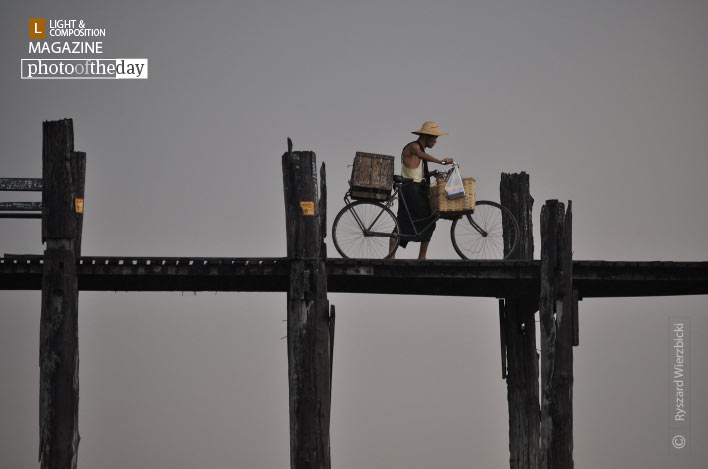
Exposure 1/250sec @ f/5 | ISO 500 | Focal Length 145mm
Ryszard Wierzbicki
Born in Poland in 1963, Ryszard Wierzbicki transitioned from a diverse career in social sciences and marketing to pursue his true passions for photography and travel. After relocating to the United Kingdom in 2006, he dedicated himself to exploring South-East Asia and documenting the human experience, often supporting charitable causes for orphans in the region. As the founder of the travel and photography forums Instant Travelling and World Around, he has established himself as a committed storyteller who captures the essence of global cultures through a lens of exploration and empathy.
Resonance Score Breakdown
Transparency Note: The resonance score (14.2/20) is calculated based on social engagement metrics collected before the award announcement.
Expert Photography Reviews · 8
The Weight of the Crossing
The smell of damp wood always brings me back to the riverbank, to the way the air feels heavy and cool against the back of my neck. It is a scent of ancient things—rotting timber, silt, and the slow, rhythmic pulse of water against stone.
Read the reflection →The Weight of a Single Step
I spent an hour this morning trying to find my keys, tearing through drawers and checking the pockets of every coat I own. When I finally found them sitting right on the kitchen counter, I felt a strange wave of exhaustion. It wasn't just about the keys.
Read the reflection →Reviews & Comments
Share your thoughts about this award-winning photograph. Your reviews contribute to the community engagement score.
The ochre haze of Amarapur’s dusk doesn’t merely frame the U Bein Bridge; it dissolves the architecture into a Morandi-esque study of muted, dusty gold. I’m breathless watching how the traveler’s silhouette bleeds into that bruised, violet-grey horizon, a collision of warmth and melancholy that feels like a Turner sunset trapped in amber. It’s a fragile, chromatic ache, where the light isn’t just illuminating the scene—it’s breathing, heavy and golden, into the very marrow of the wood.
U Bein Bridge isn’t just wood and water; it’s a threshold. Wierzbicki forces the silhouette into a brutal, beautiful confrontation with the horizon. I’ve stared at this traveler for an hour, feeling the crushing weight of their solitude against that blinding, indifferent sky. It’s not a transit point, but a purgatory. When the light bleeds out like this, shadow becomes the only truth left. It doesn’t invite us in; it demands we acknowledge our own inevitable disappearance.
At 145mm and f/5, the lens renders the U Bein Bridge with a soft, atmospheric compression that’s physically captivating. The diffraction of light across the water’s surface is, in the strictest sense, extraordinary. It’s not just a silhouette; it’s a precise study of how photons scatter through the humid Myanmar air. I’ve spent hours staring at the traveler’s crisp edge against that haze. It’s a rare moment where the optics don’t just capture life, they elevate it.
The U Bein Bridge functions here as a rigid horizontal anchor, bisecting the frame with mathematical precision. It’s a stark, linear geometry that forces the eye toward the silhouette. The negative space above the bridge is vast, yet it doesn’t collapse. It holds. I’ve rarely seen such disciplined spatial tension. The weight of the figure provides the necessary fulcrum. It’s a cold, calculated architecture, and frankly, it’s the only thing keeping this frame from drifting away.
The U Bein Bridge is a well-trodden stage, yet Wierzbicki avoids the usual tourist clutter. It’s a quiet, disciplined frame. I’ve spent enough mornings shivering in damp boots to know he didn’t just stumble upon this silhouette; he waited for the crowd to thin and the light to soften. It’s a rare, honest bit of patience. I find myself wanting to walk that bridge with him. He clearly earned this one. It’s a respectable effort.
Of the thousands of bridge shots I’ve reviewed, most are merely postcards. What separates this from the clutter is the compression of the 145mm lens, which turns the U Bein Bridge into a stark, rhythmic line. It’s the solitary figure’s placement that hits me; it feels like a quiet heartbeat in a vast, fading day. I’ll be glad this exists in thirty years because it captures the dignity of transit without needing a single word.
The bridge stretches into the haze, a skeletal line against the soft, diffused glow of a Myanmar morning. Ryszard waited for the light to lose its edge, letting the atmosphere swallow the horizon. I’ve stood in such stillness, feeling the wood grain beneath my feet as the world exhales. It’s a quiet, holy transit. Watching that lone silhouette move across the frame, I feel a sudden, sharp ache for the simplicity of just being there.
The bridge cuts the frame. A single figure walks. It’s a thin line against the haze. I’ve spent minutes watching that silhouette. It doesn’t hurry. The water and sky merge into a pale, quiet void. Nothing here is accidental. The empty corner is not empty. It’s the weight of the distance. I feel a sudden, sharp ache in my chest. Silence. It’s the only thing left to say. The rest is just noise.