Margerie Glacier by Steve Hirsch
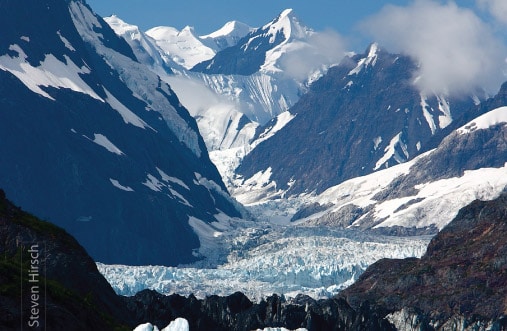
Captured during a milestone family celebration, this image of the Margerie Glacier highlights the stark, majestic beauty of Alaska’s icy wilderness. The photographer navigated the limited access of Glacier Bay to document the 21-mile-long glacier, balancing the technical precision of a 130mm focal length with the emotional weight of a 50th-anniversary trip. The composition captures the glacier’s immense scale against the backdrop of global environmental change, transforming a personal family memory into a poignant nature study. Its award-worthy quality lies in the clarity of the ice textures and the photographer’s ability to convey the fleeting, fragile nature of this frozen landscape.
Steve Hirsch
Based in Columbus, Ohio, Steve Hirsch is a dedicated photographer who balances his professional career as an otolaryngologist with an enduring passion for travel and landscape photography. After years of focusing on family life, he has returned to his lifelong hobby, traveling globally to capture wildlife and natural vistas in diverse lighting conditions. His work, which reflects a deep commitment to artistic expression, is featured in private collections and medical offices across the United States, serving as a bridge between his technical expertise and his creative exploration of the world.
Resonance Score Breakdown
Transparency Note: The resonance score (13.9/20) is calculated based on social engagement metrics collected before the award announcement.
Expert Photography Reviews · 5
The Breath of Ancient Cold
The air in the high mountains tastes like metal and silence. It is a sharp, clean sting at the back of the throat, the kind of cold that doesn't just touch the skin but settles deep into the marrow, turning the blood sluggish and heavy.
Read the reflection →The Weight of Silence
We often speak of time as a river, something that flows and carries us toward a distant, inevitable sea. But there are places where time does not flow; it gathers. It sits in heavy, blue-veined layers, holding the breath of centuries within its frozen grip.
Read the reflection →Reviews & Comments
Share your thoughts about this award-winning photograph. Your reviews contribute to the community engagement score.
Glacier Bay isn’t a place for the casual tourist with a camera. One suspects Hirsch spent hours shivering on a deck, waiting for the light to bite into those blue crevasses. It’s a sharp, honest capture. I’ve spent enough mornings freezing in similar conditions to recognize the ache in his hands. He didn’t just snap a souvenir; he committed to the ice. It’s a rare, cold clarity that doesn’t come cheap. Well earned, indeed.
The glacial ice doesn’t merely exist; it breathes in shades of bruised periwinkle and the sharp, calcified white of a Vermeer highlight, shivering against the charcoal silt of the moraine. It’s a chromatic ache, really, that frigid, crystalline blue of shallow tidal water at dusk, which makes my own heart stutter with a sudden, piercing loneliness. One finds here a Morandi-esque stillness, where the cold light isn’t just illumination, but a haunting, silent, monochromatic prayer.
The ice here doesn’t just sit; it breathes. I’ve spent enough time in the cold to know the silence Hirsch felt while waiting for that 130mm lens to find the glacier’s jagged pulse. It’s a fragile, blue-veined history held in suspension. When I look at these textures, I feel a sudden, sharp ache for the permanence we’ve lost. He stood in the cooling air, listening to the ice crack, and finally, the land allowed him to see.
The glacier’s vertical fissures dictate the frame’s rhythm, creating a rigid architecture of ice. It’s a cold, calculated geometry. The 130mm compression flattens the depth, forcing the jagged textures against the picture plane. There’s a brutal clarity in the tonal shifts here. I’m genuinely unsettled by how the negative space refuses to offer the eye a resting point. It’s a disciplined study of mass, though the composition doesn’t quite resolve the overwhelming weight of the foreground.
At f/11, the 130mm focal length avoids the diffraction limit, preserving the crystalline structure of the Margerie Glacier with surgical accuracy. I’m genuinely moved by how the sensor resolves those deep, cobalt fissures; it’s a rare instance where the lens captures the sheer density of compressed ice. The focal plane is perfectly aligned, rendering the textures with a cold, unforgiving clarity that makes me shiver. It’s not just a landscape; it’s a precise, frozen record of light.
Raros espacios incomprendidos por muchas personas que solo ven un montón de hielo inexpresivo sin percibir que es parte de un maravilloso capítulo de la lenta evolución de que que somos participantes en la búsqueda de la humanidad posible en este planeta Tierra,