Colors of Life by Kamalesh Das
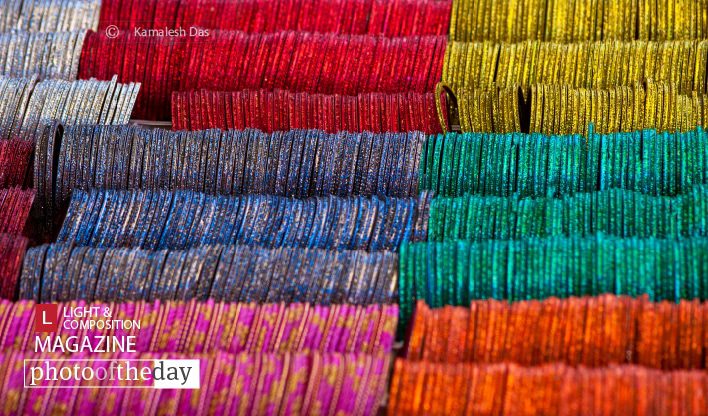
Captured at the vibrant Rasmela fair in Cooch Behar, this photograph highlights the intricate beauty of a local bangle shop. The photographer was drawn to the kaleidoscope of colors displayed in the accessories, which serve as a profound reflection of the spirit of Indian culture and tradition. By focusing on the rhythmic arrangement of the bangles, the image transforms a simple market scene into a celebration of heritage. The composition is award-worthy for its ability to capture the essence of local life through a rich, saturated palette and a keen eye for cultural detail.
Exposure 1/160sec @ f/6.3 | ISO 200 | Focal Length 105mm
Kamalesh Das
Based in Cooch Behar, West Bengal, Kamalesh Das is a dedicated school teacher who balances his professional life with a deep-seated passion for photography. Since acquiring his first DSLR in 2008, he has cultivated a unique perspective that finds artistic potential in everyday surroundings, from local fairs to the quiet corners of his home. Driven by a desire to constantly challenge his previous experiences, he approaches every shutter click as an opportunity to innovate and capture the world through a fresh, thoughtful lens.
Resonance Score Breakdown
Transparency Note: The resonance score (12.8/20) is calculated based on social engagement metrics collected before the award announcement.
Expert Photography Reviews · 8
The Weight of Small Things
I spent twenty minutes this morning digging through my junk drawer, looking for a single spare key. I didn't find it, but I did find a handful of colorful glass beads from a necklace I broke years ago. I held them in my palm for a moment, feeling their cool, smooth weight.
Read the reflection →The Weight of Glass
The smell of dry earth and cheap incense always pulls me back to the feeling of a crowded market. It is a thick, humid scent that clings to the back of the throat, tasting faintly of dust and sugar.
Read the reflection →Reviews & Comments
Share your thoughts about this award-winning photograph. Your reviews contribute to the community engagement score.
It’s a riot of glass and pigment, isn’t it? One can almost smell the dust of the Rasmela fair. Most would have snapped a quick frame and moved on, but Das clearly lingered until the light settled into those saturated hues. I’ve spent enough afternoons in similar markets to know the patience required to frame such chaos without losing one’s mind. It’s a tidy bit of work. I find myself wanting to reach out and touch the glass.
The bangles crowd the frame. A riot of glass and pigment. It’s loud. I’ve spent minutes looking for a place to rest my eyes, but there’s no room to breathe. The saturation pulls at me, yet I crave a single shadow. A moment of stillness. Nothing here is accidental. The empty corner is not empty; it’s a missed opportunity. I’d trade half these colors for a sliver of silence. It’s just too much.
The frame’s geometry relies on the rhythmic repetition of circular forms. It’s a dense, chromatic grid. The spatial tension between the foreground bangles and the receding market depth is tight, almost claustrophobic. I’m genuinely irritated by the lack of a clear focal anchor; the eye wanders aimlessly through the saturation. It doesn’t hold. The composition lacks a necessary fulcrum, leaving the visual architecture to collapse under the weight of its own color.
Color is a distraction here, a frantic attempt to mask the void. Das offers us a kaleidoscope, yet I’m haunted by the gaps between these bangles. It’s in those dark, neglected interstices that the Rasmela fair truly breathes. I find myself shivering at the silence trapped within the glass. When a photographer fears the encroaching black, they lose the soul of the frame. It’s beautiful, yes, but it’s a beauty that refuses to let us think.
The air in Cooch Behar must have been thick with the scent of dust and incense when he stood before this stall. He didn’t just capture bangles; he waited for the light to settle into those glass curves, turning plastic into something sacred. I find myself wanting to reach out and touch the warmth trapped in that red hue. It’s a quiet, rhythmic devotion. He didn’t rush the moment, and because of that, the color breathes.
At 105mm and f/6.3, the focal plane is razor-thin, isolating the bangles’ curvature with clinical precision. The Nikon’s sensor resolves the micro-contrast of the glass surfaces beautifully, avoiding the diffraction limit that often plagues such dense compositions. I’m genuinely moved by how the light refracts through these pigments; it’s a chaotic, vibrant spectrum that the human eye usually blurs into noise. It’s rare to see such technical discipline turn a simple market stall into pure, crystalline geometry.
These bangles vibrate with the feverish intensity of a Turner sunset, their saturated pigments clashing in a rhythmic, chromatic dissonance that feels almost tactile. It’s a dizzying, glorious assault on the senses; I’ve found myself breathless before the sheer audacity of those cadmium yellows colliding with the deep, bruised violets of the shadows. One doesn’t merely look at these glass circles; one feels them humming against the skin, a symphony of light that’s utterly intoxicating.
Most market scenes are visual noise, but here, the rhythmic repetition of the bangles creates a structured geometry that anchors the chaos. I’ve seen thousands of saturated street shots, yet this one lingers because the tight framing forces an intimacy with the craft. It’s not just color; it’s a tactile record of a vanishing trade. Honestly, it makes me want to reach out and touch the glass. That’s why it’ll still matter in thirty years.
congrats sir