At the Doorstep of Almighty by Prasanta Singha
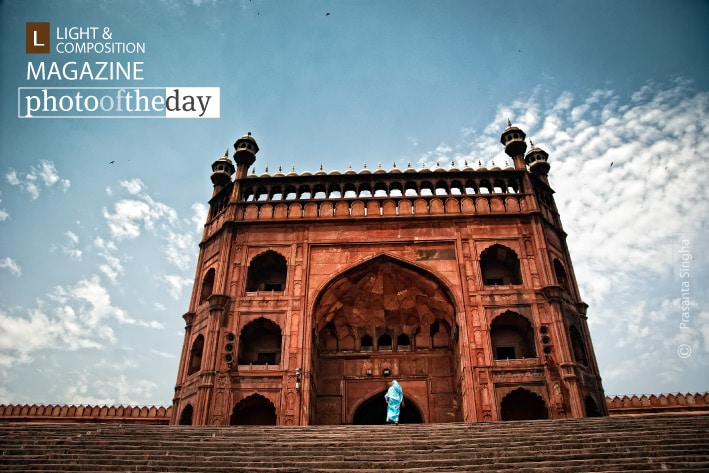
Captured at the historic Jama Masjid in Delhi, this evocative image explores the profound dimensional interplay between the grand architecture of the mosque and the human element within its walls. The photographer masterfully utilizes the striking color contrast between the deep red sandstone of the mosque and the vibrant blue attire of the subject to create a compelling visual narrative. This photograph is award-worthy for its ability to transform a candid moment into a powerful study of scale, color, and cultural atmosphere, highlighting the photographer's keen eye for finding beauty in the intersection of people and their sacred surroundings.
Prasanta Singha
Based in Kolkata, India, Prasanta Singha is a dedicated travel photographer with a deep-seated passion for documenting the lives of local inhabitants and their environments. His work focuses on capturing authentic portraits and the surrounding cultural landscapes that define a region. Driven by a lifelong commitment to the craft, he continuously strives to refine his artistic vision and contribute meaningfully to the global photography community through his evocative and human-centric imagery.
Resonance Score Breakdown
Transparency Note: The resonance score (12.4/20) is calculated based on social engagement metrics collected before the award announcement.
Expert Photography Reviews · 6
The Weight of Stone
We build to outlast ourselves. We stack stone upon stone, hoping the weight will anchor our fleeting intentions to the earth. There is a silence in these structures that has nothing to do with the absence of sound.
Read the reflection →The Architecture of Silence
In the quiet hours of the morning, before the world has fully stirred, there is a particular weight to the air in spaces built for reverence.
Read the reflection →Reviews & Comments
Share your thoughts about this award-winning photograph. Your reviews contribute to the community engagement score.
The deep, sun-baked terracotta of the Jama Masjid’s sandstone doesn’t merely frame the scene; it hums with a heat that Vermeer would have envied, providing a grounding, earthy resonance against that piercing, electric blue of the subject’s tunic—a shade like a sudden, cool intake of breath in the Delhi heat. I’m utterly breathless at how this chromatic friction vibrates, creating a sacred, shimmering tension that feels, quite frankly, like a prayer caught in light.
Delhi’s heat is a brutal companion, yet here it’s held at bay. One suspects Singha didn’t just stumble upon this blue-clad figure against the red sandstone; he likely sat in the dust until the geometry aligned. It’s a rare, quiet patience I’ve rarely seen in such chaotic surroundings. I’d have probably packed up after an hour of sweating, but he clearly stayed. It’s a disciplined, earned frame. A fine bit of work, truly.
Most architectural shots in Delhi settle for the grandeur of stone, but this one breathes. The contrast between the deep red sandstone and that sharp, electric blue fabric isn’t just a color choice; it’s a collision of permanence and transience. I’ve stared at this for years, and it still makes me feel small in the best way. It’s the scale that wins here. It’ll matter in thirty years because it captures a soul, not just a structure.
The red sandstone arches dictate a rigid geometry, yet the subject’s blue attire disrupts the frame’s equilibrium. It’s a precarious balance. The negative space above the doorway creates a necessary void, preventing the architecture from collapsing inward. While the scale suggests permanence, the human figure introduces a fleeting tension. I’m genuinely unsettled by how the vertical lines threaten to swallow the subject whole. It doesn’t just occupy the space; it challenges the frame’s structural integrity.
The red sandstone doesn’t just hold the heat; it holds the silence of centuries. Prasanta waited for that singular blue figure to anchor the vastness, didn’t he? I’ve stood in such courtyards, feeling the air grow thin and holy. It’s the way the light clings to the stone that moves me. He wasn’t rushing. He listened to the architecture until it finally exhaled, and in that quiet, fleeting second, he pressed the shutter. It’s beautiful.
The red sandstone doesn’t merely frame the subject; it consumes him. Singha’s blue figure is a fragile intrusion against the crushing weight of history. I’ve spent hours staring at these shadows, and they don’t offer comfort—they demand an accounting of the soul. It’s a haunting, claustrophobic geometry. When I look at that deep, impenetrable dark beneath the arch, I feel a sudden, sharp ache for the silence that must have existed before the shutter clicked.