Mr Everybody by Ali Berrada
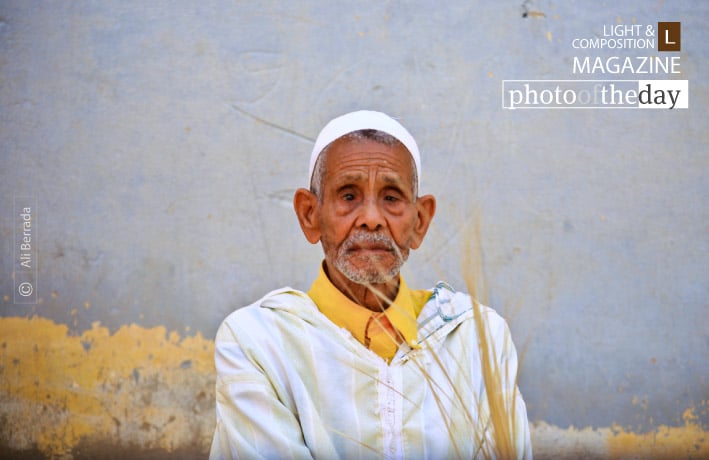
In a quiet village near Agdz, Morocco, the photographer encountered a local man whose presence demanded to be captured. The resulting portrait, titled Mr Everybody, emerged from a spontaneous request that transformed a simple meeting into a profound visual connection. By focusing on the subject's character against the backdrop of his environment, the photographer successfully distilled a fleeting interaction into a timeless image. This portrait is award-worthy for its raw authenticity and the photographer's ability to find beauty in the simplicity of human connection, effectively stopping time to preserve a genuine, unscripted moment.
Ali Berrada
Based in Casablanca, Morocco, Ali Berrada is a dedicated freelance photographer who views the medium as his passion and his perspective on the world. Though he began his professional journey only recently, he has quickly developed a style defined by a search for simplicity and creative depth. Driven by a desire to capture the perfect light, Berrada travels extensively, viewing himself as a global citizen committed to freezing fleeting moments in time to ensure they endure forever.
Resonance Score Breakdown
Transparency Note: The resonance score (13.0/20) is calculated based on social engagement metrics collected before the award announcement.
Expert Photography Reviews · 6
The Weight of a Name
We spend our lives building identities, layering titles and histories like coats against a winter chill. We are the sum of our professions, our lineages, and the specific, narrow geography of our upbringing.
Read the reflection →The Weight of a Name
We carry our names like heavy coats, buttoned against the wind. They are the first things we are given and the last things we leave behind. But beneath the name, there is a person who has stood in the sun for a long time, watching the dust settle on the road.
Read the reflection →Reviews & Comments
Share your thoughts about this award-winning photograph. Your reviews contribute to the community engagement score.
Shadow isn’t merely the absence of light here; it’s the architecture of a man’s endurance. In Agdz, Berrada doesn’t just capture a face; he traps the silence of the desert within the deep, cavernous folds of the subject’s djellaba. It’s heavy, almost suffocating. I’ve stared at these eyes for an hour, and I’m unsettled by how much they refuse to reveal. It doesn’t invite us in. Instead, it demands we acknowledge the darkness we carry ourselves.
Most portraits I review are mere transactions, but Berrada’s work captures a rare, heavy stillness. The 125mm focal length compresses the Agdz landscape, forcing the subject’s weathered skin into a dialogue with the dust behind him. It’s the eyes that get me; they hold a weary, universal patience that makes me want to sit in silence with him. In thirty years, this won’t be a dated travel shot, but a vital record of a man who simply was.
The ochre of the Agdz earth bleeds into the subject’s skin, a monochromatic embrace reminiscent of Morandi’s dust-choked still lifes, yet it’s the sudden, piercing cobalt of his djellaba that truly undoes one. It’s a shock of tidal water against desert heat, a chromatic dissonance that makes my heart ache with its sheer, unadorned honesty. One doesn’t merely look at this man; one feels the sun-baked silence of Morocco vibrating through every saturated, sun-drenched pore.
Spontaneity is often just a polite term for luck. One suspects Ali Berrada simply happened upon this man near Agdz, took the shot, and moved on. It’s a pleasant enough portrait, but it lacks the grit of a long-term commitment. I’ve spent weeks shivering in the Atlas mountains for a single frame; this feels like a tourist’s souvenir. It’s technically sound, sure, but it hasn’t been earned. Where is the weight of the return visit?
The subject’s placement creates a rigid vertical axis that anchors the frame. It’s a disciplined geometry. The negative space surrounding the figure provides the necessary breathing room, preventing the composition from collapsing into sentimentality. I’m genuinely struck by how the light defines the facial topography; it’s precise, clinical, and unforgiving. The frame holds because the subject doesn’t drift. It’s a rare instance where the architecture of the portrait actually justifies the stillness.
The light in Agdz doesn’t just fall; it settles into the deep lines of a face like dust on ancient stone. He stood there in the cooling hour, waiting for the desert to quiet its breath. I feel a strange, heavy peace looking at his eyes. It’s not a portrait of a man, but of the land itself. You can tell he didn’t rush. He listened until the light finally agreed to stay.