El Tren by Ana Sylvia Encinas
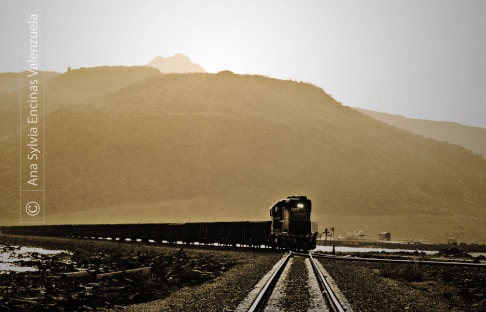
While driving through Sonora, Mexico, the photographer encountered a striking scene as a train passed near the coastline. Seizing the moment, she exited her vehicle to capture the juxtaposition of the industrial locomotive against the backdrop of Empalme, a town that retains the rustic, old-west charm of a traditional fishing village. The image is award-worthy for its spontaneous composition and its ability to evoke a sense of place, transforming a fleeting roadside observation into a compelling visual narrative that highlights the quiet, rugged beauty of the Mexican landscape.
Ana Sylvia Encinas
Born in Hermosillo, Mexico, Ana Sylvia Encinas discovered her deep-seated passion for photography after acquiring her first DSLR in 2009. Although she balances a successful career as an entrepreneur and marketing expert, she dedicates her leisure time to exploring the natural world through her lens. Her work focuses primarily on landscape and nature photography, reflecting a continuous journey to refine her technical skills and develop a distinct, personal artistic voice.
Resonance Score Breakdown
Transparency Note: The resonance score (12.8/20) is calculated based on social engagement metrics collected before the award announcement.
Expert Photography Reviews · 4
The Iron Pulse of Distance
The smell of hot metal always brings me back to the train tracks behind my childhood home. It is a sharp, ozone-heavy scent that clings to the back of the throat, tasting faintly of pennies and dry, sun-baked dust.
Read the reflection →The Weight of Passing Through
There is a peculiar melancholy in the sound of a train moving through a landscape that does not belong to it. It is a heavy, rhythmic intrusion, a mechanical heartbeat imposed upon the stillness of the earth.
Read the reflection →Reviews & Comments
Share your thoughts about this award-winning photograph. Your reviews contribute to the community engagement score.
The locomotive’s horizontal thrust anchors the frame, slicing the Sonoran landscape with geometric precision. It’s a rigid line that demands total obedience from the eye. The negative space above the train is sparse, providing a necessary counterweight to the industrial mass below. I’ve rarely seen such brutal efficiency in a travel shot. It doesn’t rely on sentimentality. The composition holds because the tension between the steel and the horizon is perfectly, coldly resolved.
Most travel photography is just visual noise, but this frame sticks. Of the thousands I’ve reviewed, few capture the friction between progress and decay so cleanly. The train’s heavy, rusted geometry slicing through that soft, coastal horizon creates a tension that doesn’t resolve. It’s haunting. I find myself wanting to board that locomotive just to see what’s left of the town. In thirty years, this won’t be a relic; it’ll be a necessary document of Sonora.
The desert air in Sonora holds a weight that demands stillness. When that train cut through the horizon, Encinas didn’t just capture metal and dust; she caught the land’s own rhythm. I feel a strange, quiet ache looking at the way the light hits those rusted cars—it’s the color of a day ending. She stood there, breathless, listening to the iron hum against the silence. It’s a rare, fleeting grace she’s found in the heat.
The locomotive cuts through Sonora like a jagged blade, yet it’s the encroaching darkness beneath the chassis that haunts me. Encinas doesn’t just capture a train; she captures the silence that follows the roar. I’ve stared at these shadows until my eyes ached, feeling the weight of a landscape that refuses to be tamed by the sun. It’s a brutal, honest confrontation. I find myself shivering, despite the heat radiating from those rusted, indifferent steel tracks.
Stunning! Beautifully conceived, composed, executed. A common scene in Northern Mexico and in the Southwestern United States rendered with iconic clarity. On a personal note, it reminds me of many happy days spent on Mexican trains from
Nogales to Guadalajara and many points in between.
Well done, Ana.