The Future of India by Achintya Guchhait
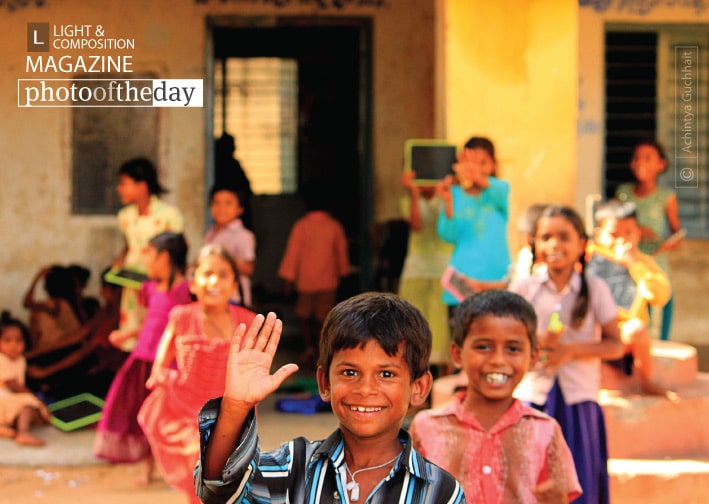
Captured near the historic Lepakshi temple in Andhra Pradesh, this image documents a spontaneous moment of joy between the photographer and a group of local schoolchildren. Upon being spotted, the photographer found themselves surrounded by curious, energetic students who viewed the encounter as a refreshing reprieve from their daily studies. The image serves as a poignant, candid portrait of the country’s youth, capturing their infectious spirit and vitality. It is award-worthy for its ability to transform a chaotic, unplanned interaction into a beautifully composed narrative that highlights the innocence and optimism defining the future of India.
Achintya Guchhait
Based in Bangalore, India, Achintya Kumar Guchhait is a dedicated photographer who balances a professional career in technology with a deep-seated passion for visual storytelling. His work is defined by a commitment to capturing authentic human experiences and the coexistence of life within the natural and built environment. A lifelong traveler and student of the craft, he utilizes his camera to document the common, everyday moments that reveal the essence of humanity, constantly refining his technical skills through the observation of diverse photographic works.
Resonance Score Breakdown
Transparency Note: The resonance score (13.4/20) is calculated based on social engagement metrics collected before the award announcement.
Expert Photography Reviews · 4
The Weight of Unwritten Days
There is a specific gravity to the beginning of things. Before the maps are drawn, before the paths are worn smooth by the repetition of feet, there is only the raw, unshaped potential of the morning.
Read the reflection →The Unbound Seed
We are often told that the future is a destination, a distant shore we must row toward with heavy oars. But look at the way a dandelion seed travels—it does not map its path, nor does it worry about the soil that will eventually catch it. It simply trusts the wind.
Read the reflection →Reviews & Comments
Share your thoughts about this award-winning photograph. Your reviews contribute to the community engagement score.
Of the thousands of portraits I’ve reviewed, most collapse into sentimental clutter. Guchhait’s frame avoids this by anchoring the chaos in the central boy’s unblinking, direct gaze. It’s that singular, piercing eye contact that forces you to confront the weight of his potential. I’ll admit, it makes me ache for his future. While the composition is tight, that specific, defiant stare is why this will still matter in thirty years. It’s a rare, honest connection.
The frame is cluttered, yet the central child’s gaze anchors the chaos. It’s a precarious balance. The spatial tension between the foreground faces and the temple architecture creates a necessary fulcrum, preventing the composition from collapsing into mere sentiment. I’ve grown weary of such frantic energy, but the geometry holds. The depth of field doesn’t isolate the subjects enough, yet the visual architecture remains sufficiently rigid. It’s a rare instance where the noise actually finds its structure.
The ochre dust of Andhra Pradesh rises like a fever, swirling around these children in a palette reminiscent of Turner’s most volatile skies, where the sun-bleached whites of their shirts collide with the deep, earthy umber of the parched ground. It’s a chromatic collision that makes my heart ache for that fleeting, golden optimism; one finds the harmony here isn’t in the composition, but in the way the light clings to their skin like warm, liquid amber.
Light here doesn’t merely illuminate; it interrogates the dust of Andhra Pradesh. These children aren’t just subjects; they’re silhouettes carving space into the temple’s ancient, indifferent stone. I’ve spent hours staring at the way their joy fights the encroaching gloom. It’s a desperate, flickering vitality that refuses to be swallowed by the dark. Honestly, it makes me ache. Guchhait understands that to capture a future, one must first confront the weight of what remains hidden.