The Aura by Abhishek Asthana
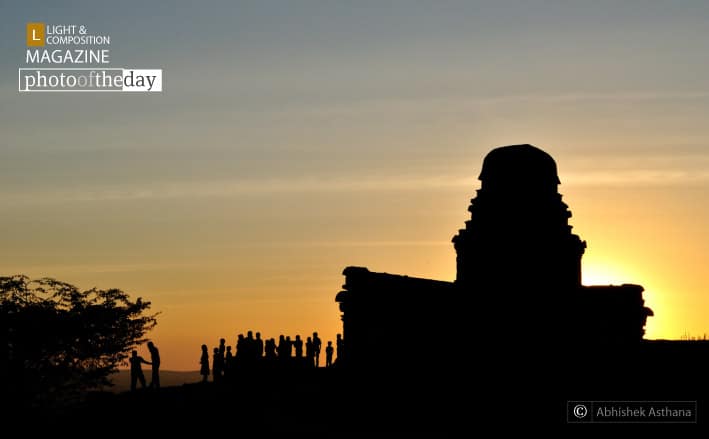
Captured atop the historic Badami fort in Karnataka, this image immortalizes the serene atmosphere of a site once ruled by the powerful Chalukya dynasty. The photographer, momentarily separated from a group of tourists, seized the opportunity to capture the temple in a moment of quiet isolation. By stepping back and observing the scene with a fresh perspective, the photographer transformed a standard travel visit into a compelling visual narrative. The photograph is award-worthy for its ability to distill the grandeur of ancient architecture and the stillness of the moment into a single, evocative frame.
Abhishek Asthana
Based in Hyderabad, India, Abhishek Asthana balances a professional career in software development with a deep-seated passion for photography. His creative journey began in his school days with manual film cameras, eventually evolving into a dedicated pursuit of digital photography using his Nikon DSLR. Asthana finds joy in documenting the nuances of everyday life, people, and common human experiences, while also contributing to social causes as the co-founder of DonateYourPC.in. His work reflects a versatile eye, shaped by a love for adventure, trekking, and the exploration of India’s rich historical landscapes.
Resonance Score Breakdown
Transparency Note: The resonance score (14.3/20) is calculated based on social engagement metrics collected before the award announcement.
Expert Photography Reviews · 5
The Salt of Ancient Stone
The smell of sun-baked rock is a dry, chalky scent that clings to the back of the throat, like the dust of a long-forgotten path. I remember touching a wall once, centuries old, where the stone felt like skin—rough, warm, and pulsing with a slow, geologic heartbeat.
Read the reflection →The Architecture of Silence
We often mistake history for something buried, a collection of heavy stones resting in the dust of what used to be. But time is not a grave; it is a slow, rhythmic breathing.
Read the reflection →Reviews & Comments
Share your thoughts about this award-winning photograph. Your reviews contribute to the community engagement score.
Most travel shots of Badami are cluttered, noisy affairs. What separates this from the thousands I’ve reviewed is the deliberate isolation of the temple against that vast, encroaching sky. It’s a quiet, haunting frame. I felt a genuine shiver looking at it, realizing how easily this stillness could have been ruined by a single tourist. It’s not just a record of a site; it’s a rare, enduring capture of silence that will matter in thirty years.
The ochre of these Badami stones, reminiscent of a Morandi still life, bleeds into a sky the colour of bruised apricots at twilight. It’s a chromatic ache that I’ve felt deep in my marrow, a resonance of ancient dust meeting the fading warmth of a dying sun. One finds oneself breathless, caught in that amber suspension where the architecture doesn’t merely exist, but breathes in the golden, suffocating light of a long-vanished empire.
Badami’s heat is legendary, yet here it’s remarkably still. One suspects the photographer didn’t just stumble upon this silence; they waited for the tourists to tire of the climb. It’s a decent frame, though I’d have preferred a bit more grit in the shadows. Still, I’ve spent enough afternoons baking on sandstone to appreciate the patience required to clear the frame. It’s a quiet, earned moment. He clearly didn’t rush the descent.
Badami’s stone doesn’t just hold history; it holds its breath. Abhishek found that sliver of silence when the crowds drifted away, leaving the temple to commune with the rising sun. I’ve felt that same ache in my chest when the light finally hits the sandstone just right. It’s not about the architecture, but the way the warmth clings to the rock. He didn’t rush. He waited until the land was ready to reveal its aura.
The frame’s geometry creates a rigid, tripartite division. The temple’s silhouette anchors the lower quadrant, providing the necessary mass to counter the expansive, atmospheric sky. It’s a disciplined arrangement. The negative space doesn’t collapse; it breathes. I’ve rarely seen such precise spatial tension in a travel capture. The horizon line acts as a brutal fulcrum, forcing the eye to acknowledge the architecture’s weight. It’s cold, it’s calculated, and frankly, it’s a relief to see such restraint.
The color composition and mood of the picture are brilliant.
You captured an intriguing silhouette of this temple.