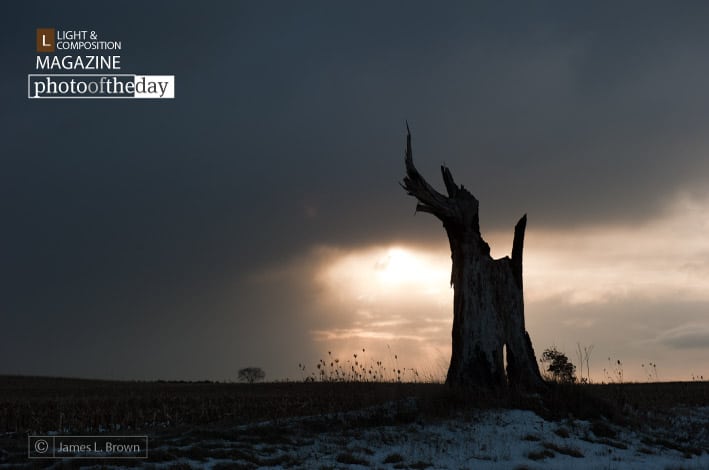
Old Man of the Lane by James Brown
The photographer captured this evocative image along a quiet, tree-lined country lane, a location he frequently visits to document the shifting seasons. By waiting for the precise convergence of weather and light, he successfully highlighted the majestic character of the ancient trees that define the landscape. The photograph is award-worthy for its masterful use of natural light and its ability to transform a simple, rural scene into a poignant study of time and nature. Through careful technical execution and a patient, observant eye, the image invites viewers to appreciate the quiet beauty found in the overlooked corners of the world.
James Brown
Based in Petrolia, Ontario, James L. Brown is a self-taught photographer dedicated to revealing the inherent beauty within simple, everyday subjects. While he maintains a deep appreciation for photographic equipment, he prioritizes artistic vision as the primary driver of his work. Beyond his creative pursuits, Brown is committed to using his photography as a vehicle for social impact, actively supporting humanitarian efforts through his involvement with the KIVA lending community.
Resonance Score Breakdown
Transparency Note: The resonance score (13.9/20) is calculated based on social engagement metrics collected before the award announcement.
Expert Photography Reviews · 4
The Architecture of Patience
In the quiet corners of a forest, time does not move in the linear fashion we demand of our clocks. It moves in rings, expanding outward from a core that remains stubbornly, beautifully still.
Read the reflection →The Architecture of Silence
We often mistake stillness for an absence, as if a quiet room or an empty field were merely waiting for the noise to return. But silence has a weight, a texture like the rough bark of a tree that has outlived the men who planted it.
Read the reflection →Reviews & Comments
Share your thoughts about this award-winning photograph. Your reviews contribute to the community engagement score.
The light here isn’t just falling; it’s listening. He stood in that Ontario lane when the air turned thin, waiting for the shadows to lengthen until the trees finally exhaled. I’ve felt that same stillness, where the shutter release feels like an intrusion on a prayer. It’s a quiet, aching grace. Looking at these gnarled branches, I find myself holding my breath, hoping I don’t disturb the ancient, heavy peace he found in that cooling hour.
The ochre light here doesn’t merely illuminate; it bruises the bark with the weary, golden melancholy of a late-autumn afternoon, reminiscent of a Morandi still life stripped of its domestic quietude. It’s a chromatic ache, that specific, dusty amber of Ontario’s dying leaves, and I’ve found myself breathless before the way the shadows bleed into a bruised, slate-grey violet, shivering against the cold, encroaching winter. One feels the season’s final, fragile gasp in every pixel.
One suspects the light cooperated on the first attempt. It often does, for the patient. Brown’s lane doesn’t scream for attention, yet it’s clearly been visited until the trees stopped being mere timber and started being characters. I’ve spent enough shivering mornings in Ontario to know that f/2.5 aperture wasn’t a choice; it was a necessity of the fading light. He didn’t just find this; he earned it. It’s a quiet, honest bit of work.
The trees here don’t just exist; they loom, heavy with the weight of Ontario’s slow, decaying winters. Brown’s lane isn’t a path, but a threshold. I’m struck by how the shadows swallow the gravel, refusing to let the light explain the terrain. It’s a cold, honest darkness. When I look at these gnarled trunks, I don’t see nature. I see the silence that remains after the world has finished its frantic, desperate attempt to be seen.