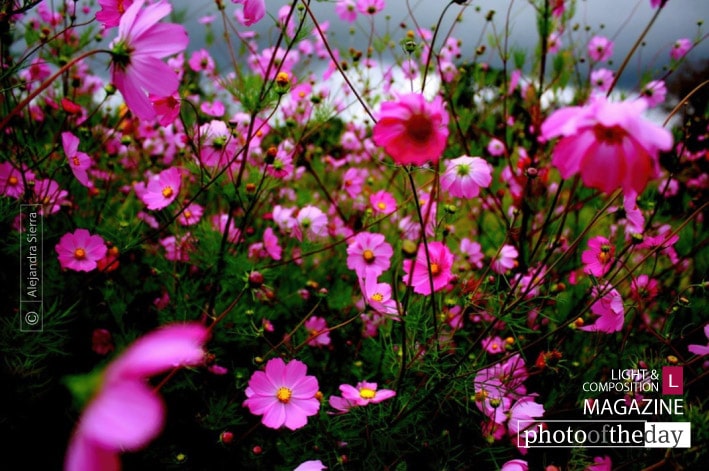
Purple Wind by Alejandra Sierra
Captured in Tapalpa, Mexico, this evocative image showcases a field of flowers transformed by the dramatic arrival of a storm. The photographer observed how the intense wind and the moody, purple-gray sky imbued the flora with a vibrant, ethereal quality that remains absent on clear, sunny days. By skillfully utilizing a wide-angle perspective, the photographer highlights the raw, atmospheric tension of the moment. This photograph is award-worthy for its ability to turn a fleeting meteorological event into a striking study of color and movement, demonstrating a keen eye for finding extraordinary beauty in the natural world.
Alejandra Sierra
Based in Guadalajara, Mexico, Alejandra Sierra is an emerging photographer who transitioned into the craft after studying International Relations at the Western Institute of Technology and Higher Education. Her technical foundation includes training at the Universitary Center of Audiovisual Media in Guadalajara and the International Center of Photography in New York. While her portfolio spans food and architectural subjects, she specializes in macro, animal, and travel photography, consistently striving to challenge viewers to perceive the common elements of daily life through a fresh, unique lens.
Resonance Score Breakdown
Transparency Note: The resonance score (12.8/20) is calculated based on social engagement metrics collected before the award announcement.
Expert Photography Reviews · 6
The Breath Before the Rain
There is a specific weight to the air just before the sky decides to break. It is a heavy, velvet silence that settles over the fields, as if the earth itself is holding its breath, waiting for the first cool shiver of the storm. In these moments, the world loses its sharp edges.
Read the reflection →The Breath of the Earth
The air before a storm has a metallic tang, like copper coins pressed against the tongue. It is a heavy, humid weight that settles into the pores of your skin, making the fine hairs on your arms stand upright as if they are listening for a sound that hasn't arrived yet.
Read the reflection →Reviews & Comments
Share your thoughts about this award-winning photograph. Your reviews contribute to the community engagement score.
Beautiful.
Tapalpa’s storms aren’t known for their hospitality. I’ve spent enough hours shivering in similar gales to know that f/3.5 at 1/500sec isn’t a lucky snap; it’s a calculated gamble against the wind. One suspects Sierra didn’t just stumble upon this purple gloom. She waited until the air turned sour and the light bruised. It’s a rare, cold comfort to see someone actually endure the weather to earn their color. I’d have stayed for the rain.
Tapalpa’s storm doesn’t merely arrive; it interrogates the flora. Sierra captures a violet turbulence that refuses to be decorative. It’s a violent, bruised light that forces the flowers into a desperate, kinetic posture. I’ve stared at these purple stalks for an hour, and I’m unsettled by how they surrender to the gloom. It’s not beauty I feel here, but a profound, heavy resignation. When the light dies, the truth finally begins to speak.
Most landscape work I see is merely pretty, but this captures a genuine atmospheric violence. The 18mm perspective forces the viewer into the gale, making the purple-gray sky feel heavy enough to crush the flowers. It’s that tension—the way the flora bends against the inevitable—that makes me shiver. In thirty years, we won’t remember the gear, but we’ll still feel the wind. It’s a rare, visceral reminder that nature doesn’t care about our comfort.
The air in Tapalpa must have been heavy, charged with the scent of ozone and damp earth. She waited until the wind forced the flowers to bow, listening to the sky’s purple shift. It’s a rare, restless grace. I’ve stood in such storms, feeling that same frantic pulse against my skin. She didn’t just capture a field; she caught the land holding its breath. It’s haunting, really. I find myself wanting to step into that gale.
The wide-angle distortion doesn’t merely capture wind; it anchors the frame against the encroaching storm. The floral massing creates a necessary fulcrum, balancing the heavy, purple-gray sky. It’s a rigid architecture of chaos. I’ve rarely seen such disciplined turbulence. The negative space at the horizon line is thin, yet it holds the entire composition together. It’s a cold, calculated success. The frame doesn’t collapse under the weight of the atmosphere. It’s structurally sound.
The bruised, violet-grey sky in Tapalpa doesn’t merely loom; it bleeds into the flora, creating a chromatic dissonance that reminds one of Turner’s most turbulent, vaporous horizons. I’m breathless at how the wind-whipped petals capture that specific, melancholic mauve of a dying bruise. It’s a violent, exquisite harmony of atmospheric pressure and pigment, where the light’s cold, metallic temper forces the flowers to surrender their warmth to the encroaching, restless storm.