Little Waterloo Bay by Cameron Cope
Captured during a trek through the rugged landscapes of Wilsons Promontory, this self-portrait panorama showcases the raw, untamed beauty of Australia’s southernmost mainland tip. The photographer navigated challenging terrain and remote coastal paths to reach the secluded shores of Little Waterloo Bay, where the juxtaposition of dense forests, towering granite boulders, and pristine beaches creates a dramatic visual narrative. By documenting the effort required to access such untouched wilderness, the image serves as a testament to the rewards of adventure. Its award-worthy quality lies in the seamless integration of the photographer within the vast, awe-inspiring scale of the Australian landscape.
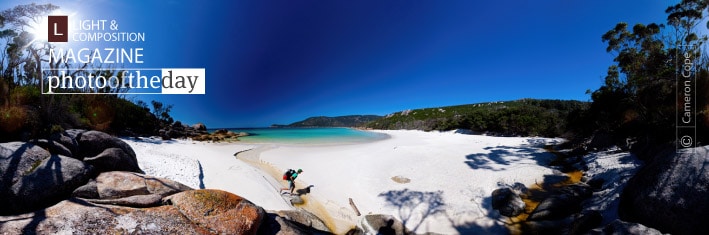
Exposure 1/250sec @ f/11 | ISO 400 | Focal Length 24-105mm
Cameron Cope
Based in Melbourne, Australia, Cameron James Cope is an emerging photographic artist whose work explores the intersections of travel, colonial history, and environmental consciousness. His practice is defined by a commitment to both personal and collaborative storytelling, often highlighting indigenous culture and the natural world. Through his lens, Cope seeks to evoke a profound sense of wonder for global landscapes while simultaneously fostering public dialogue on critical social and historical issues.
Resonance Score Breakdown
Transparency Note: The resonance score (12.6/20) is calculated based on social engagement metrics collected before the award announcement.
Expert Photography Reviews · 4
The Salt on the Skin
The taste of the ocean is not just salt; it is the sharp, metallic tang of cold air hitting the back of the throat after a long climb.
Read the reflection →The Architecture of Silence
We often mistake stillness for an absence, as if the world stops breathing when we step away from the noise of our own making. But there is a heavy, ancient weight to the places where the earth meets the sea without an audience.
Read the reflection →Reviews & Comments
Share your thoughts about this award-winning photograph. Your reviews contribute to the community engagement score.
The granite boulders anchor the frame, providing a necessary fulcrum against the sprawling horizon. It’s a rigid geometry that prevents the landscape from dissolving into mere atmosphere. The figure’s placement is precise, disrupting the negative space just enough to establish scale. I’m genuinely unsettled by how the composition forces the eye toward that jagged coastline. It’s a cold, calculated architecture. The frame holds, even if the vastness threatens to pull the entire structure apart.
The granite boulders here hold a silence I’ve felt only in the deepest reaches of the bush. He stood in the cooling hour, waiting for the light to soften against the sand. It’s a lonely, honest frame. I find myself breathing slower just looking at the way he’s placed himself against that vast, untamed horizon. He didn’t just capture a view; he listened to the land until it finally allowed him to belong to it.
Getting to Little Waterloo Bay isn’t a Sunday stroll, and it’s clear Cope didn’t just stumble upon this frame. The granite boulders have a weight that suggests he didn’t rush the composition. I’ve spent enough nights shivering in the scrub to know when someone’s actually put in the miles. It’s a lonely, honest bit of work. One suspects he waited for that specific tide. It’s a rare pleasure to see a landscape that’s truly been earned.
The granite boulders possess that bruised, melancholic violet one finds in a late Morandi, grounding the composition against the searing, bleached-bone white of the sand. It’s a chromatic tension that makes my heart ache, pulling the eye toward the horizon where the sea dissolves into a pale, bruised cerulean. One feels the salt air’s chill; it’s a shivering, atmospheric harmony that doesn’t merely depict a landscape, but breathes the very light of the Southern Ocean.