Photographing a Photographer by Christopher Johnson
Perched atop the summit of Mauna Kea, the photographer sought inspiration amidst the biting cold of a cloudless sunset. When the landscape failed to yield the expected scenic drama, a shift in perspective revealed the striking silhouette of a fellow photographer capturing the sunrise. This serendipitous encounter transformed a challenging environment into a moment of creative clarity. The resulting image is a poignant study of the observer observed, capturing the quiet dedication of a peer against the vast, ethereal backdrop of the Hawaiian sky, ultimately earning recognition for its narrative depth and spontaneous composition.
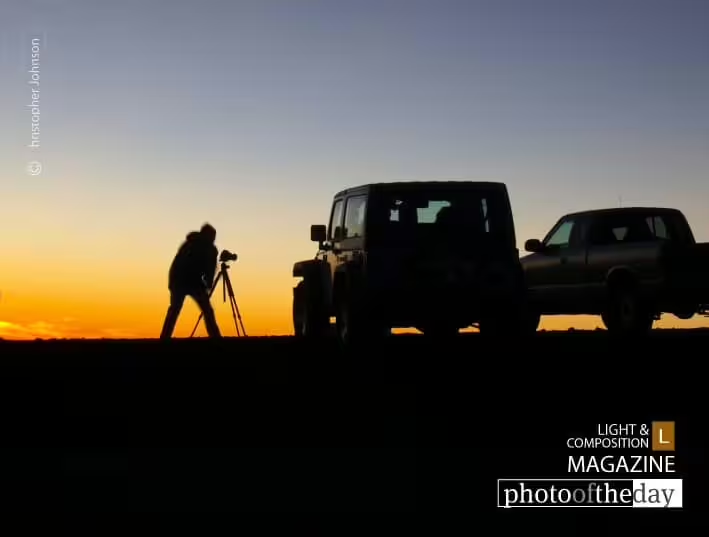
Exposure 1/4sec @ f/22 | ISO 100 | Focal Length 14-45mm
Christopher Johnson
Originally from the mountains, Christopher Johnson now resides in Kailua-Kona, Hawaii, where he translates his unique perspective into the vibrant landscapes of the tropical islands. His work has garnered significant acclaim, featuring in local galleries, art shows, and the Tahoe Quarterly Magazine, while also being held in private and commercial collections. Currently associated with Photo Resources of Hawaii, Johnson continues to explore the hidden mysteries of his environment, blending his technical expertise with an evolving artistic vision that captures the diverse qualities of the Pacific landscape.
Resonance Score Breakdown
Transparency Note: The resonance score (13.9/20) is calculated based on social engagement metrics collected before the award announcement.
Expert Photography Reviews · 6
The Witness at the Edge
We spend our lives looking outward, hoping the horizon will offer a mirror. We climb, we wait, we endure the thin air that makes the lungs ache. There is a specific loneliness in standing where the earth meets the void.
Read the reflection →The Mirror in the Mist
There is a curious vertigo that arrives when we realize we are not the only ones watching. We move through the world under the assumption of being the sole protagonist, the primary witness to our own unfolding lives.
Read the reflection →Reviews & Comments
Share your thoughts about this award-winning photograph. Your reviews contribute to the community engagement score.
Mauna Kea’s thin air demands a reckoning with the void. Here, the silhouette isn’t just a shape; it’s a philosophical boundary between the observer and the infinite. I’ve always found that when we turn our lenses toward another, we’re really just measuring our own insignificance against the horizon. It’s haunting, really. The shadow doesn’t merely define the figure; it swallows the photographer’s ego, leaving only the cold, stark necessity of the act itself. It’s deeply unsettling.
At the summit of Mauna Kea, the air is thin and the light is unforgiving. Christopher waited, listening to the silence of the clouds below. When the landscape refused to speak, he turned his lens toward a fellow traveler. I’ve felt that same cold, that desperate stillness where you finally stop chasing the view and start watching the observer. It’s a quiet, humble grace. He didn’t force the shot; he simply let the mountain reveal its human soul.
Mauna Kea at f/22 is a gamble, yet here it works. One suspects Johnson didn’t just stumble upon this silhouette; he likely spent hours shivering in that thin, unforgiving air while others retreated to their heaters. I’ve spent enough nights at altitude to know that biting cold makes the shutter button feel like a lead weight. He didn’t just find a shot; he endured the mountain until it finally offered him something worth keeping.
Most submissions from Mauna Kea rely on tired, oversaturated volcanic vistas. What separates this from that predictable field is the humility of the lens. By turning away from the horizon to capture a peer, Johnson avoids the trap of scenic cliché. It’s a quiet, honest study of obsession. Honestly, it makes me miss the days when we were more interested in the act of seeing than the spectacle itself. That’s why it’ll still matter in thirty years.
The silhouette anchors the frame, providing a necessary fulcrum against the vast, atmospheric gradient. It’s a disciplined placement. The negative space doesn’t collapse; it breathes. While the narrative of the observer is secondary, the spatial tension holds the eye captive. I’m genuinely unsettled by how the horizon line bisects the figure’s posture. It’s a cold, calculated geometry that works. The composition doesn’t rely on sentiment. It relies on the absolute rigor of the frame’s edge.
The palette here evokes a Morandi-esque restraint, where the bruised violet of the high-altitude atmosphere bleeds into the pale, chalky ochre of the volcanic dust. It’s a haunting, chromatic dialogue; I’m genuinely moved by how the silhouette’s obsidian depth anchors that ethereal, thin-aired light. One finds the transition from the cold, celestial indigo to the horizon’s faint, dying ember glow utterly sublime, a quiet, painterly surrender to the vastness of the Hawaiian heavens.