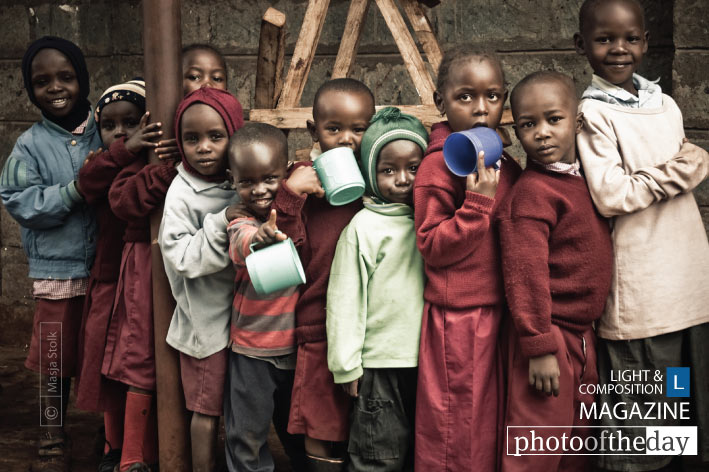
Row of Children Waiting for Porridge by Masja Stolk
In the slums of Thika, Kenya, Masja Stolk captured a poignant moment of daily life at a local school supported by the Macheo foundation. The photograph depicts a line of children patiently holding cups, awaiting their midday meal of porridge. Stolk’s decision to document this scene highlights the quiet dignity of the children amidst challenging circumstances. The image is award-worthy for its raw, documentary honesty and the photographer's ability to transform a simple act of waiting into a powerful narrative of resilience and community support, effectively bridging the gap between the viewer and the reality of life in the slums.
Masja Stolk
Based in Gouda, Netherlands, Masja Stolk transitioned into a professional photography career following fifteen years as a hairstylist. A graduate of photography school, she specializes in advertising and reportage, with a particular focus on portraiture. Stolk is deeply committed to humanitarian work, frequently traveling to regions such as Kenya and Bangladesh to document the efforts of charities and draw international attention to vulnerable populations through her evocative, storytelling imagery.
Resonance Score Breakdown
Transparency Note: The resonance score (12.4/20) is calculated based on social engagement metrics collected before the award announcement.
Expert Photography Reviews · 4
The Weight of the Cup
The smell of scorched maize and boiling water always pulls me back to a kitchen I haven't visited in decades. It is a thick, humid scent that clings to the back of the throat, promising a warmth that starts in the belly and radiates outward to the fingertips.
Read the reflection →The Weight of the Cup
Hunger is a quiet thing. It does not shout. It settles into the marrow, a slow, steady rhythm that dictates the pace of the day.
Read the reflection →Reviews & Comments
Share your thoughts about this award-winning photograph. Your reviews contribute to the community engagement score.
Most documentary work from the slums relies on shock, but this avoids that trap. Of the thousands of submissions I’ve reviewed, few capture such stillness. The children’s grip on those plastic cups is what anchors the frame; it’s a quiet, rhythmic tension that makes the hunger feel dignified rather than pathetic. I’ll admit, the sight of those small, steady hands actually makes my chest ache. It’s a rare, enduring document of resilience that’ll matter decades from now.
Waiting is a heavy, ontological burden. In Thika, these children hold their cups like anchors against a tide of scarcity. The light here doesn’t merely illuminate; it carves. I’m haunted by the way the shadows pool in their hollows, refusing to offer comfort. It’s a stark, brutal geometry of hunger. Stolk understands that to document is to confront the void. It’s not a scene of resilience, but a quiet, shivering resistance against the encroaching dark.
Waiting for a meal in the Thika heat isn’t a task for the impatient. One suspects Stolk didn’t just breeze in for a quick snap; she stayed until the children stopped noticing the lens. It’s a quiet, disciplined frame. I’ve spent enough hours in the dirt to know when someone’s earned their keep. The stillness in those cups is haunting. It’s a rare, honest bit of craft that makes me feel quite small, actually. Well done.
The ochre dust of Thika clings to these children like a dry, sun-baked pigment, echoing the muted, chalky stillness found in a Morandi still life. It’s a palette of parched earth and faded textiles that aches in the throat. I’m truly moved by the way the light catches those plastic cups, turning them into vessels of pale, translucent amber. One finds here a quiet, chromatic dignity that transcends the hunger, painting resilience in shades of dust.
This is unique piece of art