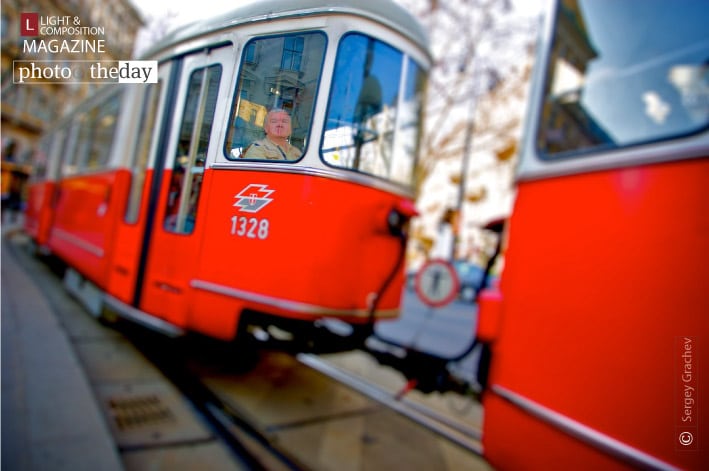
Tram on the street of Vienna by Sergey Grachev
Captured in March 2010, this evocative image of a tram navigating the historic streets of Vienna highlights the seamless integration of modern transit within a classic European cityscape. The photographer utilized a long exposure to capture the rhythmic movement of the tram, transforming the vehicle into a streak of light that cuts through the urban environment. This technical choice emphasizes the city's dynamic energy and efficient infrastructure. The composition is award-worthy for its masterful balance of motion and stillness, showcasing a sophisticated eye for urban storytelling that elevates a routine commute into a compelling visual narrative.
Sergey Grachev
Based in St. Petersburg, Russia, Sergey Grachev has established himself as a versatile professional specializing in editorial, travel, and business photography. His work serves a diverse range of national and regional clients, earning him a reputation as a visionary creative within the Russian photographic community. Beyond his local influence, Grachev is available for international assignments and stock photography, consistently demonstrating a keen ability to capture the essence of his subjects through a refined and observant lens.
Resonance Score Breakdown
Transparency Note: The resonance score (15.0/20) is calculated based on social engagement metrics collected before the award announcement.
Expert Photography Reviews · 4
The Hum of Passing
The smell of damp iron always brings me back to the rain-slicked platforms of my childhood, where the air tasted of ozone and wet wool.
Read the reflection →The Ghost of Transit
In the quiet hours before the city fully wakes, there is a peculiar sense of displacement that settles over the cobblestones. We often think of movement as a series of arrivals—a train pulling into a station, a person stepping through a doorway, a clock striking the hour.
Read the reflection →Reviews & Comments
Share your thoughts about this award-winning photograph. Your reviews contribute to the community engagement score.
The amber glow of the tram’s motion, a hue reminiscent of Turner’s most feverish sunsets, bleeds into the cold, slate-grey shadows of the Viennese evening, creating a chromatic tension that makes my heart ache with a sudden, sharp longing. It’s a collision of warmth and indifference, where the light doesn’t just illuminate the architecture; it dissolves the stone into a liquid, melancholic haze that feels, quite frankly, like the very breath of a dying, beautiful century.
A sixty-second exposure in March? I’ve spent enough freezing nights on European street corners to know that’s a recipe for numb toes and shivering hands. Grachev didn’t just snap a tram; he endured the damp Viennese air until the light behaved. It’s a rare bit of discipline in an age of instant gratification. I find myself shivering just looking at it, but the result is undeniably earned. He clearly stayed until the city stopped moving.
Most long exposures of transit feel gimmicky, but this one avoids the trap by anchoring the light streak against Vienna’s rigid, historic architecture. It’s the contrast between the fleeting orange glow and the static stone that makes me stop and stare. I’ve seen thousands of city shots, yet this one feels like a ghost passing through time. It’s not just a commute; it’s a heartbeat. In thirty years, we’ll still recognize the city’s enduring, quiet pulse.
Vienna’s architecture doesn’t merely house the tram; it consumes it. Grachev’s long exposure turns the vehicle into a spectral smear, a ghost haunting its own history. I find the encroaching darkness here unsettling, a reminder that we’re all just fleeting light against an ancient, indifferent stone. It’s not about the commute; it’s about the erasure of the present. When I look at those deep, suffocating shadows, I feel the city’s weight pressing against my own fragile existence.