Abandoned Settler Home by Cameron Cope
Captured near Burra, South Australia, this photograph documents a crumbling settler home set against a vast, transformed landscape. By utilizing a wide 24mm focal length at f/14, the photographer emphasizes the stark contrast between the decaying frontier architecture and the expansive, monocultural wheat fields that have replaced the region's original biological diversity. The image serves as a poignant historical record of human impact on the environment. Its award-worthy quality lies in the photographer's ability to weave complex themes of history, geography, and sustainability into a single, evocative frame that highlights the silent, enduring legacy of early Australian settlement.
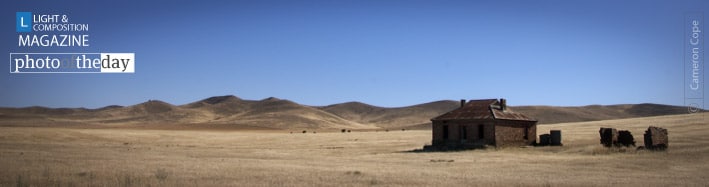
Exposure 1/125sec @ f/14 | ISO 100 | Focal Length 24mm
Cameron Cope
Hailing from Gippsland, Victoria, Cameron Cope is an Australian photographer dedicated to capturing images that inspire awe for the natural world and human experience. With a multidisciplinary academic background in history, geography, and the sciences, he brings a unique, analytical maturity to his work, specializing in environmental, historical, and adventure-based storytelling. His photography is informed by extensive global travels and a deep commitment to sustainability, allowing him to engage with diverse subject matter through a lens of both artistic curiosity and intellectual rigor.
Resonance Score Breakdown
Transparency Note: The resonance score (13.5/20) is calculated based on social engagement metrics collected before the award announcement.
Expert Photography Reviews · 4
The Salt of Stilled Time
The smell of dry earth after a long drought is a sharp, metallic sting in the back of the throat. It is the scent of things waiting to be reclaimed.
Read the reflection →The Architecture of Absence
In the quiet corners of a house, there is a particular kind of ghost that has nothing to do with spirits. It is the ghost of habit.
Read the reflection →Reviews & Comments
Share your thoughts about this award-winning photograph. Your reviews contribute to the community engagement score.
I’ll give this 5 out of 5 !
Thanks for taking this photo that I was in too much of a rush to take. Burra SA is a dry old place. The deep cellars where they tried to keep food and drink cool still have some “ghosts”. If you’re lucky enough to explore South Australia, get up to the desolate places as well as the winery’s.
You follow me on twitter. I was suspicious but actually thank you. These photos are beautiful. They are my words of Australia in pictures.
LA FOTO POR SI SOLA ES ESPLENDIDA BELLISIMA, PERO EL FONDO DE LA SITUACIÒN AMBIENTAL ES LO CAMBIA MI IDEA, ESTAMOS DESTRUYENDO TODO POR PRODUCIR, COSA QUE NO ES MALO SI SE HACE CON LOS CONCEPTOS ADECUADOS A LAS REGIONES PARA MANTENERLAS Y DESARROLLARLAS SIN DAÑAR EL AMBIENTE. SALUDOS
Most landscape work I see is just pretty wallpaper, but this hits differently. By pinning the crumbling stone against that relentless, flat horizon of wheat, Cope forces us to confront the erasure of a frontier. It’s the tension between the dying structure and the aggressive uniformity of the crops that makes me ache for what’s been lost. In thirty years, this won’t just be a photo; it’ll be a haunting record of a landscape we’ve fundamentally broken.
The light here isn’t the easy, golden-hour sort that flatters the lazy. It’s harsh, unforgiving, and exactly what one finds when they’ve spent hours waiting for the sun to strip away the pretense. I’ve shivered in similar scrub, and I can tell Cope didn’t just stumble upon this. He’s earned the grit in those wheat fields. It’s a bleak, honest piece of work. I’d have liked to see him wait for the wind to die, though.
Shadows here don’t merely cling to the stone; they consume the history of the settler. In the hollowed window frames, darkness isn’t an absence, but a heavy, thinking silence. I’ve stared at these Burra ruins until my own pulse slowed to match the decay. It’s a brutal, honest confrontation. The wheat fields offer no mercy, only a flat, blinding light that forces the architecture to hide in its own grief. It’s a haunting, necessary refusal of comfort.
The ochre of the parched earth, reminiscent of a weathered Morandi still life, bleeds into the pale, brittle gold of the wheat, creating a chromatic dissonance that aches in one’s chest. It’s a haunting, sun-bleached palette where the sky’s washed-out cerulean feels like a memory of rain. I’m truly undone by how the light clings to the crumbling stone, turning decay into a symphony of dust and shadow that feels utterly, devastatingly eternal.
very nice composition!