Knights by Phillip Biboso
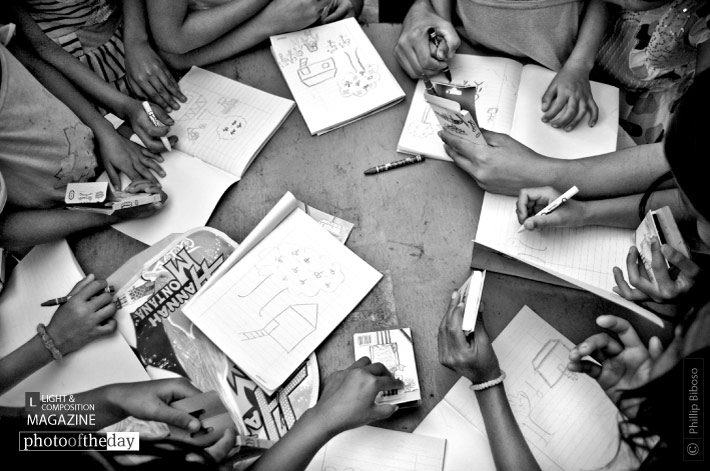
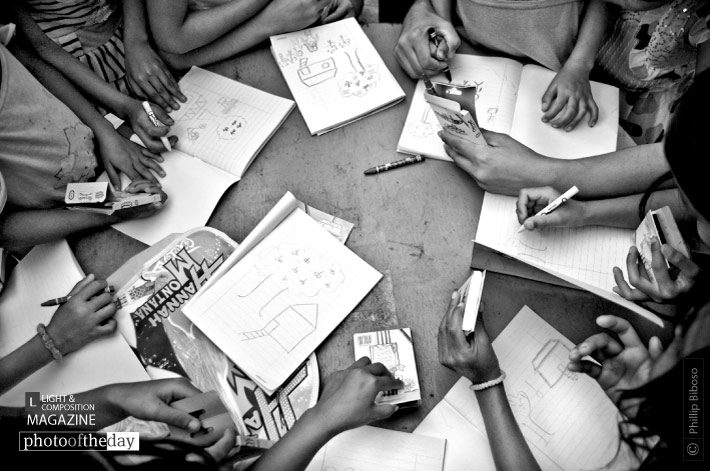
Captured from an overhead perspective, this poignant image documents a moment of pure joy as children engage with new school supplies provided by the Black Pencil Project. The photographer chose a high-angle vantage point to emphasize the children's focus and the tactile nature of their creative process as they draw in their new notebooks. This shot stands out for its raw, documentary honesty and the way it elevates a simple humanitarian gesture into a compelling visual narrative. It is a testament to the photographer’s ability to find profound beauty and human connection within the quiet, everyday moments of a community.
Phillip Biboso
Based in Koronadal City, Philippines, Phillip Gregory E. Biboso began his photographic journey in 2009. A self-taught artist who honed his skills through online tutorials and community forums, he maintains a versatile approach, capturing a wide array of subjects under the sun. He possesses a deep-seated passion for black-and-white photography and continues to refine his craft, consistently seeking to document the human experience with authenticity and dedication.
Resonance Score Breakdown
Transparency Note: The resonance score (5.1/20) is calculated based on social engagement metrics collected before the award announcement.
Expert Photography Reviews · 4
The Architecture of Beginnings
In the quiet corners of a house, there is often a drawer dedicated to the accumulation of potential. It holds the blunt pencils, the half-used erasers, and the notebooks with only a few pages marked by tentative, looping script.
Read the reflection →The Scent of Graphite
The smell of a freshly sharpened pencil is the smell of a promise. It is cedar shavings and sharp, metallic dust, a scent that clings to the fingertips long after the work is done.
Read the reflection →Reviews & Comments
Share your thoughts about this award-winning photograph. Your reviews contribute to the community engagement score.
High-angle perspectives often flatten the soul, yet here, the shadows pooling beneath these children’s heads act as anchors to the earth. They aren’t just drawing; they’re carving existence into paper. It’s a quiet, heavy gravity that moves me. I’ve spent years watching light chase subjects, but Biboso understands that true meaning hides in the dark corners of the notebooks. It’s not a simple gesture of charity; it’s a desperate, beautiful resistance against the void.
Most documentary work on humanitarian aid feels staged, but this overhead perspective avoids the usual sentimentality. By focusing on the frantic, tactile energy of hands against paper, Biboso captures a rare, unvarnished urgency. I’ve seen thousands of charity shots, yet this one lingers because it’s about the act of creation, not the donor. It’s a quiet, honest document of childhood focus. In thirty years, we’ll still recognize that specific, hungry joy of a fresh pencil.
The ochre dust of Lemblisong rises to meet the vibrant, primary-hued stationery, creating a chromatic tension that feels like a Morandi still life caught in a sudden, humid fever. It’s the way the sun-bleached earth anchors those saturated notebooks; I’ve found myself breathless, mesmerized by how the light clings to the children’s skin, turning their simple joy into a glowing, amber-toned sanctuary that doesn’t just document a moment, but breathes with the warmth of a Vermeer.
One suspects Biboso didn’t just stumble upon these children and fire off a frame. That high-angle perspective suggests he spent enough time in Lemblisong for the novelty of his presence to fade, allowing the subjects to actually lose themselves in their notebooks. It’s a rare, quiet intimacy. I’ve spent enough hours waiting for a landscape to wake up to know when someone has truly earned their seat at the table. It’s a decent bit of work.