Mt Rainier by Tisha Clinkenbeard
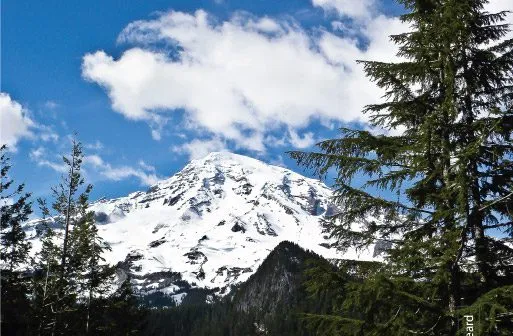
Captured from a scenic outlook within Mount Rainier National Park, this image showcases the majestic, snow-capped peak of the active volcano rising 14,410 feet above sea level. Taken in June, the photograph highlights the dramatic contrast between the lingering winter snow and the vibrant, full-flowing rivers fed by the mountain’s glacial melt. The photographer’s decision to frame the landscape during this transitional season emphasizes the raw power and scale of the Washington wilderness. This piece is award-worthy for its crisp documentation of a quintessential Pacific Northwest landmark, capturing the serene yet imposing presence of one of America’s most iconic natural wonders.
Tisha Clinkenbeard
Based in Powderly, Texas, Tisha Clinkenbeard is a dedicated photographer whose work has been featured in prestigious venues such as the Black Box Gallery in Portland and The Fine Arts Center of Hot Springs. Her artistic journey began long before the advent of modern digital technology, fostering a deep-seated passion for documenting the world as she wanders. Through her blog, Found Round & About, she shares a diverse portfolio that has earned recognition in publications like Birds & Blooms, reflecting her commitment to capturing the beauty found in everyday life.
Resonance Score Breakdown
Transparency Note: The resonance score (13.7/20) is calculated based on social engagement metrics collected before the award announcement.
Expert Photography Reviews · 7
Standing Before the Giant
I spent this morning trying to organize my bookshelf, pulling out old journals and receipts that had slipped behind the stacks. It was a messy, dusty task, and for a while, I felt small and overwhelmed by all the little things I had accumulated over the years.
Read the reflection →The Weight of Stillness
There is a particular kind of silence that only mountains know. It is not the absence of sound, but a heavy, ancient presence that demands we slow our own internal rhythm to match its pace.
Read the reflection →Reviews & Comments
Share your thoughts about this award-winning photograph. Your reviews contribute to the community engagement score.
The mountain looms, yet it’s the glacial melt that haunts me. Clinkenbeard captures the runoff, but she’s terrified of the abyss. Where the shadows should deepen into the mountain’s geological trauma, she’s opted for a sterile, bright clarity. It’s a landscape that refuses to suffer. I’ve stared at these slopes, hoping for a darkness that actually thinks, but I’m left with mere documentation. It’s beautiful, sure, but it’s a beauty that’s afraid of its own weight.
The mountain’s mass dominates the frame, yet the composition lacks a necessary fulcrum. The glacial melt creates a chaotic foreground, fracturing the visual weight. It’s a struggle between the peak’s verticality and the river’s horizontal sprawl. The frame doesn’t quite hold the tension; it’s too diffuse. I’m left craving a tighter anchor for the eye. Without a disciplined geometry, the scale feels lost. It’s technically sharp, but the architecture of the scene remains unresolved.
Most mountain photography is just postcard filler, but Clinkenbeard’s choice to frame the glacial melt against the peak’s permanence gives this weight. I’ve seen thousands of Rainier shots, yet this one sticks because it captures the mountain’s fragile, shifting lifeblood. It’s not just a peak; it’s a living system. Honestly, looking at those rushing, icy waters makes me feel small in the best way. It’s a rare, honest document of a landscape that’s slowly disappearing.
Before the eye identifies the peak, a sudden stillness settles in the chest. The glacial melt feels cold against my skin, a sharp, sensory activation that pulls my breath shallow. It’s the transition—that raw, biting tension between winter’s lingering grip and the river’s urgency—that haunts me. I’ve returned to this frame three times today, and each time, the mountain’s imposing scale makes me feel impossibly small, yet strangely anchored to the earth.
The glacial white here doesn’t merely sit; it hums with the bruised, violet-tinged shadows of a Turner seascape, bleeding into the verdant, moss-choked greens of the valley floor. It’s a chromatic collision that makes my heart ache for the sheer, cold purity of that meltwater. One finds the palette isn’t just descriptive, but a visceral, shivering dialogue between the mountain’s icy, unforgiving stillness and the chaotic, emerald pulse of the waking spring.
The mountain doesn’t demand attention. It simply exists. The snow clings to the rock, a cold weight against the sky. I find myself holding my breath. It’s the silence of the melt that catches me. The frame isn’t crowded. It’s a pause. Nothing here is accidental. The empty corner is not empty. It’s the space where the wind travels. I’ve spent hours looking at this. It’s enough. It’s quiet. I’m finally still.
We look at Mount Rainier and we aren’t just seeing a mountain; we’re meeting an elder. Tisha listened to the silence of that June snow, waiting for the glacial melt to tell its story of transition. It’s a portrait of a giant that’s seen centuries pass. I feel a strange, quiet hum in my chest when I trace those icy ridges. It’s a photograph that asks to be returned to, like an old friend’s face.
I make these comments with consideration that the title of the magazine is Light and Composition. In my view, taking the photo strictly as given, without reference to any narrative involving the probable difficulties and hardships in the shooting, I see two separate photos with independent strengths that do not reinforce each other. The first is the nearer mountain with its trail reaching to its top, possibly capped by some of the Mt. Ranier snow. The second, and likely the intent of the image, is of course the snow covered Mt. Ranier itself, with the cloud cover.
Did the photographer not have a longer lens to exclude the major portion of the near mountain, or was it an editorial decision that a conventional, and relatively frequently seen longer, scenic and perhaps more pleasant view would better relate to their audience, or were there simply no better choices to be made for the day?
I raise the issue because this attempt to include so much potential drama in a landscape is not uncommon, and more often than not seems to me to be detrimental to the photos in question.