Hispaniolan Green Anole by Claudio Bacinello
While documenting birdlife in a lush tropical environment, the photographer encountered this Hispaniolan Green Anole. Captivated by the vibrant monochromatic green-on-green palette, the photographer carefully positioned the subject against a lighter patch of vegetation to create a soft, complementary backdrop. Despite lacking a dedicated macro lens, the photographer utilized a 200mm focal length to capture the lizard's intricate details, relying on post-processing to refine the composition. This image is award-worthy for its masterful use of natural color harmony and the photographer's ability to adapt technical limitations into a striking, intimate wildlife portrait.
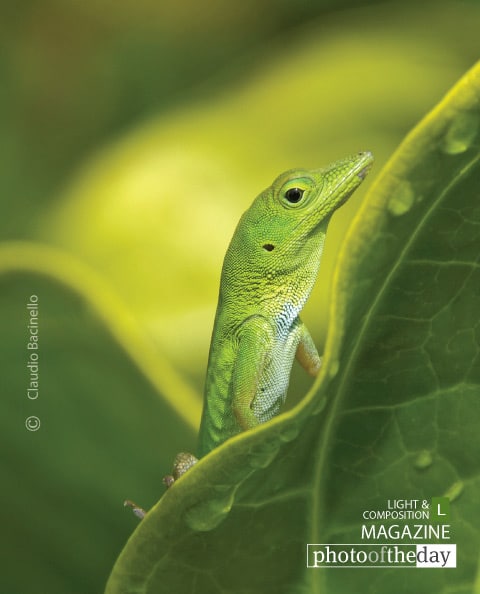
Exposure 1/160sec @ f/8 | ISO 100 | Focal Length 200mm
Claudio Bacinello
Born in Italy, Claudio now lives in Thornhill, Canada where he exercises his passion for photography. Over a career spanning three decades Claudio has delved into a number of photographic disciplines including: weddings, portraits, product, corporate and stock. His current focus is on travel, wildlife, nature and adding to his extensive stock library. He continues to travel the world in search of subjects and stories with a particular affection for Africa and South America. His work has been published globally and, in addition, is available as fine art images for private and corporate décor. Camera Gear: Nikon D4, Nikon D850, and Nikon D500 Lenses: Nikon 8-15mm f/3.5-4.5 Fisheye, Nikon 14mm f/2.8, Nikon 17-35mm f/2.8, Nikon 24-70mm f/2.8, Nikon 28mm f/1.8, Nikon 28-300mm f/3.5-5.6, Nikon 50mm f/1.8, Nikon 70-200mm f/2.8, Nikon 105mm f/2.8
Resonance Score Breakdown
Transparency Note: The resonance score (11.8/20) is calculated based on social engagement metrics collected before the award announcement.
Expert Photography Reviews · 5
Hidden in Plain Sight
I spent twenty minutes this morning looking for my keys, only to find them sitting right on the kitchen counter where I had placed them the night before. I had looked at that spot a dozen times, but my eyes just slid right over them.
Read the reflection →The Pulse of Emerald
There is a specific humidity that clings to the skin in the deep woods, a thick, damp velvet that feels like breathing through wet moss. It is the smell of decay and sudden, sharp growth—the scent of earth that has never known the bite of a frost.
Read the reflection →Reviews & Comments
Share your thoughts about this award-winning photograph. Your reviews contribute to the community engagement score.
It’s a decent enough capture, though one wonders if the lizard was merely a convenient distraction from the birds. Using a travel zoom for macro work is a chore I’ve endured myself; it’s a fiddly, frustrating business that rarely yields such crisp focus. I’ll admit, the way he’s coaxed that creature against the light is rather clever. He didn’t just stumble upon this; he clearly sat still long enough to stop being a threat.
The humidity hangs heavy here. Claudio didn’t chase this creature; he waited until the forest allowed him to see it. That vibrant, monochromatic green feels like a prayer whispered in the undergrowth. I’ve spent hours in such stillness, and I can almost feel the damp heat against his skin. It’s a quiet, intimate communion. When I look at those scales, I don’t see a specimen. I see a soul that finally decided to be known.
Most wildlife shots are just trophies, but this one lingers. I’ve seen thousands of macro attempts, yet Bacinello’s choice to use a 200mm lens creates a compression that makes the lizard feel like it’s emerging from the very soul of the forest. It’s the monochromatic tension that gets me; I actually caught myself holding my breath to see if the creature would blink. It’s a quiet, enduring study of camouflage that won’t fade in thirty years.
Before the eye identifies the lizard, something quiets in the chest. The monochromatic saturation acts as a sedative, pulling the pulse into the rhythm of the jungle. I’ve found that returning to this green, my own breath hitches, mimicking the stillness of the anole’s unblinking gaze. It’s a strange, quiet intimacy. When I look away, the world feels too loud, too sharp. It’s the kind of image that lingers, cooling the mind long after I’ve left.
Green is a cage here. Bacinello’s anole sits suspended in a monochromatic trap, where the light doesn’t reveal, it merely suffocates. I’ve spent hours staring at these scales, feeling the cold, reptilian indifference they project. It’s a claustrophobic beauty, isn’t it? The shadows don’t offer refuge; they tighten the frame until the creature’s gaze becomes an accusation. It’s not a portrait of nature, but a study of how light can be used to hold life hostage.