A Newfound Village by Shikchit Khanal
While traveling back from the remote Spiti Valley in India, the photographer stumbled upon the hidden village of Reckong Peo. Pausing to gather apples from local trees, the photographer was struck by the sudden, breathtaking vista of the mountain settlement nestled against the landscape. The image captures a quiet, contemplative moment of discovery, emphasizing the village's isolation and the grandeur of its surroundings. This photograph is award-worthy for its ability to transform an unplanned roadside stop into a compelling visual narrative, showcasing the photographer's keen eye for finding beauty in the unexpected corners of the world.
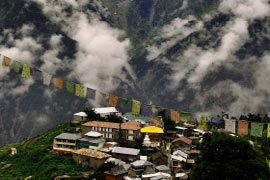
Exposure 1/125sec @ f/13 | ISO 200 | Focal Length 30mm
Shikchit Khanal
Born in Kathmandu, Nepal, Shikchit Khanal has long been driven by a desire to document the world through a unique, personal lens. After acquiring his first camera in 2010, he transitioned from capturing mental images to professional photography, spending years traveling extensively across India and Nepal. His work is defined by a deep appreciation for the beauty found in everyday life and a commitment to sharing his distinct vision with an international audience. Currently based in Kathmandu, he continues to pursue his passion for storytelling through his evocative landscape and travel photography.
Resonance Score Breakdown
Transparency Note: The resonance score (10.2/20) is calculated based on social engagement metrics collected before the award announcement.
Expert Photography Reviews · 5
The Quiet Between Peaks
I took a wrong turn while driving to the grocery store this morning. Usually, I would have been annoyed, checking my watch and cursing the GPS for its lack of clarity. But the road wound up a hill I had never climbed before, and suddenly, the noise of the city just dropped away.
Read the reflection →The Quietude of Distance
Seneca once remarked that travel cannot make us better if we carry our own restless minds with us, yet he also acknowledged that a change of scenery can act as a mirror to the soul.
Read the reflection →Reviews & Comments
Share your thoughts about this award-winning photograph. Your reviews contribute to the community engagement score.
Most travel photography is just visual clutter, but here, the scale is honest. By anchoring the village against the crushing weight of the peaks, Khanal forces us to confront human fragility. I’ve seen thousands of mountain shots, yet this one lingers because it doesn’t try to be epic; it’s quiet. It makes me feel small, and I’m grateful for that. It’ll endure because it captures a fleeting, humble isolation that the modern world is rapidly erasing.
The mountain massing creates a rigid, triangular geometry that anchors the frame. It’s a brutalist approach to landscape. The village sits precariously at the fulcrum, held by the weight of the surrounding peaks. I’ve rarely seen such stark spatial tension. It doesn’t rely on sentiment; it demands structural submission. The negative space above the ridge is perfectly calibrated. It’s cold, precise, and frankly, it’s the only thing in this gallery that doesn’t bore me.
The ochre dust of Reckong Peo doesn’t merely sit upon the earth; it sings with the parched, sun-bleached intensity of a Morandi still life, vibrating against the bruised, cerulean shadows that cling to the mountain’s jagged spine. It’s a chromatic ache, really, that sudden, breathless collision of arid earth tones and the thin, glacial air. I’ve found myself quite undone by the way the light bruises the valley, turning isolation into a profound, painterly silence.
1/125sec at f/13, ISO 200, 30mm. Stopping down to f/13 on a D90 sensor invites diffraction, yet it’s the only way to hold the Spiti foreground and the distant peaks in focus. It’s a calculated risk that pays off. I’ve spent years looking at soft landscapes; seeing this level of sharpness across the frame is a relief. The exposure is clinical, precise, and entirely correct. It’s a rare instance where the gear didn’t get in the way.
Reckong Peo isn’t a discovery; it’s a home. Khanal’s frame treats this settlement like a scenic backdrop for a traveler’s apple-picking detour. Why does the photographer’s convenience dictate the scale of this village? It feels extractive, turning a living community into a quiet, aesthetic trophy. I’m honestly bothered by how the lens flattens their isolation into a mere travel narrative. Who gave the photographer permission to frame their existence as a hidden, unexpected find?