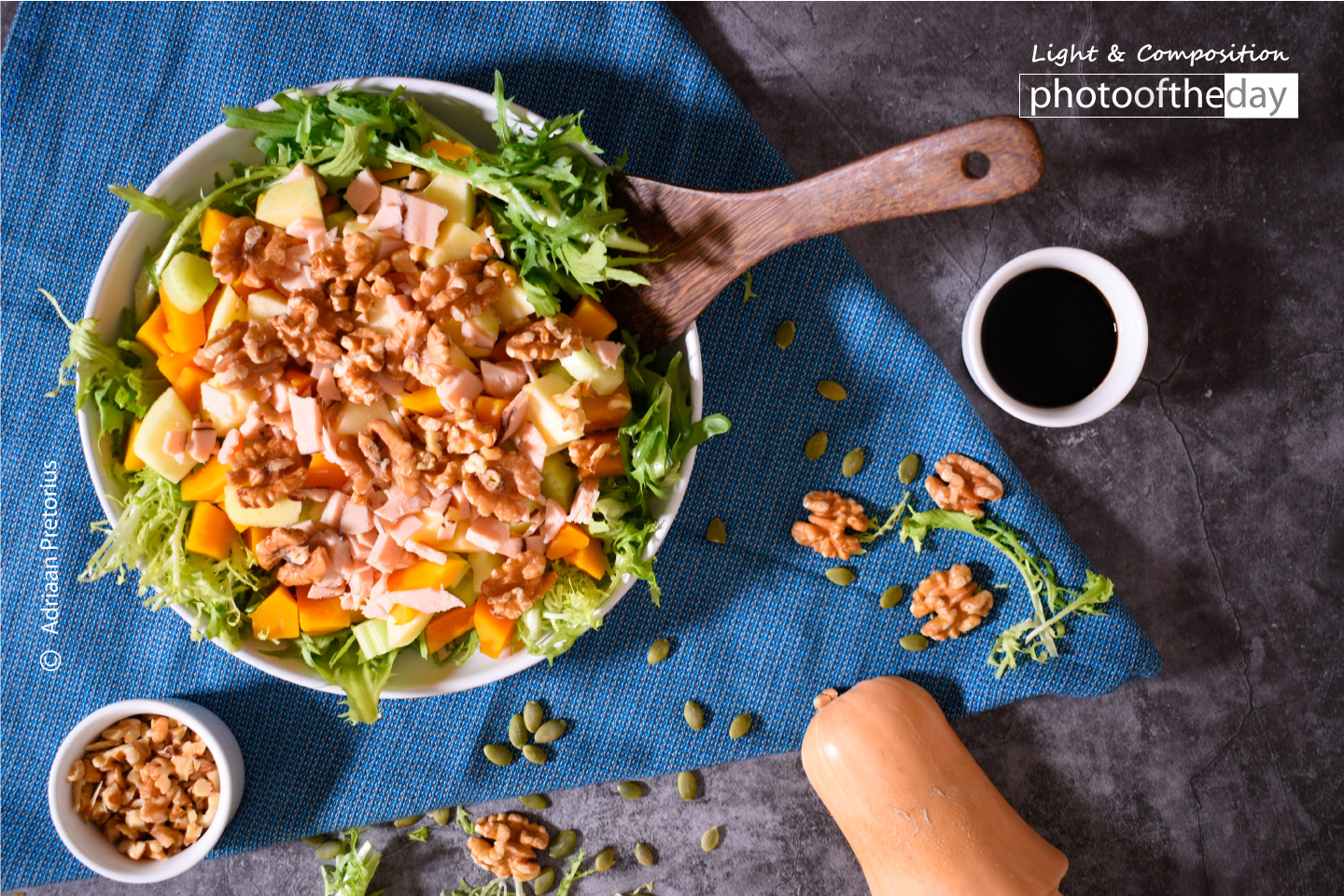
Try Something New Salad by Adriaan Pretorius
In a moment of culinary inspiration, the photographer captured this vibrant salad prepared by a visiting friend. Struck by the striking contrast of colors before the meal was served, the photographer seized the opportunity to document the dish. This image stands out for its keen eye for composition and the ability to transform a simple domestic interaction into a compelling visual narrative. By elevating a casual evening meal into a work of art, the photograph demonstrates a sophisticated appreciation for the aesthetic potential found in everyday life, earning its place as a celebrated example of food photography.
Adriaan Pretorius
Born in South Africa and currently based in Kuwait, Adriaan Pretorius views food as a powerful medium for connecting people from diverse backgrounds. His photographic practice is deeply informed by his extensive global travels, where he frequently explores local street markets to immerse himself in authentic culinary traditions. Through his lens, Pretorius captures the essence of food culture, transforming simple ingredients and shared meals into evocative stories that celebrate the universal language of gastronomy.
Resonance Score Breakdown
Transparency Note: The resonance score (10.3/20) is calculated based on social engagement metrics collected before the award announcement.
Expert Photography Reviews · 8
The Virtue of the Present
Seneca once reminded his friend that we are often more concerned with the preparation for life than with life itself.
Read the reflection →The Weight of the Table
We eat to survive, yet we often forget the ritual of the plate. There is a quiet gravity in the act of preparing a meal, a small defiance against the entropy of the day.
Read the reflection →Reviews & Comments
Share your thoughts about this award-winning photograph. Your reviews contribute to the community engagement score.
The light hits those greens and reds with the sharp, sudden clarity of a jump cut. It’s a domestic scene, but the framing feels like a high-budget close-up. I’m genuinely hungry just looking at the texture of those leaves. It’s a perfectly held beat in a quiet evening. The shutter caught the exact second before the first bite ruined the composition. It’s the frame the editor keeps because the rhythm is already perfect.
f/2.8 at 50mm, 1/125s, ISO 400. A shallow plane of focus on a salad. It’s a standard choice, yet it isolates the textures effectively. The shutter speed is safe, though the ISO introduces unnecessary noise in the shadows. I’ve seen this setup a thousand times, but the color separation here actually works. It’s technically competent, even if it’s a bit safe. I’m tired of seeing f/2.8 used as a crutch, but here, it’s the right tool.
Before the eye identifies the greens and radishes, a sudden, sharp hunger activates. It’s a visceral, sensory pull that bypasses the intellect entirely. I’ve found myself returning to this bowl, and it doesn’t just represent a meal; it’s the quiet intimacy of a shared evening. The vibrant colors trigger a pulse of warmth in my chest. It’s rare to feel so comforted by a salad, but this one lingers, haunting my peripheral vision like a memory.
We look at these vibrant greens and pomegranate seeds and we aren’t just seeing a meal; we’re seeing a friendship. Adriaan listened to the quiet rhythm of a kitchen in Kuwait, catching the warmth of a guest’s hands in the arrangement of the leaves. It’s a portrait of hospitality, really. I find myself hungry not for the salad, but for the conversation that surely followed. It’s a photograph that asks to be returned to.
Most food photography is just glossy marketing, but this works because it’s honest. I’ve seen thousands of styled plates, yet this one captures the messy, vibrant reality of a shared kitchen. The way the light hits those greens makes me crave the meal itself—a rare, visceral reaction. It’s not just a salad; it’s a memory of a Tuesday night. That’s why it’ll still matter in thirty years. It’s human, unpretentious, and perfectly framed.
The salad is static, but the composition lacks the kinetic tension I look for. It’s a pretty arrangement, sure, but it’s missing the decisive millisecond of assembly. I’m waiting for the toss, the moment the greens hit the apex of the bowl before gravity takes over. It’s too posed, too settled. I’ve spent my life chasing the exact frame where effort peaks, and this just doesn’t have that pulse. It’s technically clean, but it’s quiet.
The bowl acts as a datum, grounding the vibrant chaos of the salad against the static, neutral plane of the table. It’s a study in solid and void, where the ingredients’ texture disrupts the surface’s rigid geometry. I’m struck by how the light catches the greens, mimicking the way sun hits a facade to define mass. It’s a domestic threshold, really. I find myself wanting to pull up a chair and inhabit this fleeting, edible architecture.
The bowl’s circular perimeter anchors the frame, creating a perfect focal point against the rectangular table’s rigid edges. I’m fascinated by how the vibrant greens and reds distribute weight, balancing the negative space of the dark surface. It’s a precise 1:1 ratio of organic chaos to geometric order. That tension between the bowl’s curve and the table’s linear vectors is brilliant. Honestly, it’s the most satisfying spatial equation I’ve seen in food photography all year.