Journey Towards Nafakhum by Riasat Rakin
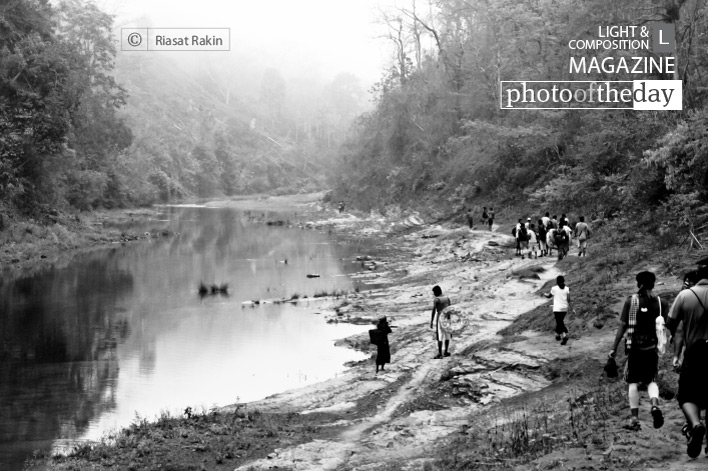
The photograph captures the ethereal, foggy atmosphere of a morning journey toward the Nafakhum falls in the Remakri region of Bandarban. By focusing on the mist-laden stream as it flows toward Remakirkhum, the photographer successfully translates the mystic, untamed beauty of the Bangladeshi hill tracts into a compelling visual narrative. The image is award-worthy for its evocative use of light and mood, which transforms a rugged landscape into a serene, dreamlike experience, inviting the viewer to feel the quiet stillness of this remote and adventurous destination.
Riasat Rakin
Based in Dhaka, Bangladesh, Riasat Rakin began his photographic journey in 2010, developing a deep passion for documenting landscapes and the human experience. His work is driven by a profound appreciation for the natural beauty of his homeland and the diverse, versatile lifestyles of its people. Through his lens, Rakin seeks to capture the fleeting, authentic moments of daily life, consistently finding inspiration in the evolving scenery and cultural richness of the Bangladeshi landscape.
Resonance Score Breakdown
Transparency Note: The resonance score (14.9/20) is calculated based on social engagement metrics collected before the award announcement.
Expert Photography Reviews · 7
The Weight of Unseen Paths
In the nineteenth century, explorers often spoke of the 'white space' on a map—those regions where the ink simply stopped, leaving the cartographer’s imagination to fill the void with sea monsters or silent, impenetrable forests.
Read the reflection →The Quiet Before the Path
I woke up early this morning, long before the sun had any intention of showing itself. The house was completely silent, and for a few minutes, I just sat in the kitchen with my tea, watching the steam rise and vanish into the cool air.
Read the reflection →Reviews & Comments

Share your thoughts about this award-winning photograph. Your reviews contribute to the community engagement score.
Mist swallows the river. It’s a heavy, grey breath. I find myself holding my own, waiting for the water to reveal its path. Rakin doesn’t force the frame. He lets the fog dictate the boundaries. The emptiness isn’t a void; it’s a presence. It’s quiet. I’ve stood in places like this, where the world just stops. Nothing here is accidental. The empty corner is not empty. It’s the sound of a journey ending in silence.
Most landscapes in this category rely on dramatic peaks, but Rakin’s work succeeds because it’s quiet. The mist doesn’t just obscure the background; it forces the eye to track the water’s jagged path through the rocks. I’ve seen thousands of travel shots, yet this one makes me want to shiver in that damp air. It’s the restraint that ensures its legacy. Thirty years from now, we won’t remember the gear, but we’ll still feel this stillness.
Getting to Remakri isn’t a Sunday stroll, and one suspects Rakin didn’t arrive just as the mist decided to lift. It’s a damp, shivering sort of frame that makes my own joints ache in sympathy. He’s clearly spent the time waiting for that specific, muted light to settle over the water. It’s a quiet, earned piece of work. I’d have preferred a bit more bite in the shadows, but honestly, it’s a decent day’s graft.
The mist here doesn’t just hang; it breathes. Riasat stood in the damp, cooling air of a Bandarbans morning, waiting for the river to surrender its secrets. I feel a shiver looking at those jagged rocks emerging from the fog—it’s as if the land itself is waking up. He didn’t rush the shutter. He listened to the silence of the water, capturing a moment where the world feels entirely, beautifully untethered from time. It’s haunting.
Fog isn’t merely weather here; it’s an ontological veil. Rakin’s stream doesn’t flow toward a waterfall, but into a void where light surrenders its authority. I’ve stared at these grey, suffocating depths until my own pulse slowed to match the current. It’s unsettling, really. Most photographers fear this erasure, yet here, the darkness doesn’t hide the landscape—it defines its silence. When the world dissolves into such heavy, monochromatic uncertainty, we finally stop looking and start thinking.
At f/5.6, the 55mm focal plane barely resolves the mist’s micro-contrast, yet it’s precisely this diffraction limit that softens the Remakri stream into a dream. The sensor’s noise at ISO 800 mimics the grain of the fog, blurring the line between digital artifact and atmosphere. I’m genuinely moved by how the light scatters across those rocks; it’s a fragile, ephemeral physics. It doesn’t just capture a landscape; it captures the very way our eyes fail to hold the morning.
Stripped of pigment, the monochromatic palette here evokes the silver-grey silence of a Morandi still life, where the mist isn’t merely atmospheric but a tactile veil of charcoal and pearl. It’s haunting how the absence of colour forces one to feel the damp, biting chill of the Remakri air against the skin. I’m utterly breathless, for in these shifting, liquid greys, the light doesn’t just fall; it breathes, turning a rugged journey into a dream.