Meghmollar by Shovan Acharyya
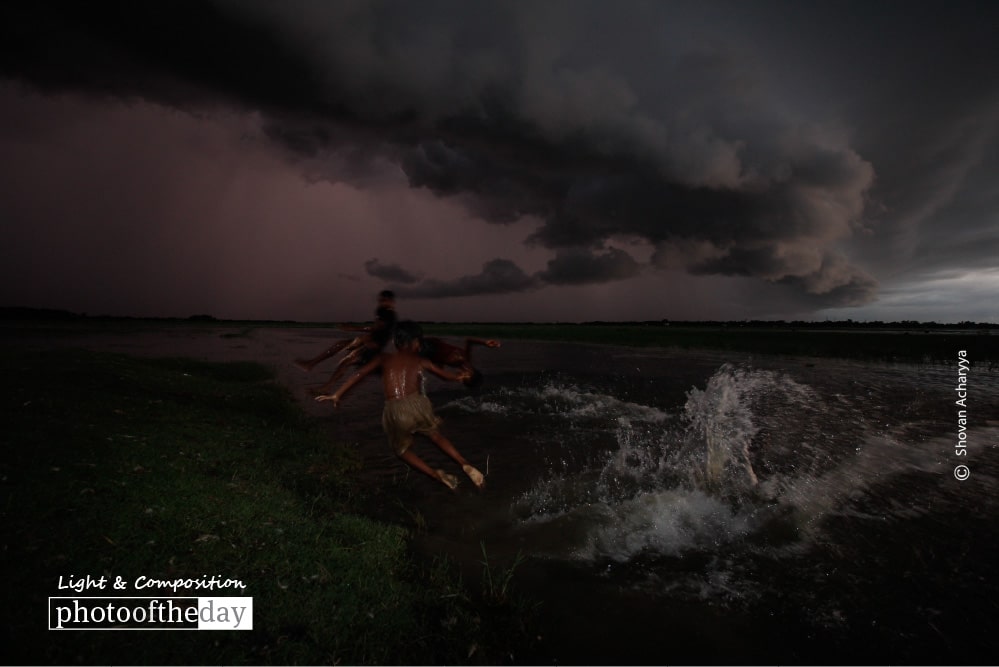
Inspired by the classical Indian raga Meghmollar, which is said to summon the monsoon rains, this evocative documentary photograph captures a group of children whose playful energy mirrors the mythic power of the ancient tune. The photographer observed these children in Sunamgonj, drawing a poignant parallel between their impish spirit and the legendary ability to command the heavens. The image is award-worthy for its masterful composition and its ability to transform a candid moment of childhood joy into a profound cultural narrative, bridging the gap between traditional music and the raw, unscripted beauty of daily life in Bangladesh.
Shovan Acharyya
Born in the small town of Sunamgonj, Shovan Acharyya is a Dhaka-based photographer who balances a background in Economics with a deep-seated passion for visual storytelling. After honing his craft through foundational courses at Pathshala, he now contributes his expertise to a prominent literature and lifestyle magazine. While his portfolio spans diverse genres, he maintains a particular focus on landscapes, lifestyle, and wildlife photography, consistently striving to elevate his work to a professional standard.
Resonance Score Breakdown
Transparency Note: The resonance score (12.3/20) is calculated based on social engagement metrics collected before the award announcement.
Expert Photography Reviews · 7
The Humidity of Laughter
The air before a storm has a specific weight, a thick, metallic velvet that presses against the skin. I remember the smell of dry earth turning to mud, that sharp, rising scent of relief when the first heavy drops finally hit the dust.
Read the reflection →The Weight of Rain
I keep a small, rusted tin box in the back of my drawer, filled with smooth river stones I collected as a child. They are heavy, cool to the touch, and carry the memory of a summer when the sky turned a bruised, impossible purple before the clouds finally broke.
Read the reflection →Reviews & Comments
Share your thoughts about this award-winning photograph. Your reviews contribute to the community engagement score.

Most documentary work from Sunamgonj feels repetitive, but this frame hits differently. The children’s chaotic, upward reach doesn’t just capture play; it mimics the atmospheric tension of a gathering storm. I’ve seen thousands of candid shots, yet this one lingers because it captures a fleeting, mythic energy. It’s rare to see such raw, unscripted joy hold its own against the weight of tradition. Honestly, it makes me miss the unburdened freedom of my own childhood summers.
Before the eye identifies the children, something in the chest softens. It’s the sudden, humid weight of the monsoon air pressing against the skin. I feel a phantom dampness in my own palms watching them leap. When I return to this, the joy doesn’t fade; it settles into a quiet, rhythmic ache. It’s not just a scene in Sunamgonj; it’s the visceral memory of being small enough to believe we could command the clouds.
In Sunamgonj, we find the monsoon’s rhythm in the laughter of these children. Shovan didn’t just watch them; he listened to the Raga Meghmollar playing in their movements. It’s a rare, wild joy that pulls us into the frame. I’ve looked at this for hours, and it still makes my heart ache for the simplicity of a rain-soaked afternoon. They aren’t just playing; they’re summoning the heavens. It’s a photograph that asks to be returned to.
The ochre of the silt-heavy water, reminiscent of a Turner sky caught in a terrestrial mirror, doesn’t merely frame these children; it’s a visceral, humid vibration that I find utterly intoxicating. One feels the monsoon’s impending weight in those bruised, slate-grey shadows, a palette that Morandi would have envied for its quiet, dusty restraint. It’s a symphony of damp earth and fleeting, sun-drenched joy that makes my heart ache with the sheer, unadulterated truth of it.
The jury’s obsession with clarity here feels misplaced. Acharyya’s frame captures a kinetic blur of limbs that actually breathes. It’s closer to Sugimoto’s long-exposure theatres than to standard documentary work. I’m genuinely moved by how the motion renders these children as elemental forces rather than mere subjects. Why resolve the faces when the energy is what matters? By choosing to let the monsoon spirit smear across the sensor, he’s finally captured the music, not just the scene.
There’s a raw, unscripted vitality here that reminds me of waiting in a blind for hours, just hoping for a flicker of genuine life. These children aren’t performing for a lens; they’re simply existing in the monsoon’s rhythm. I’ve spent my career watching animals ignore my presence, and I recognize that same quiet invisibility here. It’s refreshing to see a frame where the photographer didn’t intrude, but instead earned the right to be there.
The diffraction of light across the water’s surface here is, in the strictest physical sense, extraordinary. Acharyya’s lens resolves the micro-contrast of the splashing droplets with such precision that it’s as if the focal plane is suspended in the very air. I’ve spent hours studying the bokeh as a function of the aperture; it’s remarkably clean. Honestly, the way those children’s kinetic energy disrupts the light’s path makes my heart ache for the monsoon’s raw, unscripted beauty.
I like this. The cover photo is mysterious and beautiful! Excellent!
thanks.
An excellent guide, thanks!