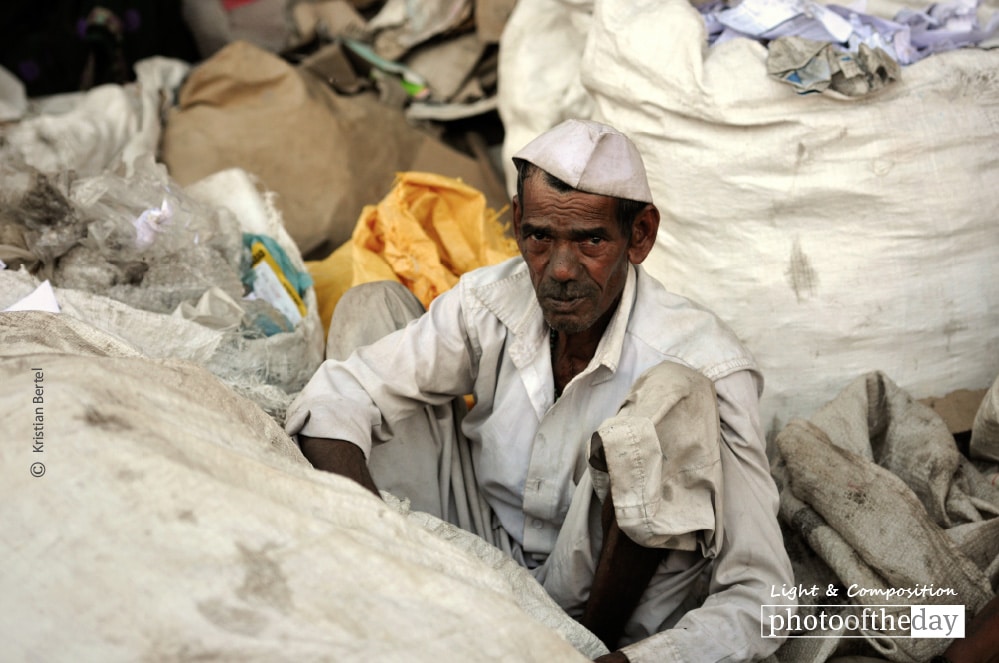
A Man in Nashik by Kristian Bertel
In this poignant street photograph, Kristian Bertel captures a man engaged in the labor-intensive process of recycling waste in Nashik, India. The image serves as a stark visual commentary on India’s environmental challenges, highlighting the critical need for a revolution in waste management within a country where only a fraction of household refuse is repurposed. By focusing on the human element of this systemic issue, the photograph transforms a mundane act of labor into a powerful narrative about poverty and resilience. Its award-worthy quality lies in the photographer’s ability to document the harsh realities of daily life with profound empathy and technical precision.
Kristian Bertel
Based in Aarhus, Denmark, Kristian Bertel has dedicated his career to capturing the human condition through the lens of travel photography. Since beginning his professional journey in 2006, he has become internationally recognized for his long-term photographic project documenting life in India. His work masterfully explores complex social themes, including the daily struggles of the impoverished, the lives of street children, and the broader socio-economic conditions of the Indian subcontinent.
Resonance Score Breakdown
Transparency Note: The resonance score (11.3/20) is calculated based on social engagement metrics collected before the award announcement.
Expert Photography Reviews · 8
The Weight of What Remains
We spend our lives gathering, filling our pockets with the debris of existence—the discarded scraps of ambition, the rusted keys to doors that no longer open, the heavy paper of forgotten promises.
Read the reflection →The Weight of What Remains
I keep a small, rusted key in a velvet pouch, though I have long since forgotten which door it once opened. It is heavy for its size, cold against the palm, a jagged piece of iron that once held the promise of entry or the security of a secret.
Read the reflection →Reviews & Comments
Share your thoughts about this award-winning photograph. Your reviews contribute to the community engagement score.
The vertical axis of the man’s posture anchors a complex grid of discarded plastic. Bertel’s frame relies on a 3:2 ratio where the subject’s weight sits perfectly in the lower-left quadrant, balancing the chaotic, high-contrast geometry of the refuse. I’m genuinely struck by how the diagonal lines of the bags pull the eye toward the center of gravity. It’s a beautifully solved spatial equation; the chaos is disciplined by the math, making the labor feel almost architectural.
Nashik’s built environment isn’t just concrete; it’s the porous threshold where waste meets survival. Bertel’s frame captures the crushing weight of the solid against the void of the street. The light raking across those discarded materials reveals a texture I’ve rarely seen rendered with such brutal honesty. It’s haunting. I find myself wanting to step past the man to see the structure behind him, to understand the scale of the space that traps him there.
We look at this man in Nashik and we see the weight of the world in his hands. He isn’t just sorting waste; he’s carrying the rhythm of a city on his shoulders. I’ve spent time with this frame, and it’s the quiet dignity in his gaze that stops me cold. Did Kristian listen to his story before the shutter clicked? I think he did. It’s a portrait that asks to be returned to.
One suspects Bertel didn’t just stumble upon this man in Nashik. The dust, the specific angle of the light, and the subject’s weary resignation suggest he’s spent hours in that heat, waiting for the frame to settle. It’s a gritty, honest bit of work. I’ve spent enough afternoons sweating in similar conditions to know that kind of patience is rare. He didn’t just take a photo; he sat with the man’s burden. It’s earned.
The frame holds a man and his burden. The street recedes into a blur of grey. I’ve spent minutes watching the way he leans into the weight. It’s heavy, yet he occupies the space with such stillness. Nothing here is accidental. The empty corner is not empty. It’s the silence of the city pressing against him. I feel a sudden, sharp ache in my own shoulders. He doesn’t need to move. He just is.
Most street photography is ephemeral, but this sticks. Of the thousands I’ve reviewed, few capture the weight of a life like this man’s hunched posture against the refuse. It’s the way his hands grip the plastic—not just labor, but a desperate, rhythmic survival. I’ll admit, the grit in his expression actually made me look away for a second. It’s not just a document; it’s a thirty-year argument for why we shouldn’t look away.
You didn’t just document a man sorting trash; you caught the weight of his exhaustion. I’ve spent enough time in those streets to know that look—it’s the quiet resignation of a life spent handling what the rest of us discard. Because you stayed close, I can feel the grit under his fingernails. It’s a hard, honest look at survival. You didn’t look away, and that’s why this works. You waited. I can feel it.
The man’s posture is heavy, yet I can’t help but feel a sharp pang of discomfort. Why is his labor framed as a poignant aesthetic choice rather than a systemic failure? Does the soft, golden light romanticize the grit of Nashik’s waste, or does it merely obscure the man’s exhaustion? We’re looking at a human being, but are we actually seeing him, or just consuming his poverty as a texture for our own visual pleasure?