Ngong Khiew Kids by Ryszard Wierzbicki
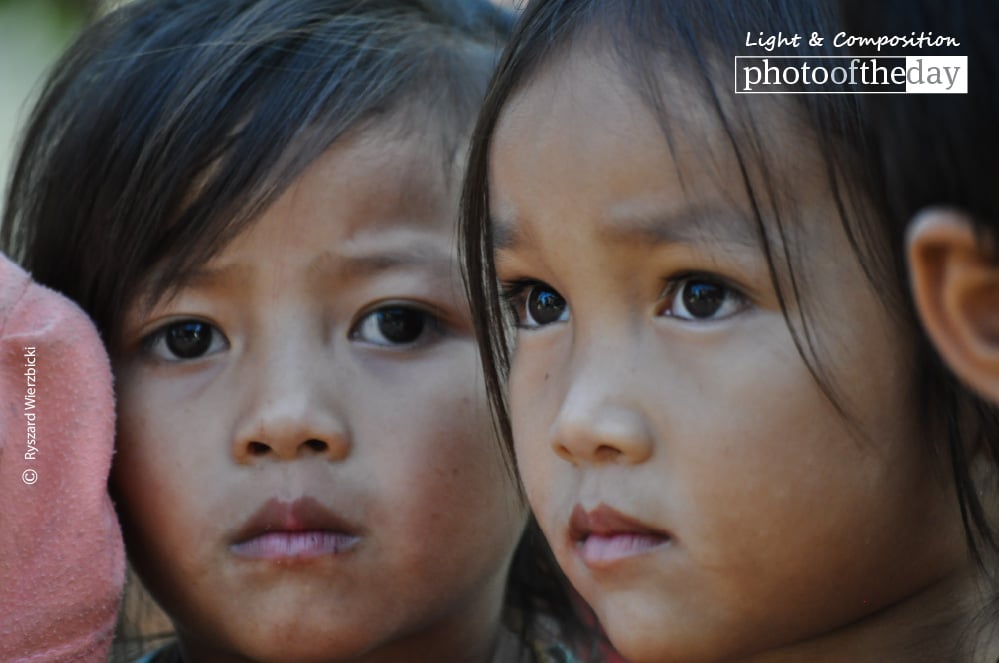
Captured during a boat journey to a remote village near Ngong Khiew in North Laos, this candid portrait highlights a moment of genuine human connection. The photographer, having arrived in a region rarely visited by travelers, engaged with the local children by sharing sweets, which allowed him to capture their natural curiosity and unposed expressions. The image is award-worthy for its authentic portrayal of childhood in an isolated community, demonstrating the photographer's ability to build rapport and document a fleeting, intimate interaction with grace and technical precision.
Ryszard Wierzbicki
Born in 1963, Ryszard Wierzbicki is a Polish-born photographer and educator currently based in Swindon, United Kingdom. After a diverse professional career in social sciences and marketing, he transitioned into a life of exploration, focusing his lens on the cultures and landscapes of South-East Asia. His work is deeply informed by his background in child care and his commitment to humanitarian efforts, frequently documenting the lives of those in remote communities with a compassionate and observant eye.
Resonance Score Breakdown
Transparency Note: The resonance score (12.2/20) is calculated based on social engagement metrics collected before the award announcement.
Expert Photography Reviews · 8
The Architecture of Curiosity
In the quiet corners of the world, where the map thins out and the roads turn to dust, there exists a particular kind of silence. It is not the absence of sound, but the presence of expectation.
Read the reflection →The Weight of a Glance
There is a language that precedes speech. It is found in the way a child holds their breath when a stranger appears, or the way eyes widen before the mind has decided whether to trust or to flee.
Read the reflection →Reviews & Comments
Share your thoughts about this award-winning photograph. Your reviews contribute to the community engagement score.
Buying access with sweets feels transactional, not candid. When Wierzbicki hands out candy to secure these expressions, does he capture their curiosity or merely their hunger for sugar? I find the power imbalance here deeply uncomfortable. Why must we exoticize isolated children to feel connected? The composition is technically sharp, but the gaze feels extractive. Are we looking at these kids, or are we just consuming their poverty? It’s a polished frame built on a hollow interaction.
The ochre dust of the Laotian riverbank clings to these children like a Morandi still life, muted and melancholic, yet it’s the sudden, piercing cerulean of a plastic wrapper that truly breaks my heart. It’s a jarring, synthetic intrusion against the earthy, sun-baked skin tones, creating a chromatic tension that feels almost violent in its beauty. One finds oneself breathless, caught in the quiet, dusty heat of a world that’s fading before our eyes.
Before the eye identifies the children, something in the chest softens. It’s the sudden, quiet activation of a memory I’ve long buried—the weightless curiosity of being small. Wierzbicki’s frame doesn’t just capture Laos; it triggers a physiological return to innocence. When I look at their faces, my own breath hitches. A year later, I still feel that fleeting, sugar-sweet connection. It’s a rare, haunting stillness that follows me into sleep, long after the gallery lights dim.
Getting to Ngong Khiew isn’t a weekend excursion; it’s a commitment to mud and uncertainty. One suspects Wierzbicki didn’t just stumble upon these children. He’s clearly put in the hours to earn their trust, which is far more difficult than fiddling with a shutter speed. It’s a quiet, honest frame. I’ve spent enough damp mornings waiting for a subject to forget I’m there to recognize the patience required here. It’s a decent bit of work.
We look at these faces in Ngong Khiew and we see the echo of a shared secret. Before the shutter clicked, there was a gift of sweets, a bridge built between stranger and child. It’s not just a candid shot; it’s a conversation captured in the quiet of a Laotian morning. I find myself smiling back at them, feeling the warmth of that fleeting, honest connection. It’s a photograph that asks to be returned to.
Most candid portraits of children in remote villages feel exploitative, but Wierzbicki avoids that trap. By using a 175mm focal length, he maintains a respectful distance that preserves the kids’ natural curiosity rather than forcing a performance. I’ve seen thousands of travel shots, yet the genuine, unposed hesitation in their eyes here makes me smile. It’s a rare, quiet document of a vanishing way of life that will still matter thirty years from now. It’s earned.
The timber structure’s rough-hewn datum provides a grounding rhythm, yet it’s the children’s faces that define the space. Wierzbicki captures how the harsh, directional light bleeds through the gaps in the wall, turning the void into a stage. I’m struck by the intimacy here; it’s not just a portrait, but a record of a threshold being crossed. The architecture doesn’t just house them—it frames their curiosity, making the village feel profoundly, beautifully alive.
Technical precision is such a bore. Wierzbicki’s shot of these children feels trapped by its own sharpness, clinging to a clinical clarity that misses the kinetic energy of the encounter. I’d have traded that 1/250th shutter speed for a smear of motion, something to capture the frantic, sweet-fueled chaos of the moment. Why resolve every pore when you could resolve the feeling? It’s technically competent, sure, but it lacks the courage to truly blur the lines.