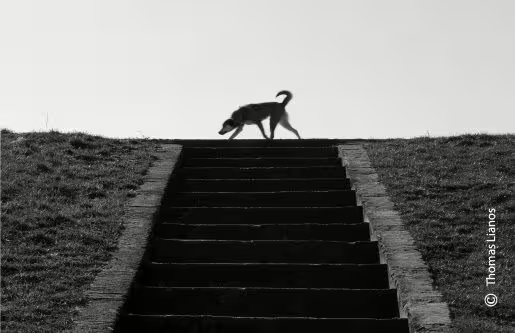
Dog on Top of Stairs by Thomas Lianos
Captured along the banks of the Wisla River in Warsaw, this image transforms a mundane urban staircase into a striking geometric composition. The photographer observed how the river’s winter morning light interacted with the architectural lines of the pedestrian access points, creating a visual path that seems to ascend directly into the sky. By patiently waiting for a subject to animate the scene, the photographer successfully framed a dog during its daily walk, seizing a singular, fleeting moment of perfect alignment. This photograph is award-worthy for its masterful use of leading lines and the serendipitous timing that brings a sense of life to an otherwise static architectural structure.
Thomas Lianos
Originally from Greece, Thomas Lianos is a Warsaw-based photographer who balances a professional career with a deep-seated passion for the visual arts. His photographic journey began three decades ago with a Russian Kiew camera, eventually evolving through the Olympus OM10 system to his current digital Nikon setup. Lianos specializes in street photography, architecture, and landscapes, dedicating his leisure time to chasing the perfect light. Recently, he has transitioned from viewing photography as a private pursuit to sharing his work with international audiences to engage with the broader creative community.
Resonance Score Breakdown
Transparency Note: The resonance score (12.2/20) is calculated based on social engagement metrics collected before the award announcement.
Expert Photography Reviews · 8
The Weight of the Ascent
I keep a small, brass key in a velvet-lined box that no longer opens any door in my house. It is heavy for its size, worn smooth by the friction of a thumb that has long since stopped searching for the lock.
Read the reflection →The Architecture of Waiting
There is a quiet, almost stubborn dignity in the way a staircase waits. It is a structure designed for transition, a bridge between the level ground we occupy and the higher planes we aspire to reach.
Read the reflection →Reviews & Comments
Share your thoughts about this award-winning photograph. Your reviews contribute to the community engagement score.

The stairs don’t merely ascend; they carve a brutal geometry into the Warsaw morning. Lianos understands that shadow isn’t an absence, but the architecture’s true weight. That dog, suspended against the void, feels like a lonely punctuation mark in a sentence written by concrete. I’ve stared at this for an hour, and it’s the darkness beneath the steps that haunts me. It’s not a walk; it’s a quiet, desperate climb toward an indifferent, blinding sky.
The staircase functions as a rigid datum, slicing through the frame with brutal precision. Lianos captures how the winter light flattens the concrete, turning the risers into a rhythmic sequence of solid and void. It’s a cold, calculated geometry until the dog appears. That small, living interruption is what I love; it breaks the architectural silence. Without that creature, the structure would just be a sterile diagram. It’s a rare, honest moment of urban life.
The light here possesses that bruised, melancholic silver of a Morandi still life, casting the concrete stairs in the pallid, exhausted tones of a Warsaw winter. It’s a quiet, shivering palette, yet when that solitary dog appears, its coat’s warm, toasted-almond hue cuts through the grey like a sudden, aching heartbeat. I’ve found myself quite breathless; it’s as if the atmosphere itself has finally exhaled, turning a cold, architectural geometry into something tenderly, impossibly alive.
Most street photography is noise, but this frame holds a quiet, geometric permanence. I’ve seen thousands of staircases, yet the dog’s placement at the apex turns a cold architectural study into a narrative of anticipation. It’s the tension between the rigid concrete lines and that solitary, living creature that makes me smile. In thirty years, we won’t care about the lens used, but we’ll still feel that singular, perfect breath of a Warsaw morning.
The staircase functions as a rigid set of parallel vectors, forcing the eye toward a vanishing point at the frame’s upper third. The dog acts as a crucial scalar, breaking the repetitive rhythm of the concrete treads. I’m genuinely thrilled by how the animal’s silhouette disrupts the vertical axis, creating a perfect 1:4 ratio of organic form to architectural void. It’s a beautifully solved spatial equation where the geometry finally breathes.
Concrete steps climb toward a pale, winter sky. The geometry is cold. Precise. Then, the dog. It’s a small, dark anchor in a vast expanse of grey. I’ve spent minutes staring at the negative space surrounding that animal. It doesn’t feel lonely. It feels deliberate. The silence here is heavy, almost physical. Nothing is accidental. The empty corner isn’t empty. It’s a breath held before the climb. I find myself wanting to walk up there, too.
Geometric precision often masks a hollow gaze. Lianos traps this dog on a concrete staircase, turning a living creature into a mere structural accent for his composition. Why must the animal serve the architecture? I find the coldness of this framing unsettling. It’s a sterile exercise in geometry that ignores the dog’s own reality. Does the creature belong to the city, or is it just a prop for the photographer’s ego? It’s a lonely, empty triumph.
Before the eye identifies the dog, a strange stillness settles in the chest. The sharp, geometric ascent of those Warsaw stairs pulls the breath upward, mimicking a climb toward an uncertain light. It’s a cold, architectural solitude that I’ve felt on my own morning walks. When I return to this frame, the dog’s small, singular presence feels less like a composition and more like a heartbeat echoing against the concrete. It’s hauntingly, perfectly lonely.