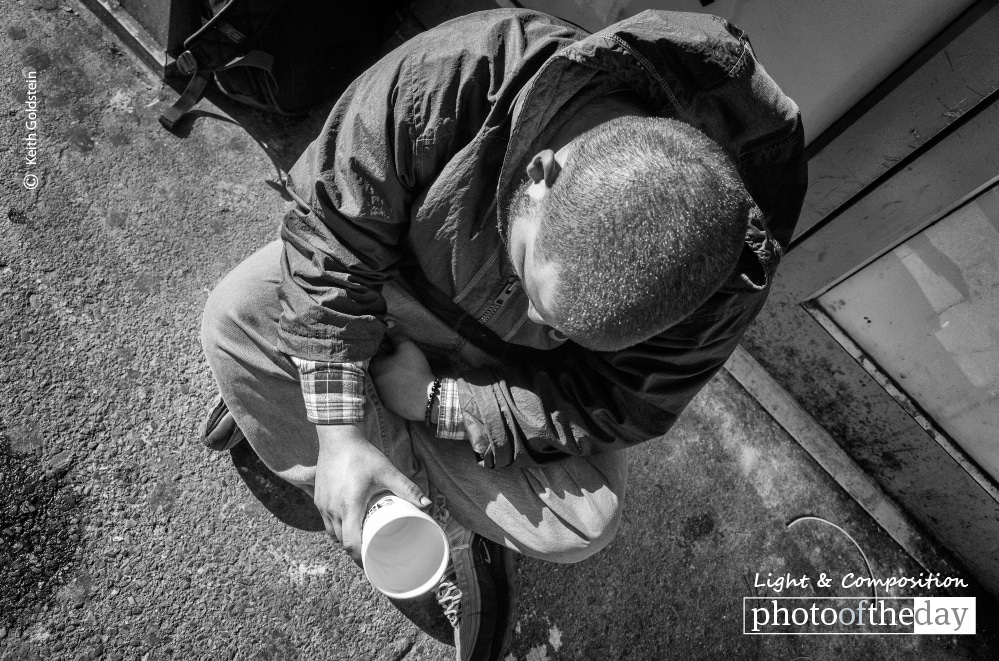
Empty by Keith Goldstein
In the rapidly changing landscape of New York City, where gentrification often obscures the realities of street life, Keith Goldstein captures a poignant moment of stillness. The photographer was struck by the sight of a man whose presence defied the typical expectations of street panhandling, particularly noting the surprising cleanliness of his attire and the stark emptiness of his cup. By isolating this individual against the urban backdrop, Goldstein invites the viewer to look past the immunity one develops to city life, transforming a fleeting encounter into a profound meditation on human dignity and the quiet struggles hidden in plain sight.
Keith Goldstein
Born in Brooklyn in 1957, Keith Goldstein is a seasoned photographer whose artistic journey began with a fascination for the medium during his high school years. After earning his BFA from the School of Visual Arts and an MFA from the Cranbrook Academy of Art, he developed a deeply emotive style of expression that has defined his career since 1980. With a diverse background spanning fine art, corporate photography, and photo editing, Goldstein maintains a minimalist philosophy, believing that being unencumbered by excessive gear provides the greatest creative freedom.
Resonance Score Breakdown
Transparency Note: The resonance score (12.2/20) is calculated based on social engagement metrics collected before the award announcement.
Expert Photography Reviews · 5
The Weight of Absence
We walk through cities built on noise, our eyes trained to skip over the gaps. We are taught that a space must be filled to have value. A cup must hold something.
Read the reflection →The Weight of Stillness
We often mistake silence for a lack of substance, as if the quiet spaces in our day are merely waiting to be filled. But there is a profound gravity in the act of simply being.
Read the reflection →Reviews & Comments
Share your thoughts about this award-winning photograph. Your reviews contribute to the community engagement score.

One suspects Goldstein didn’t just stumble upon this. It’s a quiet, uncomfortable stillness that usually demands hours of standing on cold concrete while the city ignores you. I’ve spent enough afternoons waiting for a frame to settle to know when someone’s actually put in the work. The composition is sharp, but it’s the man’s posture that gets me; it’s earned. He didn’t just find this moment. He waited until the world finally stopped moving.
The urban datum here isn’t the man, but the relentless, vertical rhythm of the storefronts behind him. Goldstein’s 28mm lens captures the harsh, unforgiving light raking across the brickwork, emphasizing the void he occupies. It’s a brutal, honest frame. I’m struck by how the fenestration creates a cage of sorts, trapping his stillness against the city’s frantic pace. It’s a lonely geometry, and honestly, it makes my chest tighten just looking at that empty cup.
Of the thousands of street shots I’ve reviewed, most rely on chaotic energy. Goldstein’s work succeeds because it’s quiet. The man’s posture, anchored by that empty cup, creates a vacuum in the frame that forces you to stop. It’s the restraint that gets me; I actually felt a pang of guilt looking at his clean shirt. It’s a rare, honest study of dignity that won’t feel dated in thirty years. It’s simply essential.
Goldstein’s frame is technically competent, yet it’s frustratingly literal. At 1/1600th, he’s frozen the subject into a static, clinical specimen. Why resolve every wrinkle in that shirt? I’d have preferred a slower shutter, letting the city’s frantic pace bleed into the man’s stillness. It’s closer to a police report than Sugimoto’s ethereal theatres. By choosing total clarity, he’s missed the chance to make the man’s isolation feel truly visceral. It’s just too safe.
Why does this man’s cleanliness matter to Goldstein? It’s a strange, unsettling metric for dignity. By framing him as an anomaly against the city’s indifference, the camera turns a human being into a prop for a narrative of urban aestheticism. I feel a sharp, visceral discomfort watching this. Does the subject know he’s being curated into a meditation on poverty? Whose struggle are we actually consuming here? It’s a polished frame, but it feels hollow.