Mother Tongue by Yasef Imroze
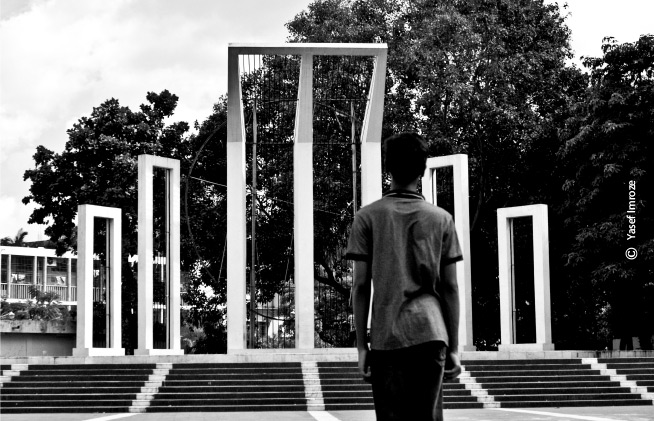
Captured at the historic Shaheed Minar in Dhaka, this poignant photograph serves as a visual tribute to the martyrs of the 1952 Language Movement. The image commemorates the bravery of those who sacrificed their lives to secure the right to speak Bangla, a struggle that eventually inspired the global observance of International Mother Language Day. By focusing on this site of profound national significance, the photographer captures the weight of history and the enduring spirit of a people. The composition is award-worthy for its ability to transform a site of political memory into a powerful, evocative narrative of cultural identity and resilience.
Yasef Imroze
Originally from Dhaka, Bangladesh, Yasef Imroze Ifaz is a Sydney-based professional currently working in the financial services industry. After completing his academic studies in Australia, he discovered a deep passion for photography, which has fundamentally transformed his perspective on the natural world. Specializing primarily in landscape and close-up photography, he frequently turns his lens toward the beauty of his homeland. With a growing ambition to travel the globe, he continues to refine his craft, finding immense personal fulfillment and creative joy in his photographic pursuits.
Resonance Score Breakdown
Transparency Note: The resonance score (12.3/20) is calculated based on social engagement metrics collected before the award announcement.
Expert Photography Reviews · 7
The Architecture of Memory
Public spaces are never truly neutral. They are built to hold our collective stories, acting as stone-and-mortar archives of what a society deems worth remembering. When we gather in these sites, we are not just occupying geography; we are participating in a ritual of belonging.
Read the reflection →The Weight of a Word
I remember sitting in a small cafe in Sarajevo, listening to an old man explain why he refused to speak the language of the occupying forces that had long since left.
Read the reflection →Reviews & Comments
Share your thoughts about this award-winning photograph. Your reviews contribute to the community engagement score.

The Shaheed Minar’s vertical pillars establish a rigorous, rhythmic grid, slicing the frame into precise, repeating intervals. I’m struck by how the central axis anchors the composition, creating a perfect equilibrium against the chaotic, blurred movement in the lower quadrant. It’s a masterclass in spatial tension; the geometry forces the eye to oscillate between static monumentality and human transience. I’ve rarely seen such a cold, mathematical structure evoke such a profound, aching sense of national memory.
Before the eye identifies the concrete at Shaheed Minar, a sudden stillness settles in the chest. It’s a heavy, rhythmic quiet. The stark monochrome pulls the breath inward, mimicking the weight of a language fought for in blood. I feel a phantom ache in my own throat looking at these shadows. When I return to this frame a year later, the silence hasn’t faded; it’s grown, anchoring itself deeper into my own quiet, unspoken memories.
Shadows at the Shaheed Minar don’t merely fall; they accumulate like sediment. Yasef Imroze understands that history isn’t found in the light, but in the heavy, suffocating ink pooling beneath the monument. It’s a brutal, honest darkness. When I look at these deep, obsidian voids, I feel a sudden, sharp ache in my chest—the silence of those who died for a syllable. It’s not a pretty picture; it’s a confrontation with the ghosts we’ve buried.
At the Shaheed Minar, we don’t just see stone; we hear the echoes of a language fought for. Yasef Imroze didn’t just point his lens at a monument; he sat with the silence of those who gave everything for their mother tongue. It’s a heavy, beautiful quiet. I’ve found myself lingering on the textures of the concrete, feeling the weight of history in the grain. It’s a photograph that asks to be returned to, again and again.
The Shaheed Minar’s geometry relies on the tension between its vertical columns and the horizontal datum of the plaza. Imroze captures the light raking across these surfaces, emphasizing the mass of the concrete against the void. It’s a rare moment where the architecture’s rhythm feels alive rather than static. I’m struck by how the framing excludes the surrounding city, forcing us to confront the threshold of memory. It’s a haunting, spatial honesty I rarely find.
The frame holds a heavy, rhythmic silence. It’s a tracking shot frozen in monochrome, where the geometry of the Shaheed Minar cuts through the haze like a jagged edit. I’m struck by the way the light clings to the stone; it’s haunting. The composition doesn’t need movement to breathe. It’s the final cut the editor keeps, a singular, breathless moment where history stops running and finally stares back at you. It’s a damn good frame.
You’ve captured the weight of the Shaheed Minar, but I’m looking for the pulse of the people beneath it. The architecture is imposing, yet it feels a bit distant. I wanted to see more of the faces, more of the struggle in their eyes. And yet, there’s a quiet dignity in the way the light hits the stone. It’s a somber, honest look at history. I just wish you’d stepped closer to the human story.