Thru The Door Of A ’54 by Tisha Clinkenbeard
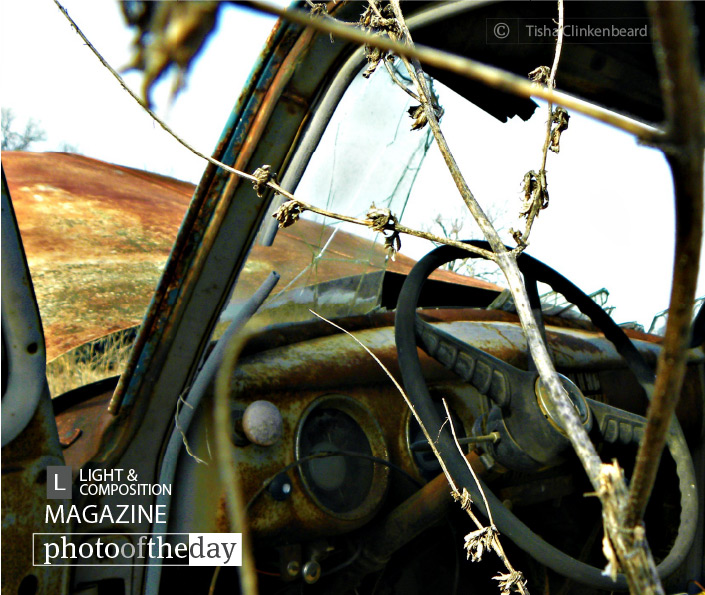
Tucked away on a quiet rural road in Arkansas, this 1954 Chevrolet 4400 truck stands as a weathered monument to a bygone era. The photographer captured the vehicle amidst an overgrown pasture, focusing on the poignant details of its decline—the rusted dents, shattered glass, and the evocative Muncie PTO knob resting on the dashboard. By framing the shot through the open door, the image invites viewers to step into the truck’s history. This piece is award-worthy for its ability to transform a decaying relic into a compelling narrative of time, texture, and the quiet beauty found in abandonment.
Tisha Clinkenbeard
Based in Powderly, Texas, Tisha Clinkenbeard is a dedicated photographer whose work explores the overlooked beauty of the world around her. Her evocative imagery has been featured in prestigious venues such as The Fine Arts Center of Hot Springs and the Black Box Gallery in Portland. Driven by a lifelong passion for capturing the essence of her surroundings, she documents her travels through her blog, Found Round & About, sharing the unique stories she discovers during her wanderings.
Resonance Score Breakdown
Transparency Note: The resonance score (12.7/20) is calculated based on social engagement metrics collected before the award announcement.
Expert Photography Reviews · 5
The Grace of Returning
There is a quiet dignity in the way things return to the earth. We often view the passing of time as a theft, a slow stripping away of purpose and shine. But if we sit long enough with the remnants of what once moved, we see that nothing is truly lost.
Read the reflection →The Architecture of Absence
We often speak of objects as if they are static, fixed in the moment they were forged. But metal breathes. It expands in the heat of a July afternoon and contracts when the frost settles into the seams.
Read the reflection →Reviews & Comments
Share your thoughts about this award-winning photograph. Your reviews contribute to the community engagement score.

1/222sec at f/4.5, 5.9mm. The Nikon P90’s small sensor struggles with the dynamic range of that rusted interior. It’s a compromise. The depth of field is too deep for a portrait of a gear knob, yet too shallow to resolve the pasture’s texture. I’ve spent years looking at these sensors, and they always leave me cold. The technical execution is barely adequate. It’s a functional capture, but the hardware’s limitations dictate the narrative here. It’s frustrating.
At f/4.5, the Nikon P90’s small sensor struggles with diffraction, yet the focal plane here captures the Muncie knob’s oxidation with startling intimacy. I’m genuinely moved by how the lens resolves that granular rust against the soft, out-of-focus pasture. It’s a delicate optical dance; the light doesn’t just hit the metal, it reveals the molecular decay of 1954. It’s rare to see such technical limitations transformed into a haunting, tactile narrative of time’s own erosion.
We look through the rusted frame of this ’54 Chevy and we aren’t just seeing a truck; we’re meeting a ghost. Tisha listened to the silence of that Arkansas pasture before she clicked the shutter. That Muncie knob on the dash feels like a hand waiting to be held. It’s haunting, really. I’ve spent hours staring at the shattered glass, wondering who last steered this machine home. It’s a portrait of a life left behind.
The Muncie knob sits in the dark, a cold anchor in a cabin reclaimed by rot. Clinkenbeard doesn’t just frame a rusted ’54; she forces us to confront the void where utility once lived. I’ve stared at that dashboard until the silence felt heavy, almost suffocating. It’s not about the decay, but the shadow’s refusal to let the past vanish entirely. It’s a brutal, necessary reminder that we are all just waiting to be reclaimed.
The frame pulls you in, a slow dolly shot into the guts of a ghost. That Muncie knob on the dash? It’s the anchor. I’ve spent hours staring at the rust, feeling the heat of that Arkansas sun. It’s a perfect cut. The shattered glass doesn’t just break; it frames the decay. You don’t need a sequence here. The shot holds its own breath. It’s the one frame the editor keeps, and honestly, it haunts me.
Old is gold.