Broken and Blessed by Sandra Frimpong
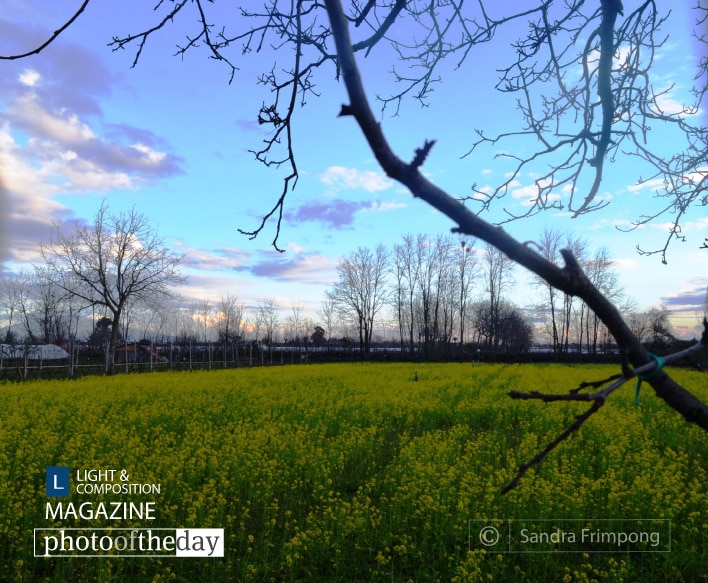
Inspired by the cyclical nature of growth and renewal, this photograph captures a poignant moment of transition. Drawing a parallel between the changing seasons and the human experience of being broken down only to be rebuilt, the photographer highlights the beauty found in vulnerability. The technical execution, utilizing a wide 18mm focal length and a deliberate f/9.5 aperture, emphasizes the textures and details of the subject. This image stands as a testament to the idea that even in times of perceived decay, there is a hidden blessing waiting for the right moment to blossom, making it a deeply resonant and award-worthy piece.
Sandra Frimpong
Born and raised in Ghana, Sandra Frimpong later moved to the United States, where she served in the Navy while pursuing higher education in business. Her global travels during her military service ignited a passion for photography, leading her to capture the simple, often overlooked beauty of daily life. Now residing in Italy, she continues to refine her craft through formal study and community-focused projects, aiming to document the human experience across diverse cultures and landscapes.
Resonance Score Breakdown
Transparency Note: The resonance score (12.3/20) is calculated based on social engagement metrics collected before the award announcement.
Expert Photography Reviews · 6
The Architecture of Becoming
We are taught to fear the fracture, to hide the hairline cracks that spiderweb across our lives as if they were failures of design. But look at the forest floor: the fallen log does not merely rot; it becomes a cradle.
Read the reflection →The Salt of Renewal
The smell of rain on dry, sun-baked earth is a scent that travels deep into the marrow. It is the smell of a promise kept. When I was a child, I would press my palms against the rough, cooling bark of the olive trees, feeling the grit of the soil beneath my fingernails.
Read the reflection →Reviews & Comments
Share your thoughts about this award-winning photograph. Your reviews contribute to the community engagement score.

1/180sec at f/9.5, 18mm, ISO 400. The aperture choice is the only thing keeping this frame coherent. At 18mm, f/9.5 forces a deep focus that captures the grit of the decay without losing the background to mush. It’s a calculated, rigid approach to nature. I’ve seen enough soft-focus sentimentality to last a lifetime, so this technical discipline actually gives me a moment of relief. It’s precise. It doesn’t apologize for the texture.
It’s a shame the jury obsessed over the f/9.5 sharpness here. By pinning the textures down so rigidly, the work feels trapped in a conventional landscape trap. I’m craving a collapse of that focal plane. Why resolve every leaf when the theme is transition? If you’d let the motion blur the edges, it would finally breathe. I’d love to see you abandon the Nikon’s clinical precision for something that actually feels like decay.
Of the thousands of nature studies I’ve judged, most rely on cheap, saturated drama. Sandra’s work avoids that trap. By choosing f/9.5, she forces the viewer to confront the grit of the decay rather than blurring it into submission. It’s a quiet, stubborn piece. I found myself lingering on the textures of the withered stalks, feeling a genuine ache for the cycle they represent. It’s not just pretty; it’s a document of survival that will still matter in thirty years.
The ochre of the Campania earth, bruised by the violet of a dying season, vibrates with a Morandi-esque restraint that makes my heart ache. It’s a chromatic dialogue where the sun-bleached stalks don’t merely exist; they surrender to the light, echoing the golden, dusty warmth Vermeer found in a quiet room. One finds here a delicate, shivering harmony, a palette of decay that feels so profoundly alive, it’s as if the very air has turned to liquid amber.
At f/9.5, the 18mm focal length pushes the diffraction limit, yet it’s precisely this constraint that renders the textures with such clinical, biting sharpness. The light’s interaction with the weathered surfaces reveals a micro-contrast I find genuinely haunting. It’s rare to see a sensor resolve the decay of organic matter with such unforgiving clarity. I’m moved by how the lens captures the physics of renewal; it’s a beautiful, cold, and perfect optical truth.
You didn’t just photograph a landscape; you found a quiet ache in the dirt. I’ve spent years looking for that specific light hitting the decay, and it’s rare to see someone capture the resilience in it so clearly. Because you chose that wide angle, I feel like I’m standing right there in the Campania soil with you. It’s honest. You waited for the transition, and I can feel the weight of that moment in my own chest.