Place of Power by Sergiy Kadulin
Captured during a Himalayan trek in Sikkim, India, this photograph frames a sacred ancient stupa against the majestic backdrop of the Kanchenjunga Range. Taken in the soft light of an October morning, the image captures the mystical atmosphere as semi-transparent clouds drift across peaks exceeding 7,000 meters. The photographer was drawn to this legendary site—believed by many to be an entry to Shambala and famously painted by Roerich—to document its spiritual resonance. The composition is award-worthy for its harmonious balance between the human-made stupa and the overwhelming, ethereal scale of the Pandim massif, evoking a sense of profound tranquility and timelessness.
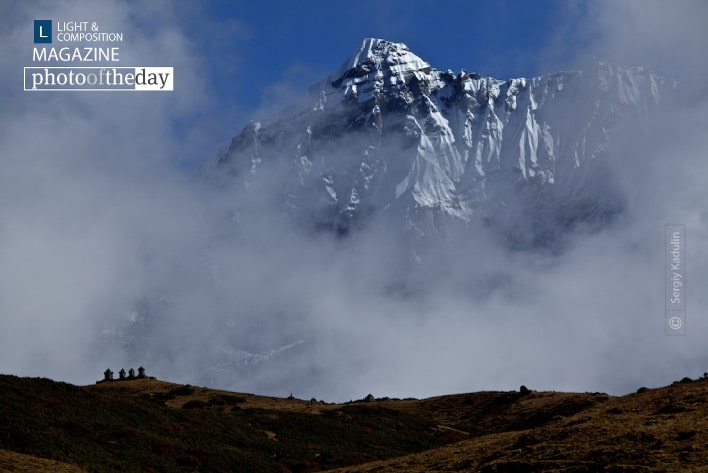
Exposure 1/320sec @ f/8 | ISO 100 | Focal Length 200mm
Sergiy Kadulin
Born in Kyiv, Ukraine, in 1967, Sergiy Kadulin balances a successful career in information technology with a deep-seated passion for photography. After honing his craft through the Kyiv School of Photography and the New York Institute of Photography, he developed a signature style focused on travel, landscape, and reportage. Driven by a desire to share his love for the world and nature, Kadulin uses his lens to capture the warmth and spiritual depth of the environments he explores, frequently showcasing his work through international exhibitions and galleries.
Resonance Score Breakdown
Transparency Note: The resonance score (14.3/20) is calculated based on social engagement metrics collected before the award announcement.
Expert Photography Reviews · 7
The Architecture of Silence
We spend our lives building walls to keep the world out, forgetting that the most sacred structures are those that invite the sky to rest upon them.
Read the reflection →Where the Earth Meets Sky
There is a particular kind of silence that exists only at high altitudes, where the air is thin enough to feel like a prayer. In these places, the world sheds its noise, and we are left with the raw, ancient bones of the earth.
Read the reflection →Reviews & Comments
Share your thoughts about this award-winning photograph. Your reviews contribute to the community engagement score.
At f/8, the 200mm focal length resolves the stupa’s weathered stone with clinical sharpness, pushing right against the diffraction limit. The light’s interaction with the high-altitude atmosphere creates a subtle micro-contrast that’s simply breathtaking. I’m genuinely moved by how the lens renders those drifting clouds; it’s as if the glass itself is breathing. It’s rare to see such precise optical discipline capture the ethereal scale of the Pandim massif without losing the texture of the foreground.
The palette here isn’t merely captured; it’s exhaled, a delicate alchemy where the stupa’s weathered stone meets the bruised, ethereal violet of the Kanchenjunga peaks. It’s the colour of silence, that specific, thin blue of high-altitude oxygen that makes one’s lungs ache with a sudden, sharp longing. I’ve found myself breathless before these shifting, diaphanous veils of mist, which possess the same haunting, spectral luminosity that Turner once coaxed from his most turbulent, light-drenched canvases.
The stupa sits. It doesn’t compete with the massif. It waits. I’ve spent minutes looking at the grey stone against the white peak, and my breath finally slows. The clouds aren’t just weather; they’re the breath of the mountain. Nothing here is accidental. The empty corner is not empty. It’s a pause. A deep, resonant silence. It’s rare to find a frame that knows when to stop. This one knows. It’s enough.
The stupa doesn’t merely sit before the Kanchenjunga; it anchors the void. Kadulin understands that light here is a thin, fragile veil draped over an ancient, indifferent silence. I’ve stared at these peaks until my eyes ached, feeling the crushing weight of the infinite. It’s not the stone that moves me, but the way the shadows swallow the base of the massif. It’s a cold, honest reckoning with the scale of our own insignificance.
Before the eye identifies the stupa, the chest tightens. It’s a physiological bracing against the sheer, thin-aired scale of Kanchenjunga. I’ve returned to this frame for years, and that initial, cold stillness never fades. The clouds don’t just drift; they dissolve the boundary between my pulse and the mountain’s silence. It’s a rare, haunting activation of the nervous system. I feel the altitude in my own lungs, a quiet, sacred ache that lingers long after.
1/320sec at f/8, 200mm. ISO 100. The choice of f/8 on a 70-200mm lens is the correct move here. It keeps the stupa sharp while compressing the Pandim massif into the frame. It’s a calculated, clinical flattening of space. I’ve seen enough soft mountain shots to know this precision is rare. It doesn’t just document the peaks; it forces them to confront the architecture. It’s cold, sharp, and entirely necessary. I actually felt the altitude.
Most mountain photography is just ego masquerading as landscape. Of the thousands I’ve reviewed, this succeeds because Kadulin resists the urge to center the peaks. By pinning the stupa against the crushing scale of the Pandim massif, he forces a dialogue between human fragility and geological permanence. It’s quiet, and honestly, it makes me want to breathe deeper. Thirty years from now, people will still feel that stillness. That’s why it earned its place here.
Beautiful picture!
Amazing