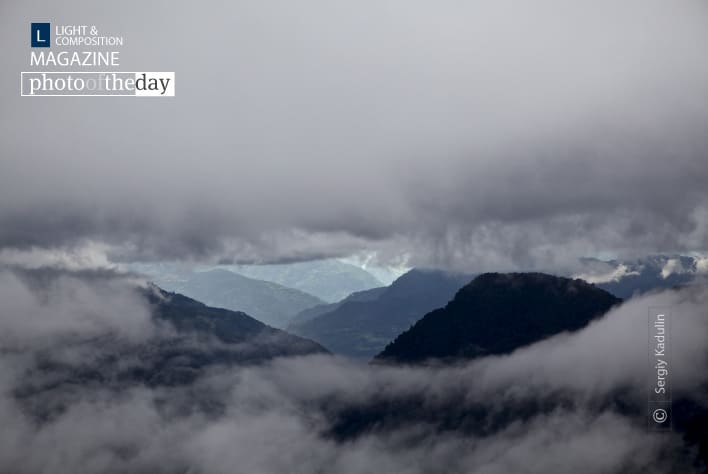
Himalayas through Storm Clouds by Sergiy Kadulin
During a trek through Eastern Sikkim in October 2010, the photographer navigated the rainy, cloud-covered ascent toward the mountain village of Tshoka. Pausing while the rest of the group moved ahead, he looked back to witness a dramatic atmospheric shift. The grey clouds parted to reveal the majestic Himalayas, framed in a unique, eye-like formation. This serendipitous moment, captured through a lens of quiet observation, highlights the raw beauty of the high-altitude landscape. The image is award-worthy for its evocative composition and the photographer's ability to seize a fleeting, ethereal connection between the earth and the sky.
Sergiy Kadulin
Born in Kyiv, Ukraine, in 1967, Sergiy Kadulin is an accomplished professional with a background in avionics engineering and information technology. Despite a successful corporate career, he has nurtured a lifelong passion for photography, evolving from early experiences with vintage film cameras to a sophisticated digital workflow. A graduate of the Kyiv School of Photography and the New York Institute of Photography, Kadulin specializes in travel and landscape imagery. He views photography as a profound medium for personal growth and a way to share his deep appreciation for the natural world with an international audience.
Resonance Score Breakdown
Transparency Note: The resonance score (13.8/20) is calculated based on social engagement metrics collected before the award announcement.
Expert Photography Reviews · 4
The Weight of Silence
The mountain does not care if we are watching. It exists in a state of permanent indifference, rising above the clouds that try to hide it.
Read the reflection →The Breath of Stone
We often mistake silence for an absence, a hollow space where nothing happens. But the mountains know better. They are the earth’s slow, heavy breathing, exhaling mist and inhaling the centuries.
Read the reflection →Reviews & Comments
Share your thoughts about this award-winning photograph. Your reviews contribute to the community engagement score.
The mountains don’t reveal themselves; they allow us a glimpse of their indifference. Kadulin’s frame captures that suffocating grey, where the peaks emerge like ghosts from a shroud. It’s a cold, heavy silence. I’ve stared at these clouds for an hour, and I feel a genuine, sharp ache in my chest—the loneliness of being small. The light here isn’t illuminating; it’s merely carving out a space for the void to breathe. It’s haunting.
Most mountain photography is just a postcard, but this frame earns its place. The way the clouds pinch into an eye around the peaks creates a tension that’s rare; it’s not just a landscape, it’s a confrontation. I’ve stared at thousands of summits, yet this one makes me feel small in a way that’s actually comforting. It’s the restraint in the exposure that saves it. It’ll still hold that same weight thirty years from now.
At f/4, the 24-70mm lens avoids the diffraction limit, preserving the crisp micro-contrast of those jagged Himalayan ridges. The focal plane is perfectly anchored, yet it’s the atmospheric scattering through the cloud-gate that truly moves me; it’s a rare, visceral collision of optics and geology. I’ve spent years studying how glass renders light, but seeing the mountain’s texture emerge through that vaporous, eye-like aperture feels like watching the earth breathe. It’s hauntingly, physically precise.
The frame’s aperture-like clouds create a precarious fulcrum. It’s a rigid geometry that forces the eye toward the peaks, yet the negative space feels underdeveloped. The weight of the grey mass threatens to collapse the composition entirely. I’m genuinely unsettled by how the mountain’s peak barely anchors the center. It doesn’t quite hold the tension required for a landscape of this scale. The structure is fragile, barely surviving the atmospheric chaos it attempts to contain.