Overlooking Skilak by Ryan Marquis
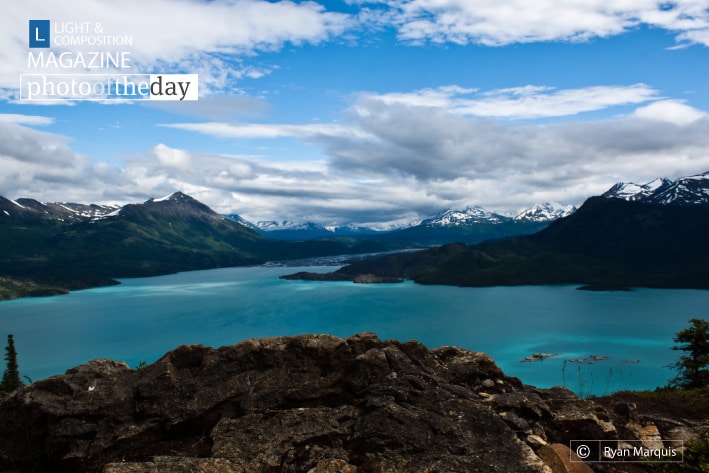
Captured on a crisp June day, this image showcases the breathtaking expanse of Skilak Lake on Alaska's Kenai Peninsula. The photographer expertly framed the scene to highlight the lake's distinct glacial blue hue, a result of sediment flowing from the retreating Skilak Glacier. By focusing on the gravel delta and the braided streams of the Skilak River, the composition emphasizes the raw, geological history of a landscape carved by ice. This award-winning photograph serves as both a stunning visual testament to the region's untamed beauty and a thoughtful documentation of the dynamic, shifting environment of the Harding Ice Field.
Ryan Marquis
Based in Kenai, Alaska, Ryan Marquis is a dedicated photographer who views his camera as an essential extension of his own vision. His work focuses primarily on the untamed landscapes and wildlife of the Alaskan wilderness, utilizing the region's extreme seasonal shifts—from the ethereal aurora borealis of winter to the endless daylight of summer—to capture the natural world. Beyond traditional photography, Marquis frequently integrates scientific and historical context into his projects, reflecting a deep commitment to documenting the environment through both still imagery and time-lapse cinematography.
Resonance Score Breakdown
Transparency Note: The resonance score (13.0/20) is calculated based on social engagement metrics collected before the award announcement.
Expert Photography Reviews · 6
The Weight of Water
The earth remembers the weight of ice long after it has turned to water. We walk over ground that was once held in a frozen grip, a pressure so immense it rearranged the stone. There is a silence in these high places that feels like waiting.
Read the reflection →The Breath of Glacial Stone
The air in high places tastes of crushed slate and ancient, biting cold. It is a sharp, metallic tang that settles at the back of the throat, reminding the lungs of their own fragility.
Read the reflection →Reviews & Comments
Share your thoughts about this award-winning photograph. Your reviews contribute to the community engagement score.
Glacial blue shouldn’t feel this heavy. Marquis captures the Kenai, yet it’s the gravel delta that haunts me; it’s a graveyard of sediment where light goes to die. I’ve stared at those braided streams until my eyes ached, searching for the shadows that refuse to settle. It’s a cold, geological indifference that resists our gaze. Honestly, it makes me feel small, like a ghost haunting a landscape that doesn’t even know I’m here.
The glacial silt here has a bite to it, doesn’t it? I’ve spent enough mornings shivering on similar gravel bars to know that blue isn’t just a color; it’s a consequence of glacial grinding. Marquis clearly didn’t just stumble upon this view. He’s stood in the wind, waiting for the light to settle over those braided channels. It’s a cold, honest piece of work. I find myself wanting to pull my coat tighter just looking at it.
The frame’s geometry hinges on the gravel delta’s jagged intersection with the glacial blue expanse. It’s a rigid, calculated division of the picture plane. The braided river channels provide necessary linear tension, preventing the composition from collapsing into mere scenic sprawl. I’m genuinely unsettled by how the negative space above the horizon line refuses to offer the eye a resting point. It’s cold, precise, and structurally sound. The architecture holds, even if the landscape itself is shifting.
The glacial blue of Skilak isn’t just color; it’s the earth’s own breath. I’ve stood in such places where the air tastes of ancient ice, and looking at this, I feel that familiar, sharp chill in my chest. He waited for the light to soften against those braided streams, listening to the water’s slow, rhythmic carving. It’s a quiet, patient surrender to the landscape. He didn’t take this; he simply let it happen.
That glacial turquoise, reminiscent of a Vermeer pigment ground from the rarest lapis, bleeds into the gravel delta with a ferocity that makes one’s breath hitch in the throat. It’s a chromatic collision where the cold, suspended sediment of Skilak Lake quarrels with the arid, ochre earth, creating a tension that feels almost tactile. I’ve rarely seen such a haunting, icy dissonance; it’s as if the landscape itself is weeping, shivering in the pale, northern light.
Most landscapes I review are merely pretty postcards, but this one earns its place. It’s the braided river’s chaotic geometry against the glacial blue that stops me cold; I’ve stared at that silt-heavy water for ten minutes, feeling the actual chill of the Harding Ice Field. It doesn’t just document a view; it captures a geological heartbeat. In thirty years, we’ll look back at this specific delta and realize exactly what we’ve lost to the thaw.