Bullfight by Mercedes Noriega
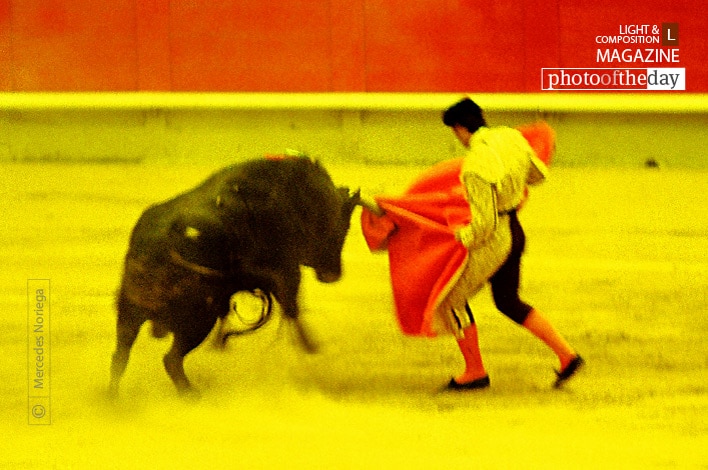
Captured in the historic bullrings of Barcelona, Spain, this poignant image documents the raw intensity of a bullfight. The photographer chose to document the event using analog film, emphasizing the stark, tragic reality of the encounter. By freezing the moment the bull fights for its dignity, the image transcends mere reportage, becoming a powerful commentary on the cycle of life and death. The composition highlights the animal's struggle, inviting viewers to reflect on the ethical weight of the tradition while admiring the technical mastery required to capture such a fleeting, emotionally charged moment on film.
Shikchit Khanal
Since he was a young boy, Shikchit Khanal always found beauty in everyday life. Born in Kathmandu, Nepal, he never realized that he had very little. He always longed for a life less ordinary, less conventional. Making photographs in his mind of the things he saw around him. He dreamed of one day being able to document the way he viewed the world. He dreamed of travelling and knowing the world through his own eyes and sharing his vision with others. In May 2010, he finally bought his first camera and for the past two years he has been living his dream of travelling and taking photos throughout India and his home country of Nepal where he is currently living with his wife and child to be. Award Winner Photo of the Day Camera Nikon D90 DX-Format CMOS Digital SLR Lenses: Nikkor 28-300mm f/3.5, Nikkor 18-105mm f/3.5, Nikkor 35mm f/2.0, Nikkor 50mm f/1.
Resonance Score Breakdown
Transparency Note: The resonance score (14.8/20) is calculated based on social engagement metrics collected before the award announcement.
Expert Photography Reviews · 8
The Weight of the Sand
There is a silence that precedes the collision. It is not a peaceful silence, but a heavy one, thick with the scent of dust and the anticipation of a debt being settled.
Read the reflection →The Weight of the Dust
There is a specific gravity to the arena, a place where the earth remembers every footfall and every shadow cast by the sun.
Read the reflection →Reviews & Comments
Share your thoughts about this award-winning photograph. Your reviews contribute to the community engagement score.
Most bullfight photography is just blood and spectacle, but this frame captures the animal’s singular, desperate dignity. I’ve seen thousands of arena shots, yet this one lingers because of the film grain—it makes the dust feel heavy, almost suffocating. It’s a brutal, honest relic. I felt a genuine ache in my chest looking at the bull’s posture against the sand. It’s not just a fight; it’s a quiet, tragic history frozen before the tradition inevitably fades away.
The ochre dust, swirling like a Goya nightmare, bleeds into the bull’s coat, a bruised charcoal that aches with the weight of impending silence. It’s a violent, sun-drenched palette where the sand’s parched gold quarrels with the shadow’s deep, cooling indigo. I’m breathless, truly, watching how the light clings to the animal’s flank, a tragic luminosity that Vermeer would have envied, turning this brutal, fleeting dance into a haunting, chromatic elegy for the dying light.
The bull’s mass anchors the frame, creating a brutal fulcrum against the sand. It’s a rigid geometry of muscle and dust. The negative space above the animal’s spine provides a necessary, cold silence. I’m struck by how the composition refuses to collapse into sentimentality. It holds its tension with clinical precision. While the subject is chaotic, the frame remains disciplined. It’s a rare instance where the architecture of the struggle actually justifies the film grain.
Shooting a bullfight on film isn’t for the faint of heart; it’s a gamble against a shutter speed that doesn’t care about your framing. Noriega clearly didn’t just stumble into the ring. She’s captured the dust and the desperation with a grit digital sensors rarely manage. I’ve spent enough hours waiting for a single frame to know when someone’s put in the work. It’s a brutal, honest piece of craft. I’d have liked to be there.
The sand holds the weight. Dust rises, yet the frame doesn’t feel crowded. It’s the stillness between the charge and the fall that catches my breath. I’ve spent minutes staring at the expanse of the arena floor. It’s not just dirt. It’s a void. Nothing here is accidental. The empty corner is not empty. It’s a pause. A breath held in the heat of Barcelona. It’s quiet. It’s enough.
The bull’s silhouette isn’t merely caught; it’s carved from the arena’s suffocating gloom. Noriega understands that true violence resides in what the light refuses to touch. I’ve stared at these deep, ink-stained voids for an hour, and I’m unsettled by how they swallow the animal’s agony. It’s a brutal, honest geometry. When the shadows finally claim the beast, it doesn’t feel like a death—it feels like an inevitable, dark return to the earth’s own silence.
The dust hangs suspended in the arena’s harsh, unforgiving light. It’s a brutal, singular moment where the bull’s shadow stretches long against the sand. I find myself holding my breath, feeling the weight of the animal’s final, desperate grace. Mercedes waited for the light to carve out this tragedy, choosing film to honor the gravity of the struggle. It’s a quiet, heavy silence captured in motion. I’ve never seen such sorrow etched into the earth.
The silver halide grains resolve the bull’s kinetic energy with a tactile grit digital sensors rarely replicate. At this shutter speed, the focal plane barely contains the creature’s muscle tension, creating a subtle motion blur that mimics the eye’s own saccadic limitations. It’s physically visceral. I’ve spent hours staring at the texture of the sand, where the diffraction of light across the dust particles feels almost agonizingly real. It’s a haunting, optical collision of biology and physics.