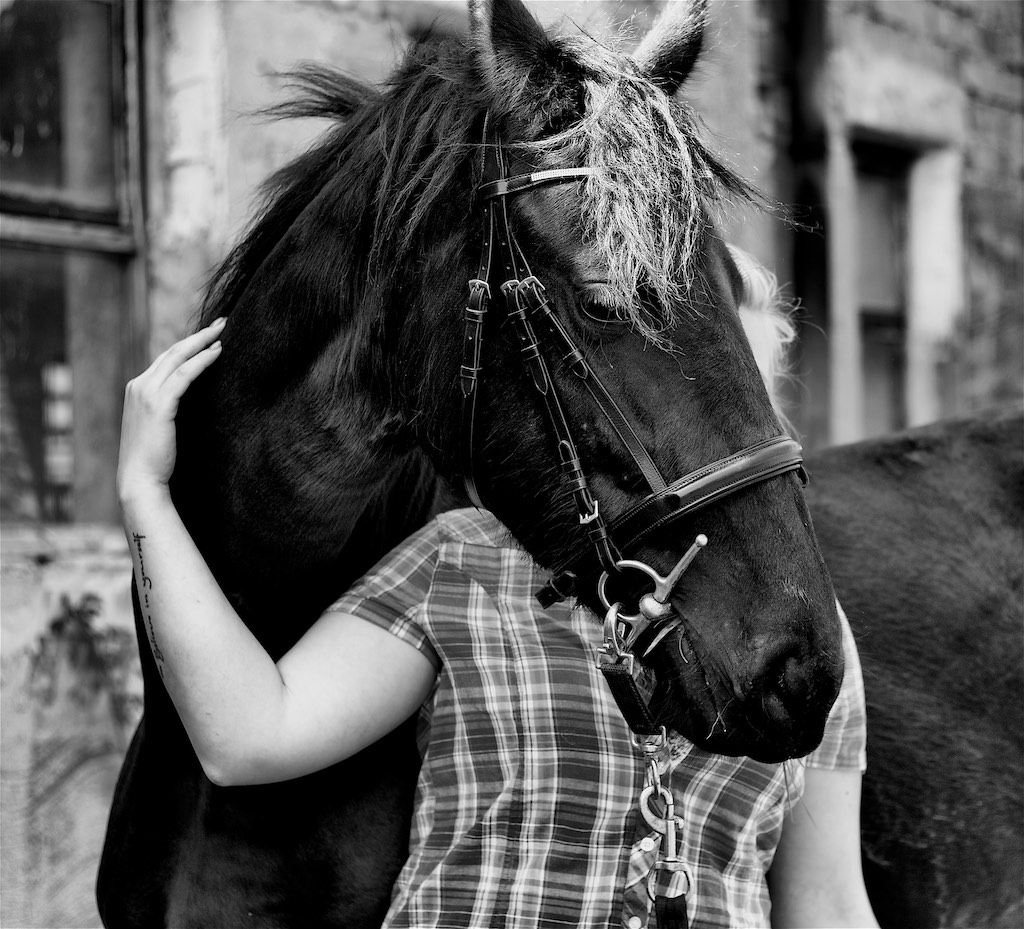
Woman and Horse by Mirka Krivankova
n this striking black-and-white photograph, a woman’s head is gently covered by a horse’s mane, creating a quiet and intimate connection between human and animal. The soft drape of the hair frames her face, hiding yet revealing a sense of trust and harmony. The monochrome tones emphasize the textures and contrasts, highlighting the strength, grace, and serenity shared in this fleeting moment. It is a visual meditation on the closeness of nature and humanity, and the silent bond that can exist between them."
Mirka Krivankova
Mirka Krivankova is a very promising photographer from Mestec Kralove in the Czech Republic. The photographs on her website depict everything from the gorgeous Czech countryside, to wonderful and interesting portraits of people at work and at play, and even include some documenting of a concert or two. Her use of formalism combined with the natural lighting and shadows in her portraits is absolutely wonderful. The combination helps add interest to the already eye-catching surroundings of her subjects, as well as the subjects themselves, while also leading the viewer’s eye entirely throughout the photographs. Mirka has a strong portfolio, but she feels as though it could be stronger if she removed the concert photos. Currently, they are the first series of photographs you see when you enter her site, and because they look more like out-of-place snapshots, rather than photographs taken by a skilled photographer, it lowered her first impression of her work. With that being said, Mirka’s portfolio is becoming stronger and stronger by the day. As she has been writing this review, she has updated it several times with new photographs as well as re-organizing the ones she has into more comprehensive bodies of work. She seems to be constantly adding to her portfolio, and I look forward to following her work as it continues to evolve.
Resonance Score Breakdown
Transparency Note: The resonance score (6.1/20) is calculated based on social engagement metrics collected before the award announcement.
Expert Photography Reviews · 4
The Language of Breath
Dear reader, I have been thinking about the things we say without ever opening our mouths. We spend so much of our lives tangled in words, trying to explain the weight of our hearts or the sudden, sharp ache of loneliness, yet the most profound truths are almost always silent.
Read the reflection →The Breath of Coarse Silk
I remember the smell of a horse’s neck after a long gallop—a thick, sweet musk of dried sweat, hay, and the deep, damp heat of a living furnace. When you press your face against that mane, the world narrows down to the rhythm of a heavy, steady pulse.
Read the reflection →Reviews & Comments
Share your thoughts about this award-winning photograph. Your reviews contribute to the community engagement score.
Stripped of chromatic vibration, one finds a monochromatic silence that echoes Morandi’s dust-muted palettes, where the horse’s mane isn’t merely hair but a cascade of charcoal shadows and silvered light. It’s a tactile, velvet darkness that I find utterly haunting. By eschewing the riot of colour, Krivankova forces the eye to dwell upon the subtle, bruised greys of intimacy, making the absence of pigment feel like a profound, whispered confession of trust between two souls.
Architecture isn’t just stone; it’s the threshold between beings. Here, the horse’s mane acts as a living fenestration, filtering light across the woman’s features. It’s a study in mass and void, where the solid weight of the animal defines the space around her. I’m struck by how the monochrome texture softens the structural reality of their proximity. It’s a rare, quiet geometry. I’d argue this frame captures the intimacy of shelter better than most blueprints.
The horse’s mane acts as a veil, but who is really being obscured here? Krivankova frames this intimacy as a universal harmony, yet I can’t shake the feeling that the animal is merely a prop for the woman’s aesthetic serenity. Why must the horse surrender its agency to complete her portrait? It’s a beautiful composition, sure, but it feels staged, almost performative. Does this closeness actually exist, or are we just consuming a romanticized fantasy?
The tactile interplay between horsehair and skin echoes the soft-focus romanticism of Julia Margaret Cameron, yet Krivankova’s sharp, modern digital rendering pulls it into the present. It’s a delicate balance; the texture of the mane against the cheek feels almost sculptural. I’ve spent decades tracing this human-animal motif, but the intimacy here caught me off guard. It’s a quiet, startlingly fresh update to the pastoral tradition that feels entirely earned, not merely borrowed from the past.