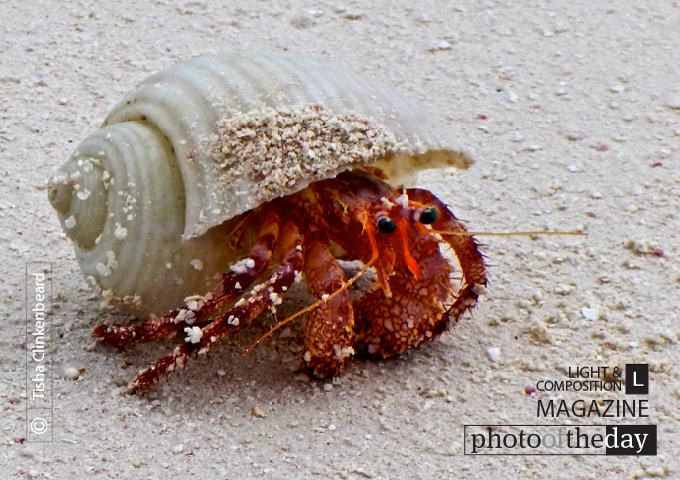
Crab in North Caicos by Tisha Clinkenbeard
Captured along the pristine shores of Horse Stable Beach in North Caicos, this intimate portrait highlights a small crab emerging from its shell to traverse the sand. The photographer utilized a precise close-up perspective to document the creature's delicate movements against the backdrop of the Turks & Caicos islands. This image is award-worthy for its ability to transform a fleeting encounter with nature into a compelling narrative, showcasing the intricate details of the crab's texture and behavior while maintaining a sense of wonder and discovery in the natural world.
Tisha Clinkenbeard
Based in Powderly, Texas, Tisha Clinkenbeard is a dedicated photographer whose work has been featured in notable venues such as The Fine Arts Center of Hot Springs and Portland's Black Box Gallery. With a passion for documenting the world around her, she seeks to share her unique perspective through her blog, Found Round & About. Her artistic journey, which began long before the digital age, continues to evolve as she captures the diverse beauty of the landscapes and creatures she encounters during her travels.
Resonance Score Breakdown
Transparency Note: The resonance score (12.6/20) is calculated based on social engagement metrics collected before the award announcement.
Expert Photography Reviews · 8
The Quiet Way Home
I spent an hour this morning watching a beetle navigate the cracks in my patio stones. It kept hitting obstacles, turning around, and trying a different path without any sign of frustration.
Read the reflection →The Architecture of the Shore
We are taught to measure existence by the grand gestures—the mountain’s reach, the river’s roar, the storm that reshapes the coastline. Yet, there is a quiet, frantic industry happening beneath our heavy footsteps.
Read the reflection →Reviews & Comments
Share your thoughts about this award-winning photograph. Your reviews contribute to the community engagement score.

Before the eye identifies the crab, a sudden stillness settles in the chest. It’s the texture of the sand, granular and vast, that triggers a primal sense of scale. I feel a strange, protective ache watching that fragile shell navigate the infinite beach. When I return to this, I’m not looking at a crustacean; I’m feeling the vulnerability of my own small movements against a world that doesn’t know I’m here. It’s hauntingly quiet.
One suspects the light cooperated on the first attempt. It often does, for the patient. Capturing a crab on the move requires more than just a Nikon P90; it demands a stillness that makes one’s own joints ache in sympathy. I’ve spent enough hours prone in the sand to know the grit never leaves your gear. Tisha clearly sat there until the creature stopped viewing her as a threat. It’s a decent, earned bit of work.
At f/9.6, the Nikon P90’s sensor pushes against the diffraction limit, yet the focal plane captures the crab’s calcified texture with startling acuity. I’m genuinely moved by how the light scatters across those granular sand grains; it’s a tactile revelation. While the small sensor struggles with dynamic range, the lens resolves the creature’s delicate appendages beautifully. It’s a rare, precise encounter where the optics don’t just record the subject—they reveal its very existence.
We look at this small traveler on Horse Stable Beach and we see a life unfolding. Tisha didn’t just snap a shell; she waited until the crab felt safe enough to emerge. It’s a quiet conversation between lens and creature. I’m struck by the vulnerability in those delicate, reaching legs against the vast, shifting sand. It’s a portrait of persistence. I find myself holding my breath, hoping it makes it safely across the shore. It’s truly beautiful.
Most macro shots of crustaceans are clinical, but this one feels like a secret. I’ve seen thousands of beach close-ups, yet the way the light catches the crab’s translucent shell against the coarse, sun-bleached sand is what keeps me looking. It’s not just the sharp focus; it’s the creature’s vulnerability. I actually found myself holding my breath, worried I’d disturb its trek. That’s the mark of an image that will still matter in thirty years.
The calcified ochre of the crab’s carapace, set against the bleached, bone-white silica of Horse Stable Beach, creates a tension that reminds me of Morandi’s dusty, hushed still lifes. It’s a quiet, sun-drenched dialogue of textures where the sand’s pale, granular warmth swallows the creature’s shadow. I’m utterly captivated by how the light renders the shell’s rough, weathered patina; it’s as if the island itself is breathing through this tiny, vibrant, sun-baked fragment of life.
The frame snaps open, and there’s the tension. A tiny, armored protagonist navigating the vast, shifting grain of Horse Stable Beach. It’s a tight, claustrophobic close-up that forces us to watch the crab’s slow-motion crawl. I’m holding my breath, waiting for the movement that never arrives. The shutter speed caught the grit perfectly; it’s a freeze-frame that feels like a long, silent take. I’d have watched this creature walk for hours. It’s pure, kinetic stillness.
The sand here isn’t merely a surface; it’s a graveyard of light. Clinkenbeard’s crab emerges from the shell, yet it’s the encroaching darkness beneath the creature that holds my gaze. It’s a brutal, existential anchor. I’ve spent hours staring at those grains, feeling the crushing weight of the tide. When the light fails to penetrate the shadow, the creature’s struggle becomes ours. It doesn’t invite wonder; it demands a reckoning with our own fragile, fleeting presence.