Painted Silos by Leanne Lindsay
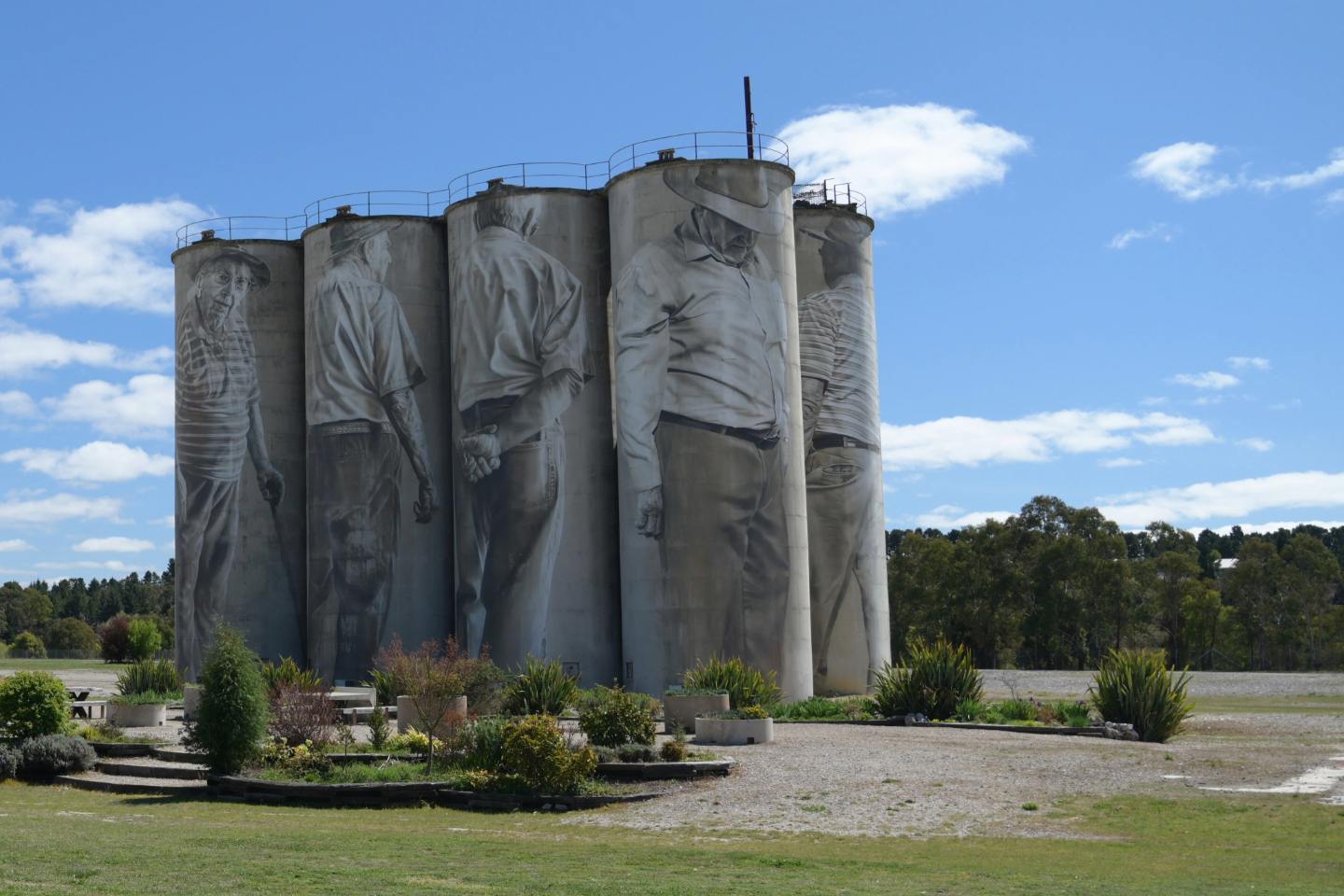
Leanne Lindsay captures the industrial heritage of Portland, New South Wales, through the striking Painted Silos. Created by artist Guido Van Helten, the mural honors former employees of the Portland Cement Works, immortalizing their personal histories on a massive scale. Lindsay’s composition highlights the intersection of local memory and contemporary public art, framing the silos against the landscape to emphasize their monumental presence. Her technical precision, utilizing a wide-angle perspective, successfully balances the intricate details of the portraiture with the imposing architecture of the silos, making this a compelling study of community identity and artistic transformation.
Leanne Lindsay
Born in Adelaide in 1962, Leanne Lindsay relocated to Sydney during her youth, where she eventually rediscovered a dormant passion for photography in her late fifties. Though she specializes in family and newborn portraiture, her portfolio is defined by a keen eye for architectural detail and the expansive beauty of the Australian landscape. Now based in Sydney, Lindsay continues to pursue her creative ambitions, documenting the intersection of human history and the built environment with renewed dedication and artistic clarity.
Resonance Score Breakdown
Transparency Note: The resonance score (7.5/20) is calculated based on social engagement metrics collected before the award announcement.
Expert Photography Reviews · 7
The Weight of Memory
Can a structure ever truly hold the ghost of a man? We build monuments to anchor our history, stacking stone and steel against the sky, hoping to defy the inevitable erosion of time.
Read the reflection →Giants in the Dust
When I was ten, my uncle took me to the old grain storehouse at the edge of town. It was a cathedral of corrugated iron and dust, smelling of dry earth and long-forgotten harvests. I remember looking up at the towering walls and feeling like a pebble at the base of a cliff.
Read the reflection →Reviews & Comments
Share your thoughts about this award-winning photograph. Your reviews contribute to the community engagement score.
1/500sec at f/4, 26mm, ISO 100. It’s a safe, clinical choice. At 26mm, the Z7ii’s sensor resolves the mural’s texture, but f/4 leaves the background’s industrial grit soft. I’d have preferred f/8 to anchor the silos in their environment. It’s technically competent, yet it feels detached. I find myself wanting more grit in the shadows. You’ve captured the scale, but you’ve missed the weight of the steel. It’s precise, but it doesn’t bite.
The light here is honest, flat and unadorned, just as it should be for a monument to labor. Leanne didn’t rush the moment; she waited for the sky to soften, letting the mural’s ghosts breathe against the concrete. It’s a quiet, heavy stillness. Looking at those faces etched into the silos, I feel a sudden, sharp ache for the hands that built this place. She listened to the land, and it finally told her its story.
It’s a strange shift for me to look at these silos, so grounded and dry. I’m used to light being stolen by the water column, where red vanishes within five metres. Here, the clarity is absolute, a luxury I rarely enjoy. Seeing those faces painted on concrete, I’m struck by how they don’t have to fight backscatter or refraction to exist. It’s hauntingly still, a stark contrast to the fluid, chaotic world I usually inhabit.
Before the eye identifies the silos, a sudden stillness settles in the chest. It’s the weight of those giant, painted faces—they don’t just loom; they watch. I felt a strange, hollow ache looking at the way the concrete skin holds such fragile human history. When I return to this, I’m struck by how the scale shrinks me. It’s an unsettling, quiet confrontation with time that lingers long after I’ve looked away. It’s hauntingly heavy.
These silos aren’t just concrete; they’re a conversation between the past and the present. Leanne’s framing captures the weight of those faces, but it’s a borrowed intimacy. I find myself staring at the eyes painted on that cold, industrial surface, wondering if the men they represent would recognize themselves here. It’s a haunting, beautiful scale. I feel a strange ache looking at them—like I’m shaking hands with ghosts who never actually gave their consent.
It’s technically competent, sure, but that’s the problem. By freezing the Portland silos at 1/500th, Lindsay renders them as static, lifeless objects. I’m bored by this clinical resolution. Why not embrace the industrial decay? I’d have loved to see the camera move, blurring the mural into the landscape’s memory. This approach is closer to a postcard than Hiroshi Sugimoto’s long-exposure theatres. What did she choose not to resolve? She chose to resolve everything, and it’s a shame.
The scale hits you first. It’s a wide, cinematic establishing shot that refuses to blink. Those silos aren’t just concrete; they’re a screen for ghosts. I love how the 26mm lens pulls the horizon tight, forcing the mural’s gaze to anchor the entire frame. It’s a long, steady take of industrial history. The cut would’ve been a mistake. Lindsay understood exactly what she was holding here—a moment where the past finally stops moving.