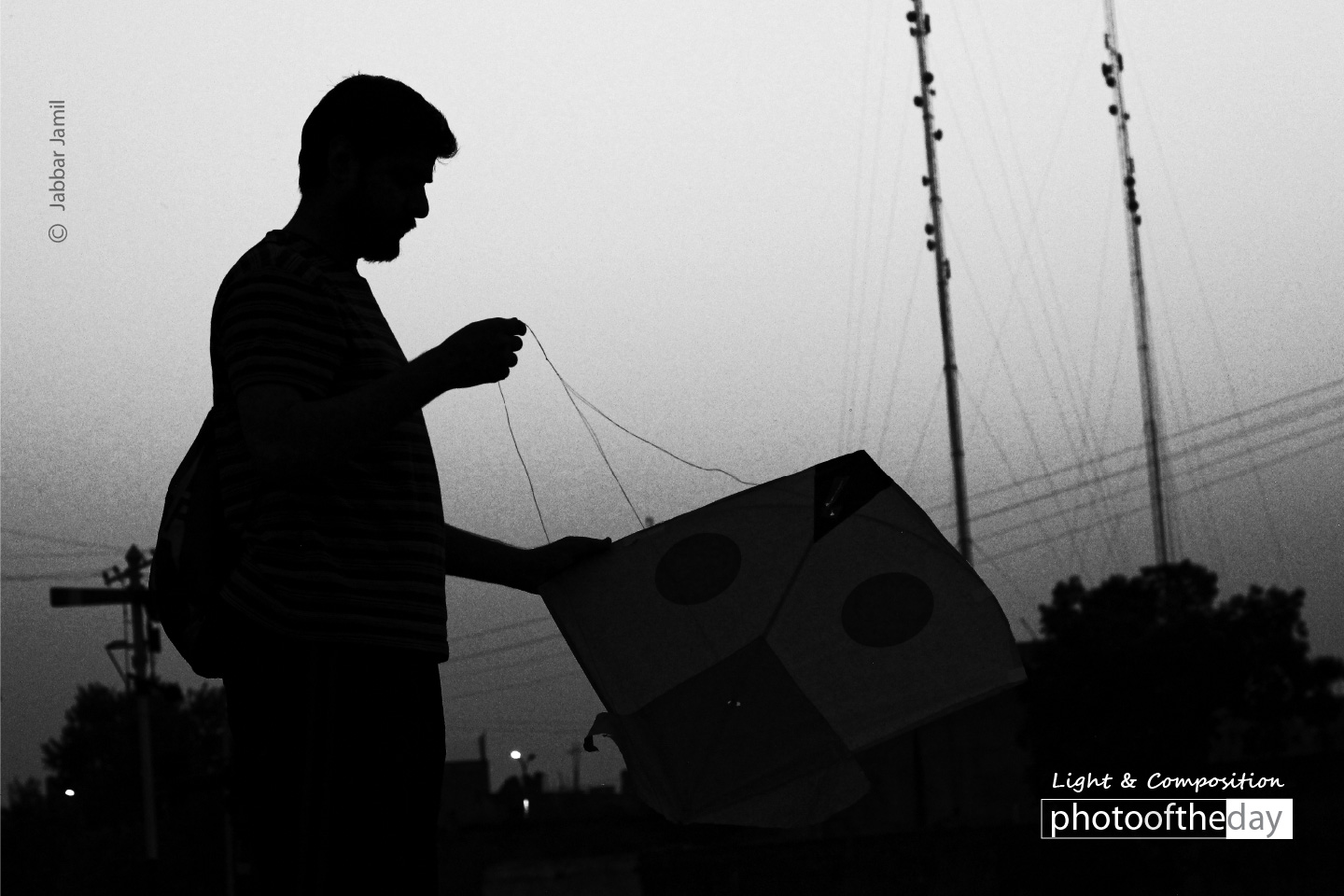
Posing with the Kite by Jabbar Jamil
In this evocative portrait, a young boy poses with a kite in Sialkot, Pakistan, capturing a quiet moment of defiance against a backdrop of cultural restriction. The image highlights the legacy of the Basant festival, which was banned in 2005 due to safety concerns regarding glass-coated strings. By focusing on this simple act of play, the photographer preserves a tradition that persists in the shadows of prohibition. The composition is award-worthy for its poignant storytelling, transforming a local social issue into a universal narrative about the resilience of childhood joy amidst evolving societal regulations.
Jabbar Jamil
Based in Sialkot, Pakistan, Jabbar Jamil is a dedicated street photographer who views his craft as a vital bridge to the outside world. He utilizes photography as both a creative outlet and a therapeutic practice, often documenting the raw, unvarnished realities of his surroundings. Through his lens, Jamil seeks to forge human connections that transcend the images themselves, capturing the complexities of life in his home country with an observant and empathetic eye.
Resonance Score Breakdown
Transparency Note: The resonance score (11.7/20) is calculated based on social engagement metrics collected before the award announcement.
Expert Photography Reviews · 3
The Paper Wing’s Promise
We are all born with a tether, a thin line connecting our palms to the vast, unwritten blue. Childhood is the art of letting that line out, inch by trembling inch, watching as our dreams climb higher than the rooftops, higher than the heavy expectations of the earth.
Read the reflection →The Persistence of Flight
When a dormant seed is buried beneath layers of compacted soil, it does not simply wait for the warmth; it exerts a quiet, persistent pressure against the weight above it. This is not a struggle of force, but of timing—a biological refusal to be silenced by the environment.
Read the reflection →Reviews & Comments
Share your thoughts about this award-winning photograph. Your reviews contribute to the community engagement score.
Shadows here don’t merely frame the boy; they swallow the prohibition surrounding him. When I look at those dark, encroaching edges, I feel a cold ache for the kite’s fragility. It’s not just a toy, but a tether to a forbidden sky. Jamil understands that light is a lie we tell ourselves to ignore the void. He’s forced the darkness to speak, and honestly, it’s the most honest thing I’ve seen all year.
The kite’s diamond geometry anchors the frame, creating a sharp diagonal that bisects the boy’s vertical axis. It’s a perfect tension between the kite’s rigid frame and the boy’s soft, organic posture. I’m genuinely moved by how the negative space in the upper quadrant balances the weight of his gaze. It’s not just a portrait; it’s a solved equation of stillness. The math here is elegant, turning a simple toy into a structural necessity.
The ochre dust of Sialkot clings to the boy’s skin like the muted, sun-baked pigments of a Morandi still life, yet it’s the kite’s sudden, sharp cerulean—the blue of a bruised Mediterranean sky—that truly pierces the heart. It’s a chromatic rebellion against the grey, suffocating weight of prohibition. I’m breathless, really, watching how that singular, defiant hue vibrates against the earth tones, turning a quiet, forbidden joy into an aching, luminous, and eternal prayer.