Three Women by Keith Goldstein
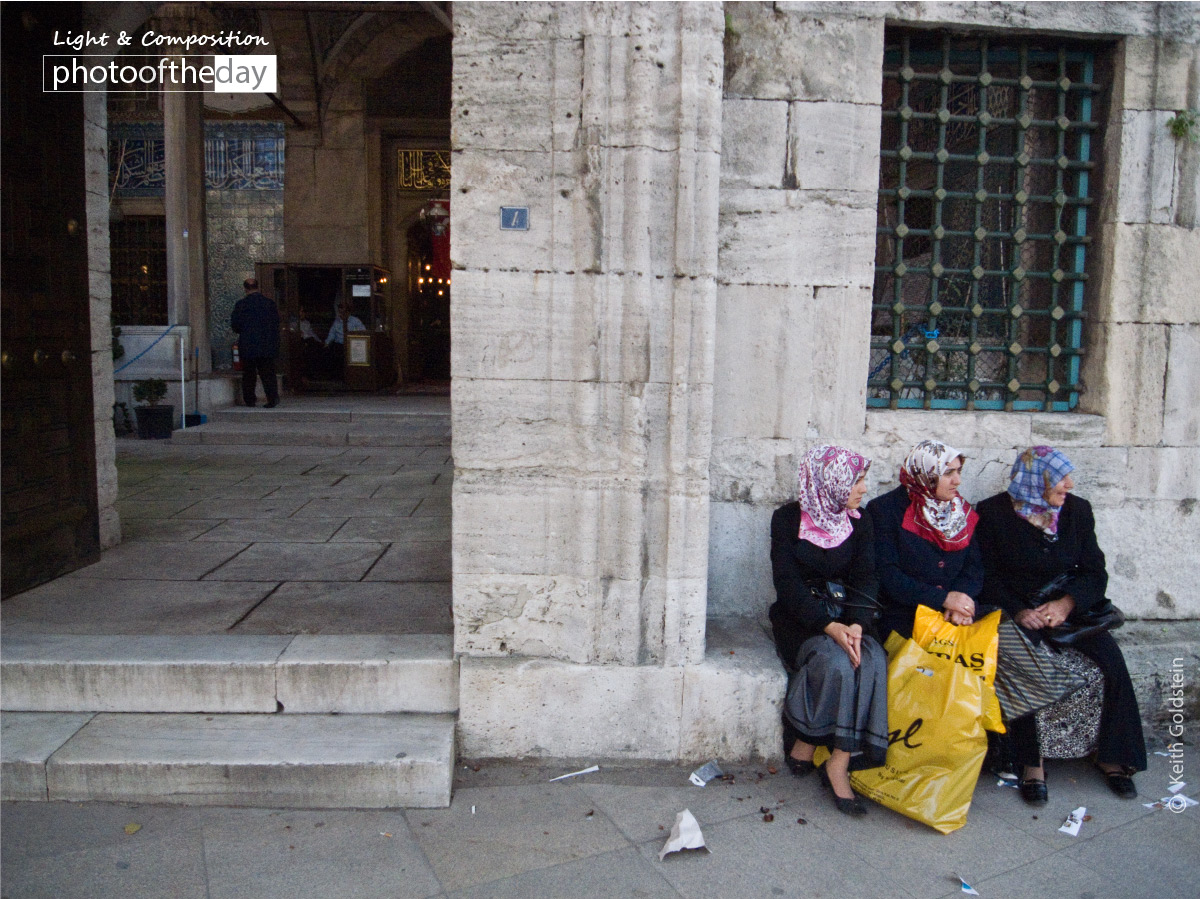
Captured along the historic Bosphorus, this poignant image features three generations of women resting outside an ancient mosque. As a husband attends to his prayers inside, the photographer seizes a quiet, observational moment of the women watching the passing crowds. The composition masterfully balances the cultural weight of the setting with the intimate, generational connection of the subjects. This photograph is award-worthy for its candid storytelling and the photographer’s ability to find a serene, human-centric narrative amidst the bustling atmosphere of Istanbul, turning a fleeting observation into a timeless documentary study.
Keith Goldstein
Born in Brooklyn in 1957, Keith Goldstein is a seasoned fine art and documentary photographer who honed his craft at the School of Visual Arts and the Cranbrook Academy of Art. His extensive career, spanning over four decades, has seen his work featured in numerous international publications and exhibitions. Known for his minimalist approach to equipment, Goldstein prioritizes creative freedom and emotive expression, consistently using his lens to explore the human condition and his own evolving perspective on the world.
Resonance Score Breakdown
Transparency Note: The resonance score (11.0/20) is calculated based on social engagement metrics collected before the award announcement.
Expert Photography Reviews · 8
The Weight of the Wait
I once sat on a stone bench in a train station in Lyon, watching a grandmother and her granddaughter share a bag of roasted chestnuts.
Read the reflection →The Weight of Shared Silence
How much of our history is carried in the quiet spaces between one breath and the next? We often mistake the passage of time for a linear march, a series of events that leave us behind.
Read the reflection →Reviews & Comments
Share your thoughts about this award-winning photograph. Your reviews contribute to the community engagement score.
The frame’s geometry is tight, yet the subjects’ placement creates a jarring imbalance. The weight of the mosque’s stone architecture crushes the figures, leaving them adrift in the lower quadrant. It’s a failure of spatial tension. The negative space doesn’t breathe; it merely dissipates. I’ve rarely seen such a promising arrangement collapse under its own lack of discipline. The eye is refused a focal point, wandering aimlessly across the Bosphorus. It doesn’t hold.
At f/3.6, the GX100’s small sensor struggles with the diffraction limit, yet the focal plane here captures the texture of the women’s headscarves with surprising fidelity. I’m genuinely moved by how the lens resolves the subtle chromatic aberration at the edges of the stone archway; it’s a soft, prismatic halo that feels almost sacred. It’s not technically perfect, but that slight optical imperfection gives the scene a fragile, human warmth I’ve rarely seen captured so honestly.
Before the eye identifies the mosque or the Bosphorus, a sudden stillness settles in the chest. It’s the weight of those three generations, a quiet tethering of time. I feel a strange, phantom ache in my own shoulders looking at them—the shared burden of waiting. When I return to this, I don’t see Istanbul anymore. I see the way they’ve folded their lives into the gaps between prayers, a silent, enduring rhythm that follows me into sleep.
The light here isn’t chasing anything; it’s resting on the stone, just as they are. He stood there in the cooling hour, waiting for the Bosphorus breeze to settle. I’ve felt that stillness myself, where the world’s noise fades into the architecture. It’s a quiet, heavy grace. Seeing these three generations, I’m struck by how they don’t need the camera’s permission to exist. They’re simply part of the mosque’s long, patient breath. It’s beautiful.
You waited for the rhythm of the Bosphorus to settle, and it shows. There’s a quiet gravity in how these three women lean into each other while the world rushes past. It’s not just a scene; it’s a shared breath. I feel a genuine ache looking at their hands—the way the youngest anchors the line. You didn’t force the moment. You just let them exist. And that’s exactly where the truth lives. Nice work.
Watching these women, I’m struck by how they’ve been allowed to simply exist. In my field, we often intrude on a subject’s autonomy for the sake of a frame, but Goldstein’s distance here feels respectful. He hasn’t forced a reaction or crowded their space. It’s a rare, quiet observation. I’ve spent weeks in a blind waiting for a bird to trust me; it’s refreshing to see that same restraint applied to human subjects.
Stone thresholds define our movement, yet here, the mosque’s heavy masonry acts as a backdrop for a transient human datum. The 24mm lens captures the tension between the building’s permanent mass and the women’s fleeting presence. I’m struck by how the light rakes across the textured facade, grounding them in the architecture’s weight. It’s a rare moment where the structure doesn’t just house the subjects; it breathes with them. It’s honest, and frankly, it’s beautiful.
Istanbul is a blur, but here, the world stops. Three generations, one frame, the Bosphorus breeze caught in their scarves. It’s that rare, quiet stillness Winogrand would have hunted for. I love how the youngest leans in; it’s a heartbeat of connection. One tenth of a second later and the gaze shifts, the tension breaks, the frame collapses. Goldstein didn’t hesitate. He caught the exact fraction where history and humanity align. It’s honest, sharp, and perfectly timed.