Jemaa el-Fnaa is a storm of noise, yet here, the light finds a quiet pocket. She stood in the cooling hour, shielding the child from the square’s relentless glare. I’ve felt that same stillness when the world around me dissolves into dust. It’s not just a candid shot; it’s a sanctuary carved from chaos. Looking at the way she holds the boy, I feel a sudden, sharp ache for the simple, heavy grace of being truly present.
Before the eye identifies the chaos of Jemaa el-Fnaa, something in the chest tightens. It’s the sudden, visceral recognition of sanctuary. The nanny’s grip isn't just holding; it’s anchoring a child against the sensory roar. I’ve returned to this frame for years, and that stillness still slows my pulse. It’s a quiet, heavy gravity. When I look away, I’m left with the phantom weight of that embrace, a memory of being safe in a storm.
In the swirling dust of Jemaa el-Fnaa, we find a quiet harbor. Nilla Palmer didn’t just snap a shutter; she waited for the silence between the chaos. We look at this nanny’s grip and we understand that safety isn't a place, but a person. It’s a tender, heavy anchor in a storm of noise. I’ve felt that same protective ache in my own life. It’s a photograph that asks to be returned to, again and again.
Most candid street shots from Jemaa el-Fnaa are just noise. They’re frantic, messy, and forgettable. What separates this from the pack is the nanny’s posture; she isn’t just holding the child, she’s shielding a private world from the square’s chaos. It’s a quiet, fierce defiance. I’ve looked at thousands of these, and honestly, this one makes me want to hold my own children tighter. It’ll still matter in thirty years because protection is universal.
The ochre of the nanny’s veil, a shade reminiscent of Morandi’s dustiest pigments, anchors the frame against the chaotic, sun-bleached turquoise of the square. It’s a chromatic sanctuary, really. I’m quite moved by how the shadow’s cool, bruised violet cradles the child, shielding them from the harsh, unrelenting glare of the Moroccan noon. One finds here a rare, quiet harmony, where the heat doesn't merely burn, but instead, it hums with a profound, protective grace.
It’s a striking composition, but I can’t help but feel a familiar unease. In Jemaa el-Fnaa, proximity is often bought, not earned. When I see that child’s guarded expression, I wonder if this moment was extracted through intrusion rather than patience. Did the photographer wait for trust, or just shove a lens into a private sanctuary? I’ve spent weeks in blinds to avoid this exact look of startled vulnerability. It’s technically sharp, but ethically hollow.
Jemaa el-Fnaa is a sensory assault, yet Palmer has managed to find a quiet pocket of humanity amidst the din. It’s a rare feat. One suspects she didn’t just stumble upon this; she likely stood in that heat until her feet ached, waiting for the chaos to align. I’ve spent enough afternoons in such squares to know the exhaustion involved. She earned this stillness. It’s a decent bit of work, and frankly, I’m rather impressed.
You found the quiet center of that madness. Jemaa el-Fnaa is a sensory riot, but you didn't get distracted by the noise. You waited for the nanny’s grip to tighten. I’ve been in that square, and it’s easy to lose your head in the chaos. But you stayed grounded. Because you felt the weight of that protection, I can feel it too. There’s something honest happening here. You didn't just take a picture; you felt the sanctuary.

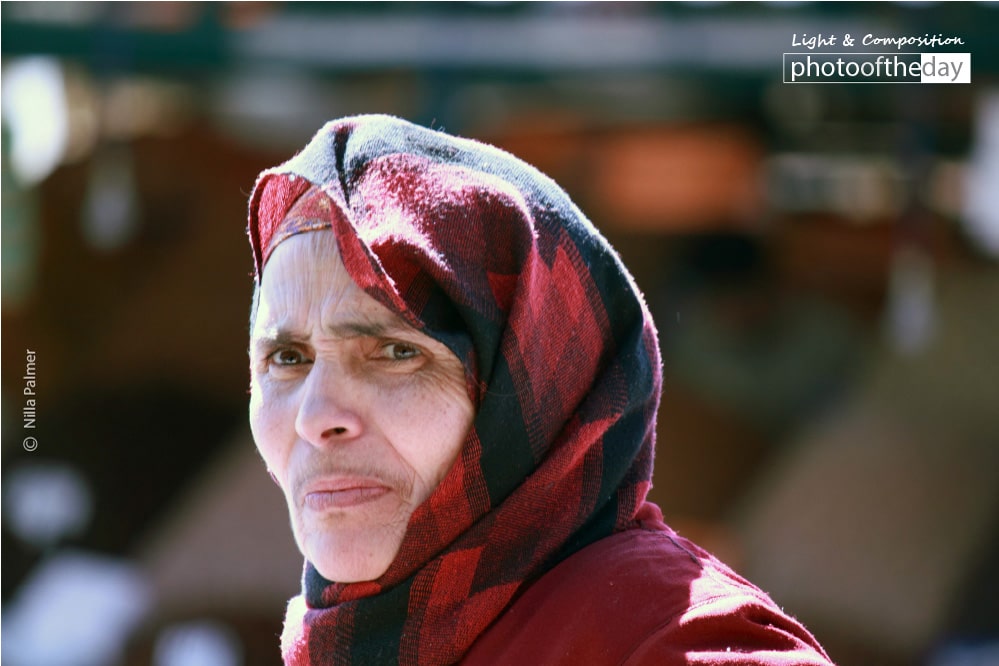
Forgot to add Guy, I rarely use a flash, preferring to work with available natural light:)
Thank you Guy!
The light was in your favour. You have good light sense in your photos
Thank you:)
Another wonderful image captured by Nilla!