The View by Thomas Lianos
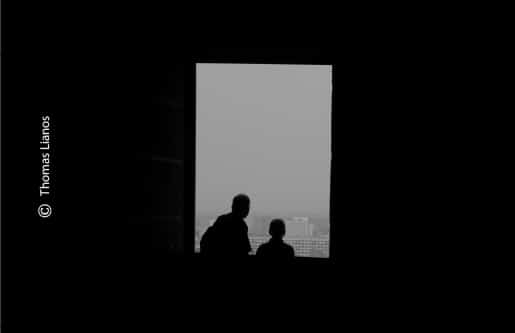
Captured within the historic Monument of Battle of Nations in Leipzig, this poignant image features a father and son silhouetted against the bright light of an external window. The photographer carefully waited for their figures to align perfectly against the high-contrast backdrop, opting to expose for the window to render the building's interior in deep, dramatic shadow. This deliberate technical choice emphasizes the emotional weight of the moment, drawing a parallel between the subjects' shared history and the photographer’s own experiences with his son. The composition’s minimalist strength and the evocative interplay of light and shadow make this a standout piece of storytelling.
Thomas Lianos
Originally from Greece and currently based in Warsaw, Poland, Thomas Lianos is a dedicated photographer whose work spans street, architectural, and landscape genres. His photographic journey began three decades ago with a Russian Kiew camera, eventually transitioning through film systems like the Olympus OM10 before embracing digital Nikon gear. While photography remains a passionate pursuit outside of his professional career, Lianos has recently begun sharing his deeply personal vision with a wider audience, seeking to capture the perfect harmony of light and scene in every frame.
Resonance Score Breakdown
Transparency Note: The resonance score (13.3/20) is calculated based on social engagement metrics collected before the award announcement.
Expert Photography Reviews · 5
The Weight of Small Hands
I remember standing in the hallway of my grandfather’s house, watching him point out the cracks in the plaster. He didn't see them as damage; he saw them as a map of the years he’d spent leaning against those walls.
Read the reflection →The Weight of Inheritance
How much of our own shadow is actually our own? We walk through the corridors of history, stepping into the footprints of those who came before us, often unaware that we are merely repeating the rhythms of a song we did not compose.
Read the reflection →Reviews & Comments
Share your thoughts about this award-winning photograph. Your reviews contribute to the community engagement score.
Silhouettes are usually a crutch, but here, the crushing of detail into pure void feels intentional. It’s closer to Sugimoto’s long-exposure theatres than conventional travelogue. I’m genuinely moved by how Lianos chose not to resolve the interior’s texture, letting the architecture dissolve into an abyss. Why reveal the stone when the darkness tells the real story? It’s a brave refusal of clarity that makes the father and son feel like ghosts in their own history.
The frame’s geometry dictates the narrative. By crushing the interior into absolute black, Lianos forces the eye toward the singular, high-contrast aperture. The subjects’ silhouettes act as a vertical fulcrum, anchoring the vast, oppressive negative space of the monument. It’s a cold, calculated arrangement. I’ve rarely seen such brutal economy of form. The architecture doesn’t just contain the figures; it consumes them. It’s a rigid, structural success that leaves no room for sentimentality.
The light hits like a sudden cut to white. It’s a brutal, beautiful exposure. The silhouettes of father and son hold the frame, suspended in the Monument’s heavy, cavernous dark. I’ve watched this scene play out in my own life, and it hits me right in the chest. Lianos didn’t rush the shot; he let the rhythm of the architecture dictate the stillness. It’s the frame the editor keeps because the silence is deafening.
The interior’s obsidian gloom, a void reminiscent of Morandi’s most melancholic studies, yields to that piercing, clinical white of the Leipzig window, a light so sharp it’s almost violent. One feels the weight of history pressing against the silhouettes, their forms suspended in a chromatic silence that’s truly breathtaking. It’s a stark, brutal harmony, where the absence of pigment doesn’t signify emptiness, but rather the profound, aching resonance of a shared, fleeting human tether.
Most submissions in this category rely on the Monument’s scale to do the heavy lifting, but Lianos ignores the architecture to focus on the human tether. By crushing the interior into absolute black, he forces us to confront the silhouettes as universal archetypes rather than specific people. It’s a brave choice. I’ve seen thousands of father-son portraits, yet this one actually made me miss my own father. That’s why it’ll still matter in thirty years.