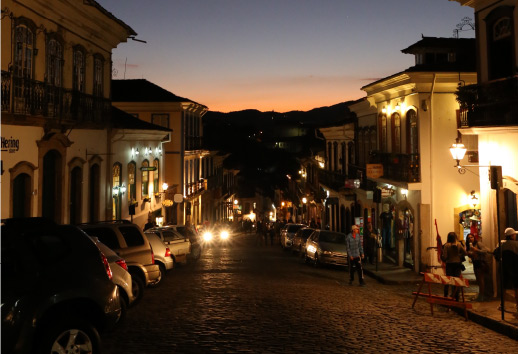
Sunset at Ouro Preto by Patricia Saraiva
Captured amidst the bustling streets of Ouro Preto, this photograph masterfully documents the transition from day to night in one of Brazil’s most historic cities. The photographer was struck by the interplay of gradient sky colors, deepening shadows, and the emerging warmth of artificial lights illuminating the colonial architecture. By pausing in a crowded thoroughfare to frame this fleeting daily ritual, the artist elevates a common sunset into a poignant study of urban atmosphere. The image is award-worthy for its evocative composition and the delicate balance between the natural light of the horizon and the emerging character of the city’s historic landscape.
Patricia Saraiva
Born in Apucarana, Brazil, Patricia Saraiva is a dedicated photographer and plastic surgeon based in Belo Horizonte. Her transition from documenting her children's milestones to capturing professional-grade travel and architectural imagery highlights her keen eye for detail and composition. Having showcased her work in exhibitions such as 'Barcelona Balconies' and contributed to significant publications on Baroque art, Saraiva continues to refine her craft. She remains committed to exploring the world through her lens, sharing her passion for visual storytelling with a global audience.
Resonance Score Breakdown
Transparency Note: The resonance score (12.4/20) is calculated based on social engagement metrics collected before the award announcement.
Expert Photography Reviews · 7
The Softening of Shadows
There is a specific grace in the way the day surrenders to the night. It is not a sudden departure, but a slow, rhythmic folding of light into shadow.
Read the reflection →The Architecture of Twilight
In the old maps of the world, the edges were often marked with the warning: here be dragons. It was a way of acknowledging that beyond the familiar hearth, the geography of the known world simply dissolved into mystery.
Read the reflection →Reviews & Comments
Share your thoughts about this award-winning photograph. Your reviews contribute to the community engagement score.
In Ouro Preto, the shadows don’t just fall; they listen to the stone. We look at these colonial walls and feel the weight of centuries holding their breath. Patricia Saraiva didn’t just capture a sunset; she waited for the city to reveal its secrets to the twilight. I’ve walked these streets, and this quiet hum of amber light against the darkening sky makes my chest ache with nostalgia. It’s a portrait of a city that’s finally resting.
The vertical axis of the colonial spire anchors a complex tension between the darkening sky and the street’s warm, artificial glow. I’m struck by how the 1:2 ratio of horizon to architecture creates a perfect, weighted equilibrium. The diagonal lines of the cobblestones pull the eye toward the negative quadrant, solving the spatial chaos of the thoroughfare. It’s a rigorous, elegant equation. Honestly, I’ve rarely seen urban geometry resolve with such satisfying, mathematical precision.
The sky bleeds into the stone. Ouro Preto doesn’t shout; it waits. I’ve stood in these streets, feeling the weight of the colonial shadows. Saraiva captures the exact moment the light retreats. It’s a quiet surrender. The empty corner isn’t empty. It’s a breath held between the day’s heat and the night’s cold. I feel a sudden, sharp ache for that stillness. Nothing here is accidental. The silence is the loudest part of the frame.
The bruised violet of the Ouro Preto horizon bleeds into the ochre of colonial stone, a chromatic collision that reminds one of Turner’s late, feverish canvases. It’s a haunting transition, where the fading light of day doesn’t merely vanish but surrenders to the warm, flickering amber of streetlamps. I’ve felt my pulse quicken at such alchemy; it’s a delicate, melancholic harmony that captures the very soul of the evening as it settles into the ancient, waiting earth.
You stood in that Ouro Preto street while the rest of the world rushed past. I can feel the quiet you found as the colonial stone cooled under the fading light. It’s a lonely, beautiful transition. Because you waited, the architecture finally breathes. I’ve walked those hills, and looking at this, I felt a sudden, sharp ache for the stillness of a Brazilian dusk. You didn’t just take a picture; you held onto a moment.
Most sunset shots are forgettable clutter, but this one lingers. Of the thousands I’ve reviewed, few capture the precise moment colonial stone turns cold while the streetlamps begin their work. It’s the way the light clings to the uneven cobblestones that gets me; I can almost feel the evening chill settling in. It’s not just a pretty view; it’s a record of a city breathing. Thirty years from now, this quiet transition will still matter.
Ouro Preto’s colonial stones don’t give up their secrets to the casual tourist. One suspects Saraiva didn’t just stumble upon this transition; she likely stood in that thoroughfare until her feet ached and the light finally relented. It’s a rare, quiet victory over the chaos of a busy evening. I’ve spent enough nights shivering in similar squares to recognize the discipline here. She didn’t just take a picture; she waited for the city to breathe.