In the Pair-matching by Nirupam Roy
Captured along the serene beaches of the Bay of Bengal in West Bengal, this image documents the elusive behavior of red crabs during the evening hours. The photographer patiently navigated the challenges of these sensitive creatures, which retreat into their burrows at the slightest hint of danger, turning the observation into a delicate game of hide-and-seek. By utilizing a long focal length, the photographer successfully isolated the pair in their natural habitat, capturing a moment of quiet interaction. The image is award-worthy for its technical precision in wildlife photography and its ability to transform a fleeting, cautious encounter into a compelling narrative of coastal life.
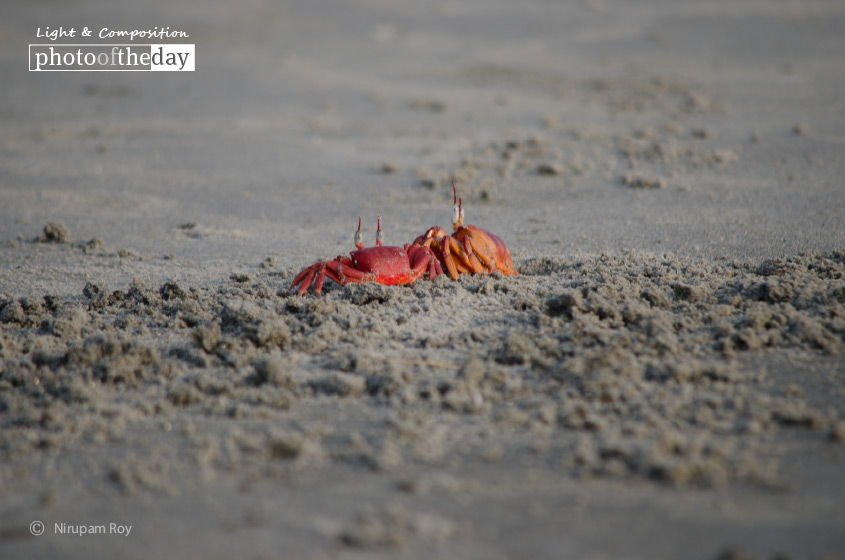
Exposure 1/250sec @ f/5.6 | ISO 100 | Focal Length 300mm
Nirupam Roy
Hailing from the small town of Tufanganj in the Coochbehar District of West Bengal, India, Nirupam Roy balances a career as a school teacher with a profound dedication to photography. His creative journey began during a family trip to Odisha, where a desire to document scenic coastlines and his son sparked an enduring passion for the craft. Now deeply committed to exploring new concepts in nature and human-centric photography, Roy views his work as a meditative pursuit that has fundamentally transformed his perspective on the world around him.
Resonance Score Breakdown
Transparency Note: The resonance score (13.0/20) is calculated based on social engagement metrics collected before the award announcement.
Expert Photography Reviews · 8
The Architecture of the Edge
We often mistake the periphery for a wasteland. In our obsession with the center—the high-density hubs, the plazas of commerce, the monuments of power—we forget that the most vital social contracts are often negotiated at the margins.
Read the reflection →The Architecture of Silence
We spend our lives building walls, brick by heavy brick, convinced that safety is found in the thickness of our defenses. Yet, there is a different kind of architecture in the wild—a geometry of soft edges and sudden retreats.
Read the reflection →Reviews & Comments
Share your thoughts about this award-winning photograph. Your reviews contribute to the community engagement score.

Sand. Two crabs. A distance between them that feels like a conversation. I’ve spent hours watching the tide, but Roy captures the stillness before the retreat. The frame isn’t crowded. It’s a study in restraint. The vast, beige expanse pushes them together, yet they remain apart. It’s lonely. It’s perfect. Nothing here is accidental. The empty corner is not empty. It’s the breath between two heartbeats. I find myself holding my own.
The tide was retreating, leaving the sand damp and mirror-like. Nirupam waited in the cooling hour, his breath held steady against the salt air. These red crabs don’t offer themselves easily; they demand a stillness that borders on prayer. I’ve felt that same ache in my knees, waiting for the earth to reveal its secrets. It’s a quiet, fragile communion. Watching them, I feel a sudden, sharp longing for the silence of that distant shore.
Before the eye identifies the crabs, a sudden stillness settles in the chest. It’s the tension of the hunt, that held-breath moment where the world narrows to two tiny, vibrant specks against the cooling sand. I’ve found myself returning to this frame; it triggers a strange, primal alertness. When I look at it now, I don’t see wildlife—I see the quiet, fragile geometry of connection. It’s a small, persistent pulse in the vast, empty tide.
Most wildlife shots are just trophies, but this one lingers. Of the thousands I’ve reviewed, few capture such genuine intimacy. By isolating these red crabs against the vast, neutral sand, Roy forces us to acknowledge their tiny, fragile social contract. It’s a quiet, fleeting moment that makes me smile every time I look at it. Thirty years from now, this frame will still feel like a secret shared between the photographer and the tide.
We look at these two red crabs on the wet sand and we see a conversation. They aren’t just wildlife; they’re neighbors sharing a secret in the fading light of Bakkhali. I’ve spent my life listening to stories, and here, the silence between them is heavy with intent. It’s a delicate dance of trust. I find myself holding my breath, hoping they don’t retreat. It’s a portrait of connection that makes me feel remarkably small.
The shutter snaps, and the frame freezes a tension that’s almost cinematic. It’s a standoff. Two crabs, locked in a rhythm of retreat, caught at the precise moment before the cut. I’ve spent hours waiting for such stillness in the edit suite; it’s rare to find it in the wild. The 300mm reach isolates them perfectly. It’s a quiet, breathless sequence. Honestly, I’m holding my own breath just looking at them. It’s a keeper.
Shadows here aren’t merely gaps in the sand; they’re the threshold where these crabs negotiate their existence. Roy captures a tension that feels almost existential. I’ve spent hours watching the tide, and there’s a genuine ache in how these creatures cling to the edge of the dark. It’s not just nature; it’s a quiet, desperate defiance against the encroaching light. They don’t just hide; they retreat into the very philosophy of their own survival.
The frame operates on a strict horizontal axis, bisected by the crabs’ radial symmetry. Their positioning creates a perfect 1:1 equilibrium, anchoring the negative space of the sand. I’m genuinely struck by how the shadows extend the vectors, turning biological movement into a calculated geometric sequence. It’s a beautifully solved spatial equation. By isolating the pair against the granular texture, Roy has transformed a fleeting encounter into a stable, rhythmic pattern that feels mathematically inevitable.
How could India owns Bay of Bengal, isn’t it belongs to Bangladesh.
Dear Harald, the map of the World perhaps can solve the problem. I am from WestBengal in India. Please examine it carefully. Thank You.
Where did you learn photography, Roy? Some of your settings are not right.
Yes, I admit that. I am learning this unique area by practical experiences and discussing matters with my photography friends. Trying hard to develop. Thank You.
I don’t like this POV, it could have zoomed and portrayed nicely.
Yes, you are right. It could be. But unfortunately I was given a little chance as I mentioned they are very quick to hide themselves and I had in my hand 55-300mm. Comparatively it is a slow lens to focus. Thank You.
I like how you utilized the 55-300mm lens, nice POV.
Thank You.
WOW
Thank You.